

A blazer in Saigon has to cope with three kinds of weather in a single day: a meeting room at about 20 degrees, a pavement above 33 degrees at noon, and the muggy air after an afternoon downpour. A cloth that survives all three without stuffiness or crumpling is worth having made. The table below compares each cloth on exactly those three things.
The short answer
For someone working in Saigon, the easiest blazer fabric is thin wool of about 230–270 g/m, with an open weave and a thin or half lining: comfortable in a cold room and low on creasing. If you spend a lot of time outdoors, linen or a linen blend is cooler but creases. Cotton suits strolling around town. Flannel and heavy wool are for cold countries.
Table: seven blazer fabrics compared
The weights are the ranges usually found in jacket cloth, given in grams per running metre of cloth about 1.5 m wide (g/m), the way Italian mills often state them; each mill differs. Breathability and creasing are judgments from the trade's experience in Ho Chi Minh City conditions, not laboratory measurements.
| Cloth | Weight, about | In a cold room | In the sun | Creasing | Holds its shape |
|---|---|---|---|---|---|
| Thin wool, open weave | 230–270 g/m | Comfortable | Copes for short stretches | Little, recovers after hanging overnight | Good |
| Wool blend 40–60% | 250–300 g/m | Comfortable | Stuffier when you sweat | Little | Good |
| 100% linen | 250–350 g/m | Slightly chilly | Cool | A lot, creases after a few minutes sitting | Soft, tends to sag |
| Linen blended with wool or cotton | 250–320 g/m | Comfortable | Fairly cool | Moderate | Moderate |
| Cotton (chino, gabardine) | 280–350 g/m | Fine | Fair, but once damp with sweat it stays damp | Moderate, marks at the elbows | Moderate |
| Heavy wool, flannel | From 330 g/m | Warm | Hot | Little | Good |
| Polyester, poly blends | 220–280 g/m | Fine | Stuffy | Very little | Good |
How to read the table
Weight says more than the name of the cloth. A wool of 240 g/m is cooler than a wool of 320 g/m, even if both are labelled 100% wool. If there is a weight figure, go by that; if not, pick up two swatches and compare how heavy they feel.
The weave decides whether air gets through. An open weave, where holding it up to the light shows pinpricks of light passing through, lets heat escape. A tight, flat, glossy weave keeps the heat in, however thin.
The lining counts as much as the cloth. With the same cloth, a full lining makes it stuffy and a thin or half lining is clearly more breathable; at Mon Amie the stylist suggests the lining after you have chosen the cloth line. A jacket with several layers of fused interfacing is hotter than one with soft construction; full canvas, half canvas or fused goes into this in detail.
Creasing isn't always bad. Linen creases because of the fibre, and people who wear linen accept creases as part of the jacket. But if you need to look flat and neat through an afternoon meeting, linen will bother you.
Choosing by your day
| What your day looks like | Cloth to choose | Why |
|---|---|---|
| In a cold office, outside for short stretches | Thin wool or a 60–70% wool blend | Breathable when you sit a long time, no creases when you stand up |
| Meeting clients outdoors, standing in the sun | Linen blend or thin cotton | Cooler than wool when you are outside all the time |
| Riding a motorbike, folding the jacket into a bag and putting it on at your destination | Wool or a wool blend | Hang it up and it recovers; linen folded up is badly creased |
| Wearing a suit from 3 days a week | 60–70% wool | Durable, recovers after a night on the hanger |
| A few occasions a year, parties | 40–50% wool | Looks good enough without paying for a grade you rarely use |
| Garden weddings, the beach | Linen or a linen blend | Cool, photographs naturally |
| Business trips to cold countries | Heavy wool, flannel, wool from about 330 g/m | Keeps you warm |
On the matter of motorbikes: whatever the cloth, don't wear the jacket while riding. Fold it inside out into a shoulder bag and put it on when you arrive. The right cloth is one that survives that fold.
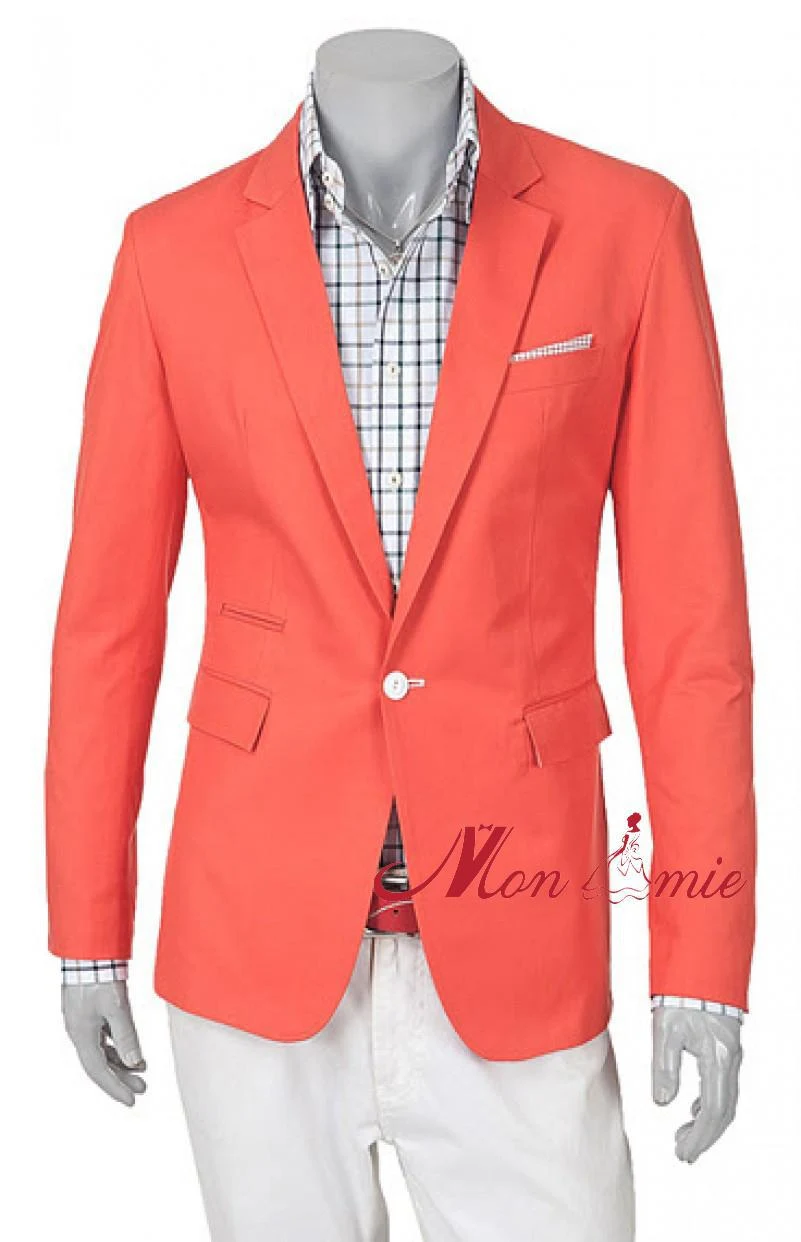
Model SN-245: a blazer in firmly woven cotton. Cotton is comfortable at weekends, but it marks at the elbows faster than wool.
Exceptions worth knowing
- Dark colours in the sun. Standing a long time in the sun, a midnight blue or black blazer absorbs heat more than beige or pale grey. Indoors there is almost no difference.
- People who sweat a lot. Polyester is the most uncomfortable, because moisture has nowhere to go and the shirt sticks to your back. Wool absorbs moisture and releases it again, and linen absorbs and dries quickly.
- All day in deep air conditioning. A thin linen jacket can leave you feeling cold. Wool is the better support.
- A jacket worn every day. Wool of 80% and above is smoother but no more durable under daily rubbing, and suits someone with plenty of jackets to rotate.
Which line to choose at Mon Amie
Mon Amie has wool cloth in various percentages, linen and open-weave cloth. For a single Kevinlli jacket worn 1–2 days a week, 50–60% wool (VND 4.35–5.6 million) is enough; from 3 days a week, 60–70% wool (VND 5.6–6.35 million). If you like a cotton blazer for weekends, there is Salford Khaki Cotton, a single jacket at VND 9 million. Prices exclude 8% VAT; the other lines and the full list are in the price of a made-to-measure men's blazer.

Linen and open-weave cloths depend on the sample, so ask the stylist when you look at cloth. To see the colours first, visit the fabric library. If you're still deciding on a style for the hot season, men's blazers for summer has pairings to go with it.
Frequently asked questions
Should a linen blazer be lined?
Usually half-lined or unlined, to keep the coolness of linen. A full lining takes away the reason for choosing linen. In an unlined jacket the seams inside must be neatly bound, because you see them every time you take the jacket off.
Is cloth with a little stretch good for a blazer?
Good for people who move a lot or sit in vehicles for long, because the jacket strains less at the back and elbows. In return, stretch cloth is usually less breathable than wool of the same weight. If you wear it mostly in cold rooms, that is an acceptable trade.
Which blazer colour is coolest outdoors?
Light colours such as beige, pale grey and pale blue absorb less heat than navy and black when you stand in the sun. If you need one jacket that works in both a meeting room and outdoors, mid grey is the point of balance.
Can a wool blazer be machine washed?
It shouldn't be. Machine washing easily shrinks the cloth, separates the interfacing and distorts the shoulders. Hang the jacket in the open air after each wear, and have it dry cleaned only when there is a stain or a clear smell.
Choose cloth by your day, not by its name
The right blazer fabric for you is the one that suits where you sit and how far you go each day: thin wool for cold rooms, linen or cotton outdoors. Bring your weekly schedule and book an appointment so a stylist can lay a few swatches in your hand to compare directly.