
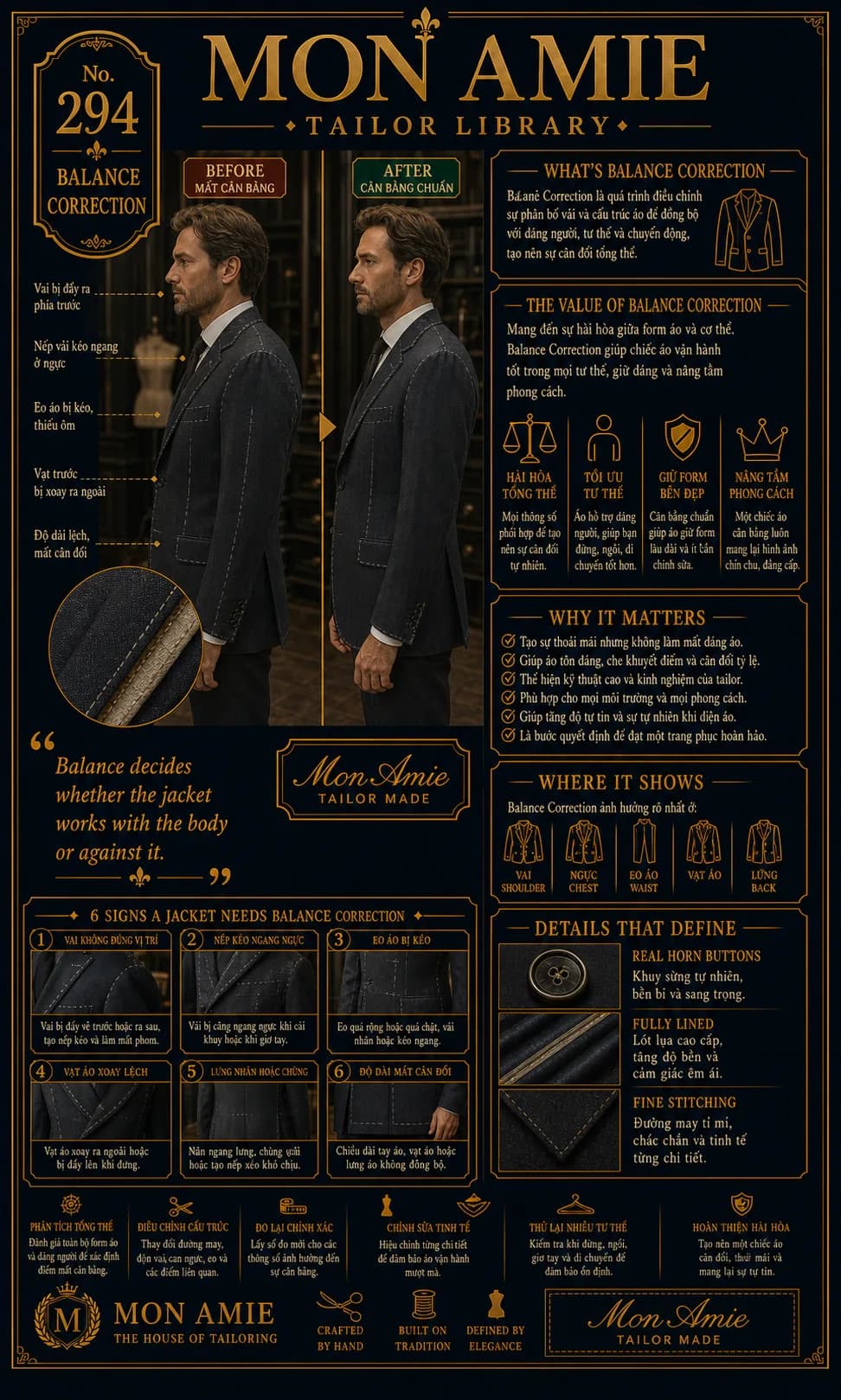
What is balance correction? It is the process of redistributing cloth and structure so a jacket agrees with your build, your posture and the way you move, producing harmony across the whole garment. Ordinary alterations answer the question "does it fit?"; balance correction answers a deeper one: is the jacket working with your body, or against it?
What balance correction is, and how it differs from ordinary sizing
Balance is the relationship between the front and the back of a jacket. Every man carries himself differently: some stand chest forward, some with a slight stoop, some with sloping shoulders, some with one shoulder lower than the other. A jacket cut to a "standard" figure will sit off balance on those bodies even when the chest measurement is exactly right. That is when balance correction is needed — not taking in or letting out, but redistributing cloth to match the wearer's true posture.
The value of this step lies in the harmony between the jacket's form and the body, allowing the garment to perform in every position, hold its shape and elevate your presence:
- Overall harmony: every measurement works together to create a natural sense of proportion.
- Better posture: the jacket supports your frame, helping you stand, sit and move more easily.
- Lasting shape: correct balance keeps the jacket in form for years and reduces the need for further alterations.
- Elevated style: a balanced jacket always reads as considered and refined.
Six signs a jacket needs balance correction
You can check for these six signs yourself in front of a mirror:
- Shoulders out of place: the shoulder line pushes forward or back, creating drag lines and breaking the shape.
- Pull lines across the chest: the cloth strains horizontally when you button the jacket or raise your arms.
- The waist pulls: too loose or too tight, with creasing or horizontal drag.
- Fronts that swing open: the front edges flare outward or ride up when you stand.
- A wrinkled or slack back: horizontal folds across the back, loose cloth or awkward diagonal creases.
- Uneven lengths: sleeve, front and back lengths out of step — the front hem shorter than the back, or the reverse.
In the trade, the two classic faults are a long front balance (fronts swinging open, common on a full chest) and a short back balance (horizontal wrinkles below the collar, common on a rounded back). Neither can be solved by taking in the waist or shortening the sleeves — both must be corrected in the structure.
Why balance decides the quality of a suit
- It brings comfort without softening the jacket's shape.
- It flatters the figure, disguises flaws and evens out proportion.
- It demonstrates advanced technique and a tailor's accumulated experience.
- It suits every setting and every style.
- It brings confidence and ease to the way you wear the suit.
- It is the decisive step toward a truly finished garment.
Balance correction shows most clearly at the shoulders, chest, waist, fronts and back — precisely the areas people look at first.
The tailor's correction process
Balance correction is demanding work, so the process must be methodical:
- Full assessment: study the whole jacket and the wearer's figure to locate where the balance falls away.
- Structural adjustment: rework seams, shoulder padding, chest canvas, waist and every related point.
- Fresh measurements: retake the measurements that govern balance.
- Refined corrections: adjust each detail so the jacket moves smoothly.
- Fittings in several positions: check standing, seated and with arms raised to confirm stability.
- Harmonious finishing: deliver a jacket that is balanced, comfortable and quietly confident.
This is the real difference between genuine tailoring and altered ready-to-wear: balance can only be judged when the tailor sees you in the jacket, observes your true posture and can work into the structure — not from figures on a page.
A word from Mon Amie's artisans
Mon Amie's artisans believe balance is what separates a jacket you can wear from a jacket that belongs to you. That is why, from the very first measuring session, we record more than numbers: shoulder slope, the curve of the back, the way you habitually stand. Those notes are kept for life alongside your measurements, so every future suit is balanced correctly from the pattern onward, while our alteration guarantee takes care of the rest as your body changes.
If your current jacket shows one of the six signs above — or you would like your next suit balanced properly from the start — we invite you to book an appointment at one of Mon Amie's five showrooms in Ho Chi Minh City (Nguyen Trai, Ho Van Hue, 3/2 Street, Caravelle Hotel District 1, Nguyen Thi Thap) or call 0888.111.118. Learn more about our bespoke service.