
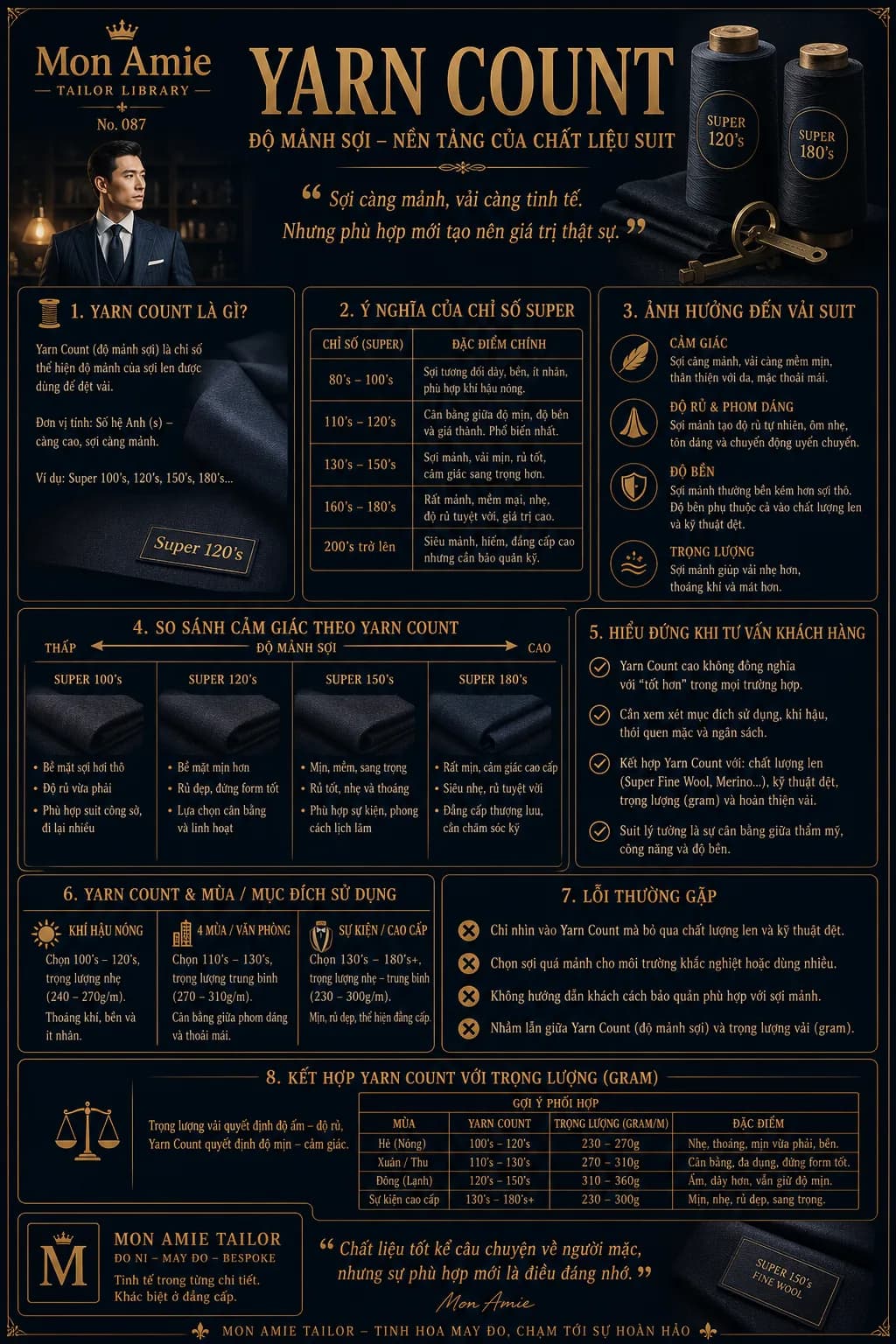
Yarn count — the fineness of the yarn — is the figure that describes how fine the wool used to weave a suiting cloth is, usually written as Super 100's, 120's, 150's, or 180's. The finer the yarn, the softer and more refined the cloth; but as Mon Amie tells its clients, finer is not automatically better — suitability is what creates real value. This article will help you read yarn counts correctly and choose cloth that matches your needs.
What is yarn count?
Yarn count is the measure of how fine the wool yarn used to weave a cloth is. It is expressed in the English system (s) — the higher the number, the finer the yarn. In the suiting market you will most often meet Super 100's, 120's, 150's, and 180's, and Super 200's or above at the most distinguished mills.
The word "Super" is a convention of the wool industry: it indicates the average diameter of the raw wool fibre. Super 100's corresponds to a fibre of roughly 18.5 microns, and each additional step of ten reduces the diameter by around 0.5 microns. Yarn count is therefore first of all a story about raw material, and does not tell the full story of a cloth's quality.
What each Super band means
Every band has a character of its own:
- Super 80's – 100's: relatively thick, durable, wrinkle-resistant; suited to hot climates and frequent wear.
- Super 110's – 120's: balanced in fineness, durability, and price — the most popular territory for made-to-measure suiting.
- Super 130's – 150's: fine yarn, smooth cloth, excellent drape, with a clearly luxurious hand.
- Super 160's – 180's: very fine, soft, light, with superb drape and high value.
- Super 200's and above: ultra-fine, rare, of the highest order, but demanding careful maintenance.
How yarn count affects a suit
Yarn fineness influences four aspects of a suit:
- Hand: the finer the yarn, the softer and smoother the cloth against the skin.
- Drape and shape: fine yarns give natural drape, a gentle closeness, a flattering line, and fluid movement.
- Durability: fine yarns are generally less hard-wearing than coarser ones; durability also depends on wool quality and weaving technique.
- Weight: fine yarns make lighter cloth, more breathable and cooler.
To picture it: Super 100's has a slightly firmer surface and moderate drape, ideal for a business suit worn on the move. Super 120's is smoother and holds its shape well — the balanced, versatile choice. Super 150's is smooth, soft, and refined, at home at events and in polished dress. Super 180's is very smooth, feather-light, and beautifully draping, with a rarefied feel that demands proper care.
Choosing yarn count by season and purpose
Mon Amie's advice comes down to three scenarios:
- Hot climates (Saigon, for instance): choose Super 100's – 120's at a light weight of around 240 – 270 g/m — breathable, durable, and wrinkle-resistant.
- Year-round office wear: choose Super 110's – 130's at a medium weight of 270 – 310 g/m — a balance of shape and comfort.
- Events and formal occasions: choose Super 130's – 180's and above, light to medium at 230 – 300 g/m — smooth, beautifully draping, unmistakably fine.
One principle worth remembering: cloth weight governs warmth and drape, while yarn count governs smoothness and hand. The two figures must be read together. A Super 150's woven at 310 – 360 g/m for cold weather will be warmer and heavier yet still smooth; the same count at 230 – 270 g/m is light and airy for summer.
Common mistakes when reading Super numbers
- Looking only at yarn count and ignoring wool quality and weaving technique — factors that matter just as much.
- Choosing yarn that is too fine for a demanding environment or heavy rotation, so the cloth tires quickly.
- Failing to follow the care that fine yarns require: high Super cloth needs rest on the hanger, minimal washing, and correct pressing.
- Confusing yarn count (fineness) with cloth weight in grams — two entirely different concepts.
A high yarn count does not mean "better" in every case. Consider the purpose, the climate, your wearing habits, and your budget; and read yarn count alongside wool quality (Super Fine Wool, Merino, and so on), weave, weight, and finish. The ideal suit is a balance of beauty, function, and durability.
A word from Mon Amie's artisans
In Mon Amie's fitting room we never begin with "what Super would you like", but with where you will wear this suit and how many days a week. A man who wears a suit daily under the Saigon sun will be happier for far longer in Super 110's – 120's than in a delicate Super 180's. Save the high counts for occasions that deserve them — and then the difference at the sleeve will say everything for you.
Fine cloth tells a story about its wearer, but it is the fit for purpose that stays in the memory. With collections from Kevinlli (full suits from VND 4.8 million) through Canonico, Holland & Sherry, Dormeuil, and Scabal at five showrooms in Ho Chi Minh City, Mon Amie is ready to help you choose the right yarn count for each need. We invite you to book an appointment or to consult our pricing — hotline 0888.111.118.