
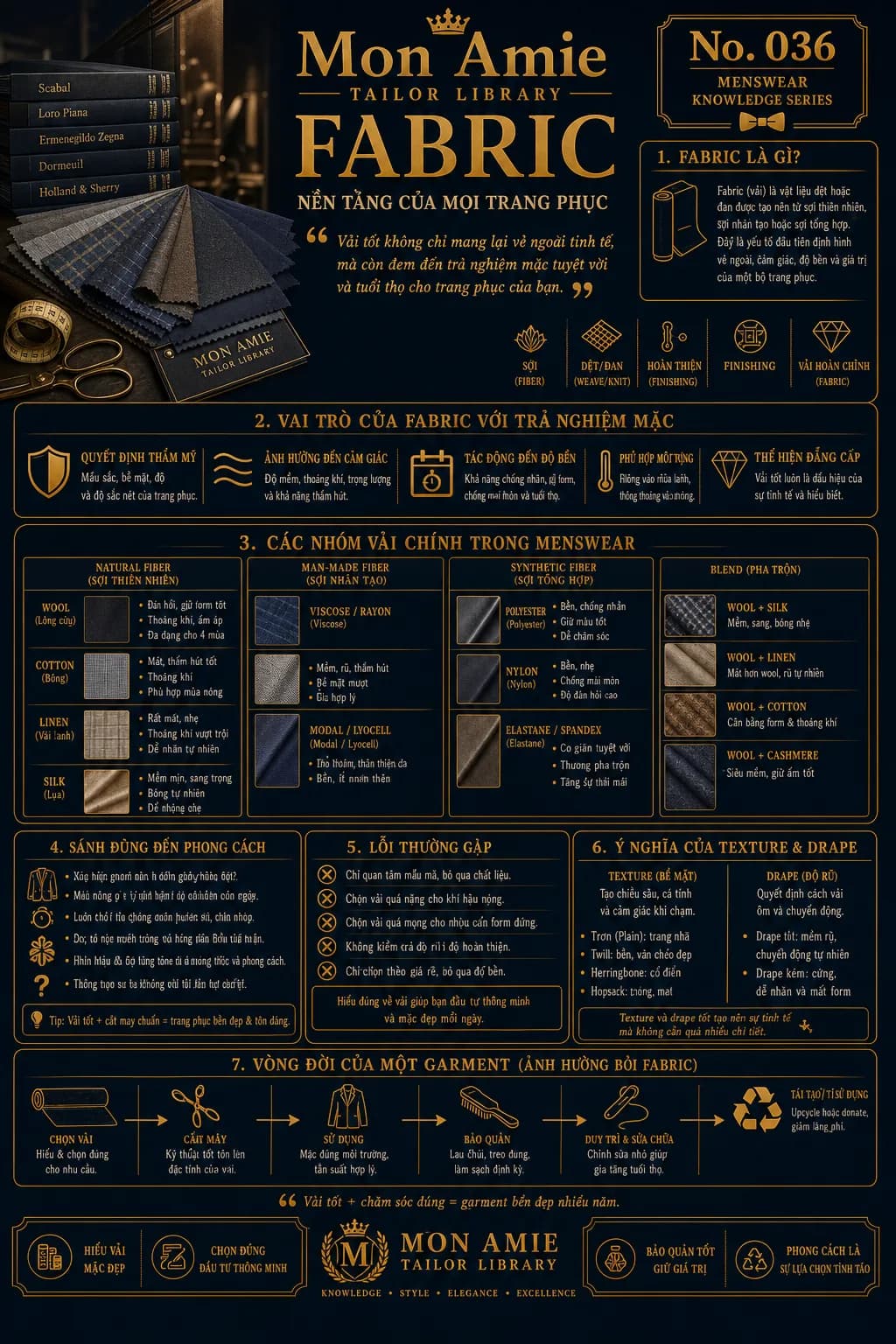
Fabric is a woven or knitted material made from natural, man-made or synthetic fibres — and it is the first thing that shapes the appearance, hand, durability and value of a garment. Put simply, long before you discuss silhouette or stitching, a beautiful suit has to begin with good cloth. In this article, Mon Amie walks you through the foundations of fabric: how it is made, the main cloth families in menswear, and how to choose the right material for your own style.
How fabric comes into being
A finished cloth passes through a sequence of stages, and each one leaves its mark on the result:
- Fibre: the raw material — wool, cotton, linen, silk, or man-made and synthetic fibres. The fibre dictates most of the cloth's character.
- Weave or knit: the way the yarns interlock, giving the cloth its structure, weight and surface.
- Finishing: the closing treatments — brushing, pressing, dyeing — that bring the cloth to the desired softness, lustre and colour.
- Finished fabric: the cloth ready to be cut and sewn.
Understanding this chain explains why two cloths both labelled "100% wool" can differ enormously in price and in the experience of wearing them.
What fabric does for the way a suit wears
Fabric influences almost every aspect of a garment:
- It sets the aesthetic: colour, surface and crispness all originate in the cloth.
- It shapes the feel: softness, breathability, weight and moisture management determine your comfort across a long day.
- It governs durability: crease resistance, shape retention and abrasion resistance decide how long a suit lasts.
- It suits the climate: heavier, warmer cloths for cold seasons; light and breathable cloths for a hot, humid climate like Saigon's.
- It signals discernment: good cloth has always been a mark of taste and knowledge — a practised eye reads it instantly in the way the fabric catches light.
The main cloth families in menswear
Menswear fabrics fall into four broad groups.
Natural fibres — the foundation of fine tailoring:
- Wool: resilient, excellent at holding shape, breathable and warm, and versatile across all four seasons. This is the standard cloth of the suit.
- Cotton: cool, absorbent and breathable, well suited to warm weather — familiar in chinos and casual suits.
- Linen: exceptionally cool with outstanding breathability, and a natural crease that gives summer dressing its ease.
- Silk: soft, luxurious and naturally lustrous, often used for accessories or blended in to add sheen.
Man-made fibres — regenerated from natural cellulose:
- Viscose/Rayon: soft, fluid, absorbent, smooth-surfaced and sensibly priced — a common choice for linings.
- Modal/Lyocell: cool, kind to the skin, and more durable and crease-resistant than viscose.
Synthetic fibres — products of the petrochemical industry:
- Polyester: durable, crease-resistant, colourfast and easy to care for — though less breathable than natural fibres.
- Nylon: strong, light, abrasion-resistant and highly elastic.
- Elastane/Spandex: superb stretch, usually blended in small proportions to add ease of movement.
Blends — combining the strengths of several fibres:
- Wool and silk: soft, refined, gently lustrous — a familiar choice for evening suits.
- Wool and linen: cooler than pure wool, with a natural drape.
- Wool and cotton: a balance between shape retention and breathability.
- Wool and cashmere: exceptionally soft and warm; the difference is obvious the moment you touch it.
Texture and drape: two ideas every suit wearer should know
- Texture creates depth, character and tactile pleasure. A plain weave reads as understated; twill is hard-wearing with an attractive diagonal line; herringbone carries a classic spirit; hopsack is open and cool.
- Drape determines how the cloth follows the body and moves with it. Good drape means the fabric falls softly and moves naturally as you walk; poor drape leaves the cloth stiff, prone to creasing and quick to lose its shape.
Good texture and drape create refinement on their own, without any need for decorative detail.
Common mistakes when choosing cloth
- Focusing on the pattern alone and ignoring the material and fibre content.
- Choosing cloth that is too heavy and too dense for a hot, humid climate.
- Choosing cloth that is too thin and lacks the body a structured silhouette requires.
- Failing to check drape and finishing quality before committing.
- Chasing a low price at the expense of durability — a cheap suit replaced early costs more in the end.
Understanding cloth properly lets you invest wisely and dress well every day.
A garment's life begins with its cloth
The material shapes the entire life of a garment: choose the cloth to match your needs, let the cutting and sewing bring out its qualities, wear it in the right setting at a sensible frequency, care for it by brushing, hanging correctly and cleaning periodically, then maintain it — small alterations extend its years considerably. Good cloth combined with proper care gives you a suit that stays handsome for many years, rather than one you replace again and again.
A word from Mon Amie's artisans
In the Mon Amie workroom, we always suggest you pick up the cloth before you look at the colour card: squeeze it gently to feel its resilience, then let go and watch how quickly the creases recover. In the climate of Ho Chi Minh City, a lightweight wool or a linen blend will be far more comfortable than a heavy European cloth. And if your budget is limited, favour good cloth with a restrained design — beautiful fabric is elegant enough on its own.
Fabric is the foundation of every garment: understanding cloth is the first step towards dressing well and investing wisely. At Mon Amie's five showrooms in Ho Chi Minh City, you can handle collections ranging from Kevinlli (full suits from VND 4.8 million) to Canonico, Holland & Sherry, Dormeuil and Scabal. We invite you to book an appointment or look through our pricing, hotline 0888.111.118.