
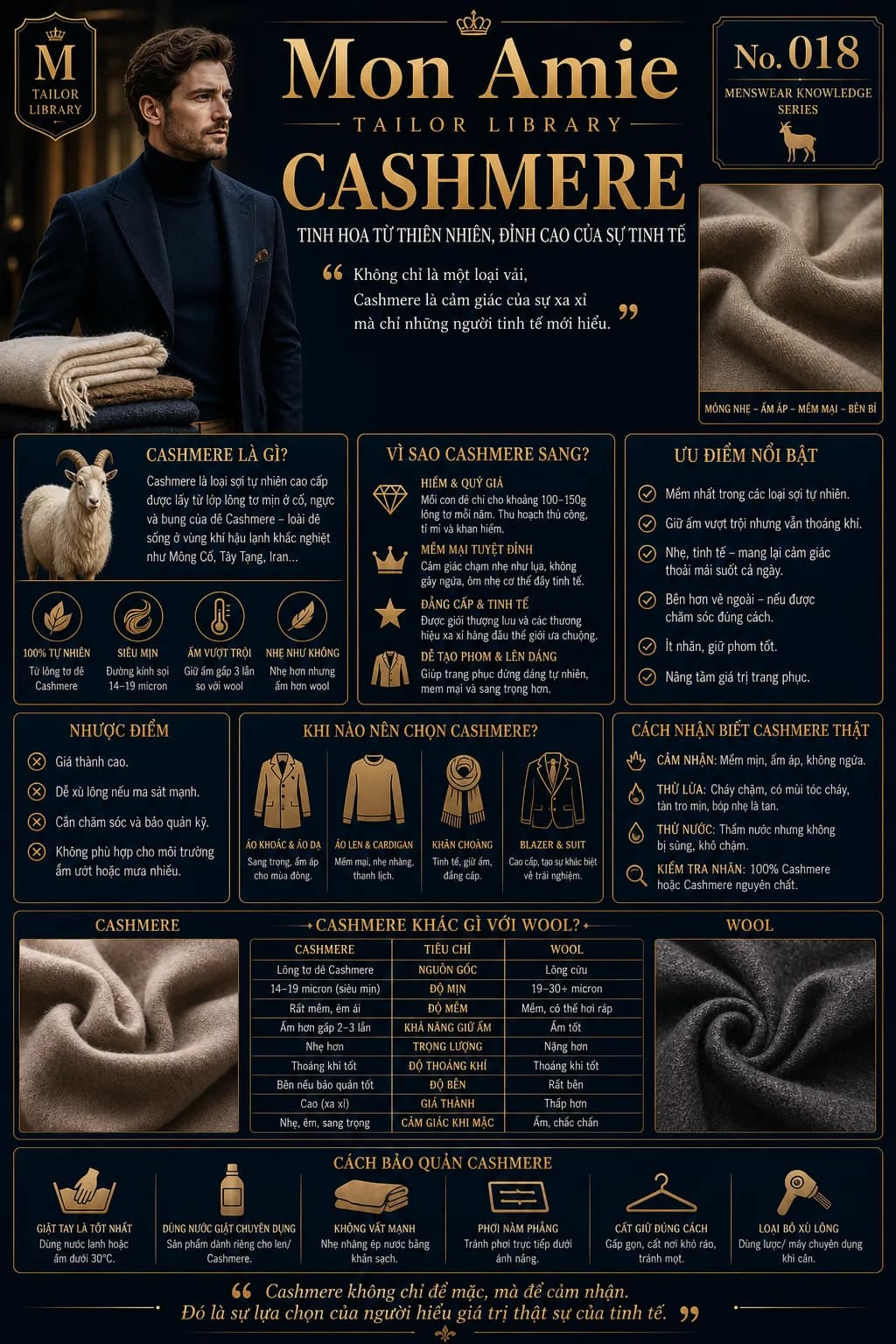
Cashmere is a luxury natural fibre taken from the fine down at the neck, chest and belly of the Cashmere goat — a breed that lives in harsh cold climates such as Mongolia, Tibet and Iran. With fibres measuring only 14 to 19 microns and warmth three times that of ordinary wool, cashmere is considered the pinnacle of refinement among menswear materials. It is not merely a cloth but a sensation of luxury that only the discerning truly register.
What cashmere is, and why it is scarce
Unlike wool, shorn from an entire fleece, cashmere is taken only from the softest down closest to the goat's skin — the coat it grows to survive brutal winters on the plateau. Each animal yields roughly 100 to 150 grams of down a year, and the harvest must be done by hand, patiently, with a comb rather than shears.
To weave enough cloth for a single coat requires the down of several goats gathered over an entire season. That is why cashmere is always rare, always costly, and always present in the collections of the world's leading luxury mills.
The qualities that set cashmere apart
Touch cashmere once and you will understand why those who know suits rarely return to ordinary cloth. Its distinguishing qualities:
- The softest of all natural fibres — silk-like to the touch, never itchy, following the body gently.
- Exceptional warmth while remaining breathable, comfortable through a full day.
- Noticeably lighter than wool yet warmer — ease that lasts from morning to night.
- Shapes and drapes beautifully: garments hold their line naturally, softer and more luxurious.
- Resists creasing, keeps its shape, and proves more durable than its delicacy suggests when properly cared for.
- Elevates an entire outfit — a cashmere blazer speaks for the wearer without a word.
The drawbacks worth knowing first
Mon Amie always speaks plainly with its clients: cashmere is not a material for every circumstance. Consider the following:
- The price sits well above ordinary wools.
- It pills readily under friction, particularly at the sleeves and inner body.
- It demands more attentive care and storage.
- It is unsuited to damp environments or places with heavy rainfall.
If you need a suit for daily wear and constant movement, a fine wool may be the more practical choice. Cashmere belongs to the pieces meant to stand out.
When to choose cashmere
Cashmere shows its worth best in cold-weather garments and occasions that call for luxury:
- Overcoats and topcoats: luxurious and warm through winter.
- Knitwear and cardigans: soft, light, elegant.
- Scarves: refined, warm, quietly distinguished.
- Blazers and suits: exceptional to wear and unmistakably different — usually blended with wool for added durability.
How cashmere differs from wool
Both are animal fibres, yet the two differ markedly. Cashmere comes from goat down, at 14 to 19 microns; wool comes from sheep's fleece, coarser at 19 to 30 microns and above. In softness, cashmere is exquisitely gentle while wool is soft but can feel slightly abrasive on sensitive skin. Cashmere retains two to three times the warmth of wool at a lower weight. Both breathe well, but wool is more durable and more affordable, while cashmere returns a lightness, softness and luxury that nothing else replaces.
Identifying genuine cashmere is straightforward once you know the tests: it feels soft, warm and never itchy; a single fibre held to a flame burns slowly, smells of burnt hair, and leaves a fine ash that crumbles between the fingers; it absorbs water without becoming waterlogged or drying unnaturally slowly. And always check the label — trust "100% Cashmere" or "pure cashmere" only from a reputable mill.
Caring for cashmere properly
Cashmere is hardier than most people think, provided it is treated correctly:
- Hand washing is best, in cold water or warm water below 30°C.
- Use a detergent formulated for wool and cashmere.
- Never wring — press the water out gently with a clean towel.
- Dry flat, away from direct sunlight.
- Store it well: folded, somewhere dry, protected from moths.
- Remove pilling with a comb or a dedicated device when needed.
A word from Mon Amie's artisans
Given the climate of Ho Chi Minh City, Mon Amie usually recommends a cashmere-blend blazer or suit rather than pure cashmere: you keep the characteristic softness while gaining durability for frequent wear in air-conditioned offices. Reserve pure cashmere for overcoats and scarves on trips to colder countries, or for formal occasions that call for a genuinely distinctive note. Whatever the piece, invest in its care — a cashmere garment properly looked after can stay with you for a decade or more.
Cashmere is not simply worn but felt — the choice of a man who understands what refinement truly costs. If you would like to handle cashmere bolts from Canonico, Holland & Sherry, Dormeuil or Scabal yourself, you are welcome to book an appointment at one of Mon Amie's five showrooms in Ho Chi Minh City, or to read about the tailoring process first. Our hotline, 0888.111.118, is always available.