
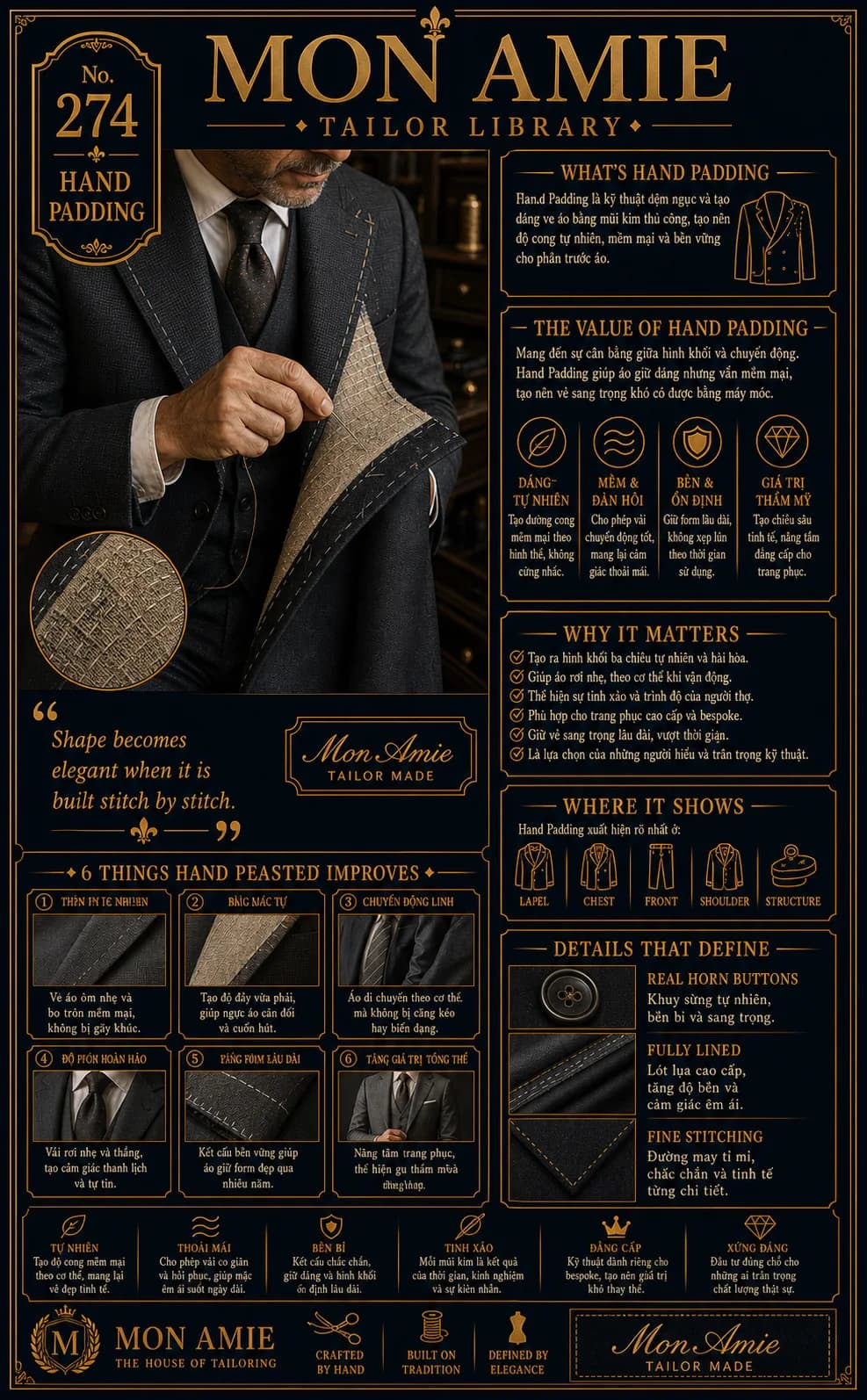
Hand padding is the technique of shaping the chest and lapel with hand stitches, giving the front of a jacket a natural curve, a soft hand and lasting structure. If horsehair canvas is the material and floating canvas is the architecture, hand padding is the hand that brings both to life. Mon Amie would like to explain why these thousands of tiny stitches decide the class of a suit.
What hand padding is, and what it gives you
While padding by hand, the tailor holds the canvas and the cloth in a pre-curved position, then works rows of small, evenly spaced diagonal stitches through the layers. Each stitch locks a little of that curve into the structure, so that when the jacket is finished the lapel rolls softly towards the chest with no pressing or fusing required. It is a balance of shape and movement: the jacket holds its form yet stays supple — an elegance that is difficult to obtain by machine.
The four core values of hand padding:
- Natural shape: a soft curve that follows the body rather than a rigid outline.
- Softness and spring: the cloth is free to move, and the jacket feels comfortable.
- Durability and stability: the form holds for years without collapsing.
- Aesthetic value: a subtle depth that lifts the whole garment.
Why hand padding matters
- It builds a natural, harmonious three-dimensional shape across the front of the jacket.
- It lets the jacket fall lightly and follow the body in movement.
- It reveals the refinement and skill of the tailor.
- It suits high-end garments and bespoke commissions.
- It preserves an elegance that lasts, well beyond passing fashion.
- It is the choice of those who understand and value craft.
There is a saying pinned up in many classical tailoring workshops: shape only becomes elegant when it is built one stitch at a time.
Six things hand padding improves on a suit
- A natural lapel — the lapel hugs gently and curves softly, rather than breaking sharply like a fused one.
- A balanced chest — a measured fullness that makes the chest look poised and attractive.
- Free movement — the jacket moves with the body without pulling or distorting.
- A perfect drape — the cloth falls lightly and straight, for a look of quiet confidence.
- Lasting form — a durable structure that keeps the jacket in shape for years.
- Greater overall value — it elevates the garment and reflects the wearer's taste.
Where hand padding appears on a jacket
The technique is concentrated in the areas that determine the jacket's shape: the lapel (where the padding stitches are densest, to create the roll), the chest, the front as a whole, the shoulder, and the entire structure — the internal framework that gives the jacket its form. Looking at a jacket on a hanger, you will hardly see any trace of hand padding; put it on, and these are precisely the areas that make the difference.
Alongside it come the finishing details of properly made-to-measure clothing: natural horn buttons, durable and refined; a fine silk lining that feels smooth against the body; and meticulous, solid stitching in every detail.
A craft built on time and experience
Hand padding creates a soft curve that follows the body naturally, allows the cloth to stretch and recover so you stay comfortable through a long day, and gives a firm structure that keeps the shape stable for years. Every stitch is the product of time, experience and patience — a technique reserved for bespoke, and one whose value is hard to replace. It is money well placed for anyone who values genuine quality.
A word from Mon Amie's artisans
Mon Amie's tailors like to say that a sewing machine travels fast but only travels straight, while the hand travels slowly and knows how to curve. When padding a lapel, the artisan reads the weight of the cloth, the direction of the grain and the wearer's build to adjust the pressure of the needle section by section — something no production line can be programmed to do. That is why every hand-padded jacket leaving Mon Amie's workshop carries a little "memory" of its owner, and comes with an alteration guarantee so it keeps fitting well over the years.
We invite you to visit one of Mon Amie's five showrooms in Ho Chi Minh City, or call 0888.111.118, to see hand padding for yourself. You are welcome to book an appointment and read about the tailoring process at Mon Amie — from choosing cloth and building the structure to the final stitch.