
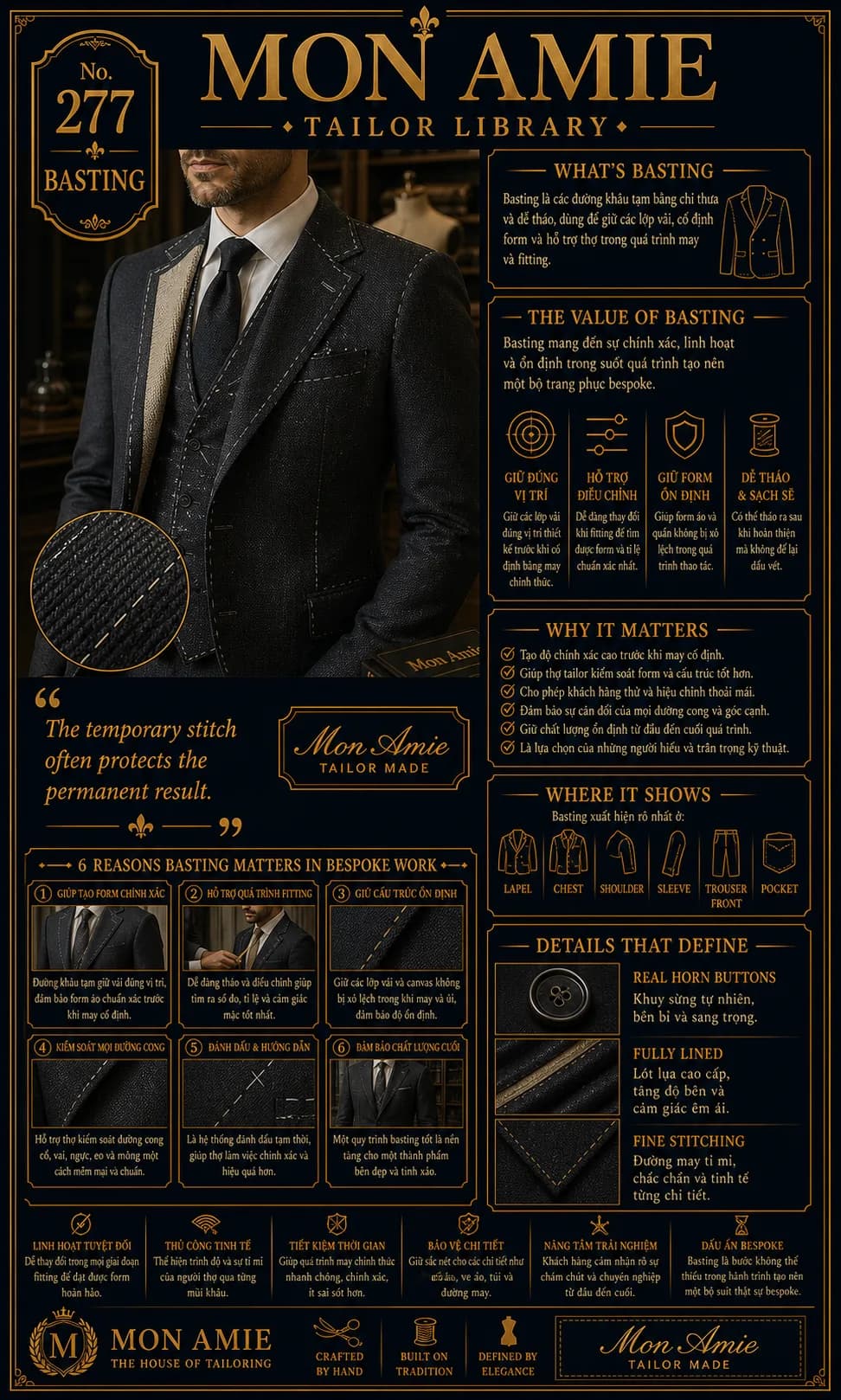
Basting means loose temporary stitches, worked in light thread and easily removed, used to hold layers of cloth together, fix the shape of a garment and guide the tailor through the making and the fittings. If you have ever seen an unfinished jacket criss-crossed with white thread along the lapel, shoulder and chest, you have seen the sign of a suit being made in the true bespoke spirit. Mon Amie would like to tell you about this quiet but decisive stage.
What basting is in the tailoring trade
Before any permanent seam is fixed, the tailor uses basting thread — usually fine white cotton — to tack the layers of cloth, canvas and lining into their designed positions. The stitches are widely spaced and just loose enough to hold, and they can be removed completely when the garment is finished, leaving no trace behind.
Basting brings precision, flexibility and stability to the whole process of creating a bespoke garment, in four ways:
- Holding position: every layer sits exactly where the design intends before permanent stitching begins.
- Allowing adjustment: easy to alter at a fitting, so the shape and proportion can be brought to perfection.
- Keeping the form stable: the shape of jacket and trousers does not shift while being worked.
- Clean removal: taken out at the end without leaving a mark on the cloth.
Why basting matters to a bespoke suit
To an outsider, basting may look like a minor step; in practice it determines the accuracy of the entire suit:
- It provides great precision before anything is permanently sewn.
- It gives the tailor better control over shape and structure.
- It lets the client try the garment and refine it freely across the fittings.
- It keeps every curve and angle in balance.
- It maintains consistent quality from beginning to end.
- It is the choice of those who understand and value tailoring.
Six reasons basting is indispensable in bespoke
First, basting creates an accurate shape: the temporary stitches hold the cloth in place so the form is correct before permanent sewing. Second, it supports the fitting: because it is easy to remove and adjust, it helps find the best measurements, proportions and feel — which is why a fitting garment usually still carries its basting thread. Third, basting keeps the structure stable: cloth and canvas do not shift during sewing and pressing.
Fourth, it gives control over every curve: collar, shoulder, chest and waist are shaped softly and precisely. Fifth, basting is a temporary system of marks and guides, letting the tailor work more accurately and efficiently. Finally, good basting is the foundation of a beautiful, durable and refined finished garment — the temporary stitch protects the permanent result.
Where basting appears on a suit
In the workshop, basting thread is most visible in the areas that demand the greatest precision:
- Lapel — holding canvas and face cloth before the lapel is rolled.
- Chest — securing the chest piece that builds the three-dimensional shape.
- Shoulder — the hardest area, and the one that decides how the jacket stands.
- Sleeve — set in provisionally to check the pitch and the length.
- Trouser front — keeping the crease and the pleats true.
- Pocket — positioning the pocket mouth before final sewing.
What basting gives the wearer
For the client, a serious basting process means complete flexibility — anything can be changed at any stage of the fittings in pursuit of a perfect fit. It shows the tailor's skill and care in every stitch, and it saves time, because the permanent sewing then proceeds quickly, accurately and with fewer errors. Details such as edges, lapels, pockets and seams stay crisp and protected, and the client feels professional attention from start to finish. Basting is, in short, an indispensable step on the way to a genuinely bespoke suit.
A word from Mon Amie's artisans
At Mon Amie, the tailors remind one another that the temporary stitch usually protects the permanent result. A fitting with a still-basted jacket is the moment when tailor and client hold a conversation with the suit — adjusting the shoulder, shaping the chest, balancing the lapels — before anything is fixed for good. Patience at this stage is exactly what separates true tailoring from an altered off-the-peg suit.
If you would like to experience the full bespoke process with proper fittings, we invite you to book an appointment at one of Mon Amie's five showrooms in Ho Chi Minh City, or call our hotline 0888.111.118. You may also wish to read about the tailoring process at Mon Amie beforehand.