
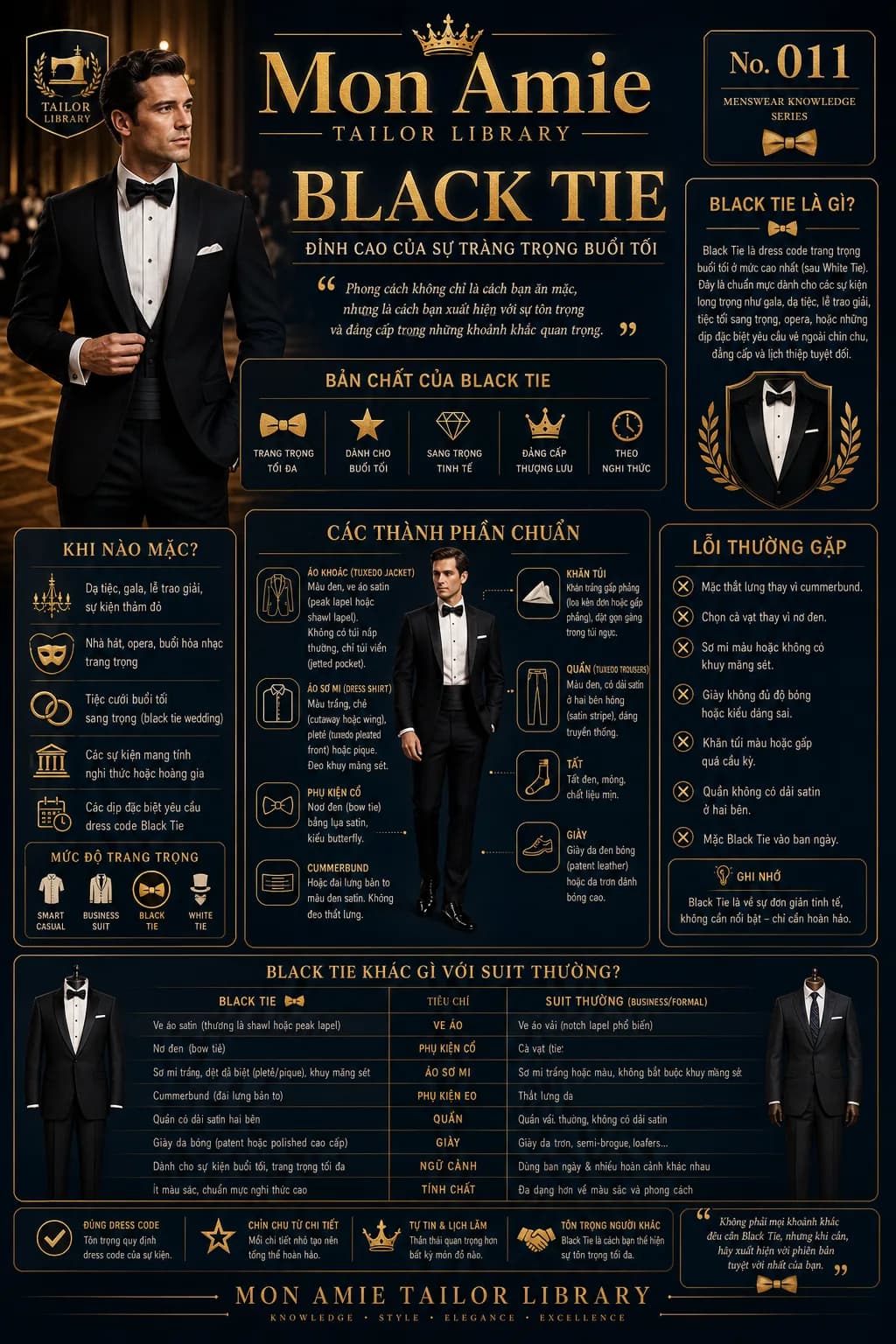
What is Black Tie? It is the most formal evening dress code a gentleman is likely to encounter in his lifetime, second only to White Tie, which today is exceedingly rare. It is the standard for grand occasions such as galas, evening receptions, award ceremonies, refined dinners and nights at the opera — occasions that call for absolute polish, distinction and courtesy.
The essence of Black Tie
Before looking at individual pieces, it helps to understand the spirit of the code. Black Tie is defined by five qualities:
- Maximum formality — this is not clothing for expressing personality, but for expressing respect.
- Reserved for the evening — by classical etiquette, Black Tie appears only after sundown.
- Understated luxury — the beauty lies in the cloth and the finishing, never in colour or ornament.
- Rarefied company — it belongs to events with a strong ceremonial character.
- Governed by etiquette — every component follows a clear rule, and the wearer is expected to observe it.
Put differently, style is not only how you dress, but how you present yourself with respect for the moment and for the people around you.
When to wear Black Tie
You will need a tuxedo on occasions such as these:
- Evening receptions, galas, award ceremonies, red-carpet events.
- The theatre, the opera, formal concerts.
- Refined evening weddings (black tie weddings).
- Ceremonial or royal occasions.
- Any special occasion where the invitation states Black Tie.
On the scale of formality, the ladder runs from smart casual, to the business suit, then Black Tie, with White Tie at the summit. When an invitation says "Black Tie", it is a polite but serious request: a business suit, however handsome, is not the correct answer.
The correct components of a Black Tie ensemble
A true Black Tie ensemble is made of fixed elements, each with a reason for being there:
- The tuxedo jacket: black, with satin-faced lapels — usually a peak lapel or a shawl lapel. Rather than flap pockets it uses jetted pockets, for the cleanest possible line.
- The dress shirt: white, with a cutaway or wing collar, a pleated tuxedo front or a piqué weave, and always fastened with cufflinks.
- The black bow tie: in satin silk, in the classic butterfly shape. This is the detail that gives the code its name.
- The cummerbund: a wide black satin waist sash covering the waistline, replacing the belt entirely. A cummerbund and a belt are never worn together.
- The tuxedo trousers: black, with a satin stripe running down each side, cut in the traditional line.
- Socks: black, fine and smooth.
- Shoes: black patent leather, or highly polished plain calf.
Each satin element — lapel, bow tie, trouser stripe, cummerbund — catches the evening light together, creating the distinctive richness a normal suit cannot achieve.
How Black Tie differs from an ordinary suit
Many men mistake a tuxedo for a handsome black suit. In practice the two differ in almost every respect:
- Lapels: Black Tie uses satin lapels (shawl or peak); a suit uses cloth lapels, most often a notch lapel.
- Neckwear: Black Tie takes a black bow tie; a suit takes a necktie.
- Shirt: Black Tie requires a white shirt in a special weave (pleated or piqué) with cufflinks; a suit accepts white or coloured shirts, with no cufflinks required.
- At the waist: Black Tie uses a cummerbund; a suit uses a leather belt.
- Trousers: tuxedo trousers carry a satin stripe; suit trousers are plain cloth.
- Shoes: Black Tie calls for high-shine leather; a suit is flexible — plain calf, semi-brogue or loafers.
- Context: Black Tie is reserved for the most formal evening occasions; a suit serves by day and in many settings.
- Character: Black Tie is restrained in colour and high in ceremony; a suit allows far more variety in colour and style.
Common Black Tie mistakes
These are the errors Mon Amie sees most often, and the easiest to avoid:
- Wearing a belt instead of a cummerbund.
- Choosing a necktie instead of a black bow tie.
- A coloured shirt, or a shirt without cufflinks.
- Shoes lacking shine, or of the wrong shape.
- A coloured pocket square, or one folded too elaborately — with Black Tie, a flat-folded white square sitting quietly in the breast pocket is the standard.
- Trousers without the satin side stripe.
- Wearing Black Tie during the day.
The point to remember: Black Tie is the beauty of refined simplicity. You do not need to stand out — you need to be faultless. Any attempt to be "creative" with colour or unusual detail works against you in this code.
A word from Mon Amie's artisans
With a tuxedo, fit matters even more than cloth, because a dark, minimal ensemble reveals every surplus fold at the shoulder and waist. Have your tuxedo made at least two to three weeks before the event, so there is time for fittings and final adjustments. And if you will invest only once, choose a satin shawl lapel with a classic silhouette — that is the tuxedo that never dates, and will carry you through galas for years.
Not every moment calls for Black Tie, but when it does, appear as the most impeccable version of yourself. Mon Amie is glad to accompany you on such occasions, with five showrooms in Ho Chi Minh City and measurements kept for life. You are welcome to book an appointment or to read about our bespoke service.