
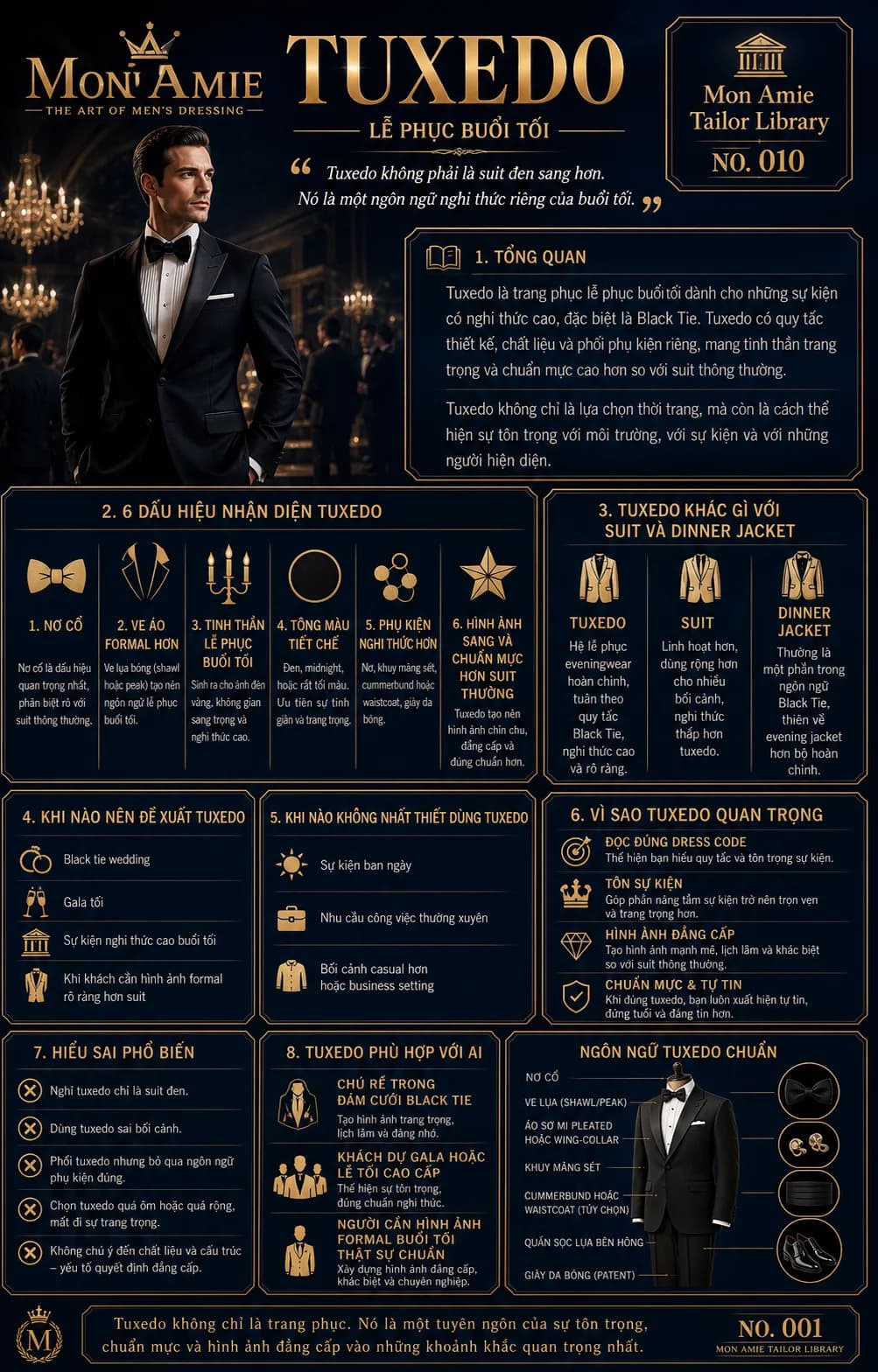
What is a tuxedo? It is evening dress for occasions of high ceremony, above all those with a Black Tie dress code. A tuxedo is not "a fancier black suit" — it is a distinct language of evening ceremony, with its own rules of design, cloth and accessory, and a formality well above that of an ordinary suit.
An overview: the tuxedo as a language of ceremony
The tuxedo was made for moments where formality comes first: banquets, galas, Black Tie weddings. Wearing one is not only a matter of taste; it is how you show respect for the setting, the occasion and everyone present.
For that reason the tuxedo follows far stricter rules than a suit: from colour and lapel facing down to every accessory. Understand those rules and you will never strike the wrong note at an important event.
Six marks of a genuine tuxedo
To tell a tuxedo from an ordinary black suit, look for six signs:
- The bow tie: the single clearest marker, separating the tuxedo from a suit, which is worn with a necktie.
- Silk-faced lapels: faced in lustrous silk, in shawl (a smooth rounded roll) or peak form, creating the distinctive language of evening dress.
- The spirit of evening dress: the tuxedo belongs to warm light, refined rooms and high ceremony — not the office, and not daytime.
- Restrained colour: black, midnight blue or very dark tones; simplicity and gravity first.
- More ceremonial accessories: bow tie, cufflinks, cummerbund or waistcoat, polished leather shoes.
- A more refined, more correct image: the tuxedo presents a polish and authority no ordinary suit can match.
Tuxedo, suit and dinner jacket
These three terms are frequently confused, but they are clearly distinct:
- The tuxedo is a complete system of eveningwear, governed by the Black Tie code, formal and precise from jacket and trousers through to accessories.
- The suit is more versatile and far broader in use — work, daytime events, everyday life — and lower in formality than the tuxedo.
- The dinner jacket usually forms part of the Black Tie language, referring to the evening jacket itself (in ivory or velvet, for instance) rather than to a complete rig.
Put another way: a suit is clothing, while a tuxedo is ceremony cut into cloth.
When to wear a tuxedo — and when not to
A tuxedo comes into its own in these settings:
- Weddings with a Black Tie dress code, particularly for the groom.
- Evening galas, awards dinners and fundraising events.
- Occasions of high ceremony held after dark.
- Whenever you need an unambiguously formal image, above the standard of an ordinary suit.
Conversely, a tuxedo is not required — and often should not appear — at:
- Daytime events, which belong to lighter suits or morning dress.
- Regular business needs, meetings and partner appointments.
- Casual or business settings, where a tuxedo simply looks out of place.
Common misunderstandings about the tuxedo
In the course of tailoring for clients, Mon Amie meets a few recurring errors:
- Treating a tuxedo as merely a black suit — ignoring the whole system of silk lapels, bow tie and accessories.
- Wearing a tuxedo in the wrong context, for instance to a daytime meeting.
- Wearing a tuxedo but abandoning the correct accessory language: swapping the bow tie for a necktie, or dropping the cummerbund.
- Choosing a tuxedo cut too close or too loose, which strips away its inherent gravity.
- Overlooking cloth and construction — the factors that decide the quality of formal dress.
The correct tuxedo language, from bow tie to patent shoes
A complete Black Tie rig comprises the following elements, each with its own purpose:
- A hand-tied bow tie, black, matching the lapel facing.
- Silk lapels in shawl or peak form.
- A pleated-front shirt or a wing-collar shirt.
- Cufflinks in place of ordinary buttons at the wrist.
- A cummerbund or waistcoat (optional) covering the transition between jacket and trousers.
- Silk-braided trousers — a stripe running down the outer seam, matching the lapels.
- Patent leather shoes to complete the whole.
When every detail is respected, the tuxedo creates a striking, elegant image clearly distinct from an ordinary suit — you appear more confident, more assured and more credible.
A word from Mon Amie's artisans
With a tuxedo, one small error throws off the whole — which is why Mon Amie always advises settling the event's dress code first, then choosing silhouette and cloth. If this is your first tuxedo, begin with black or midnight blue and a silk-faced shawl lapel: a choice that is never wrong at any Black Tie occasion. And do not economise on the accessories — the hand-tied bow, the cufflinks and the patent shoes are the punctuation that finishes the sentence.
A tuxedo is more than clothing. It is a statement of respect, of correctness and of presence at the moments that matter most. If you have a Black Tie event ahead, or wish to own a properly tailored dinner suit, you are welcome to book an appointment with Mon Amie or read about the tailoring process at one of our five showrooms in Ho Chi Minh City.