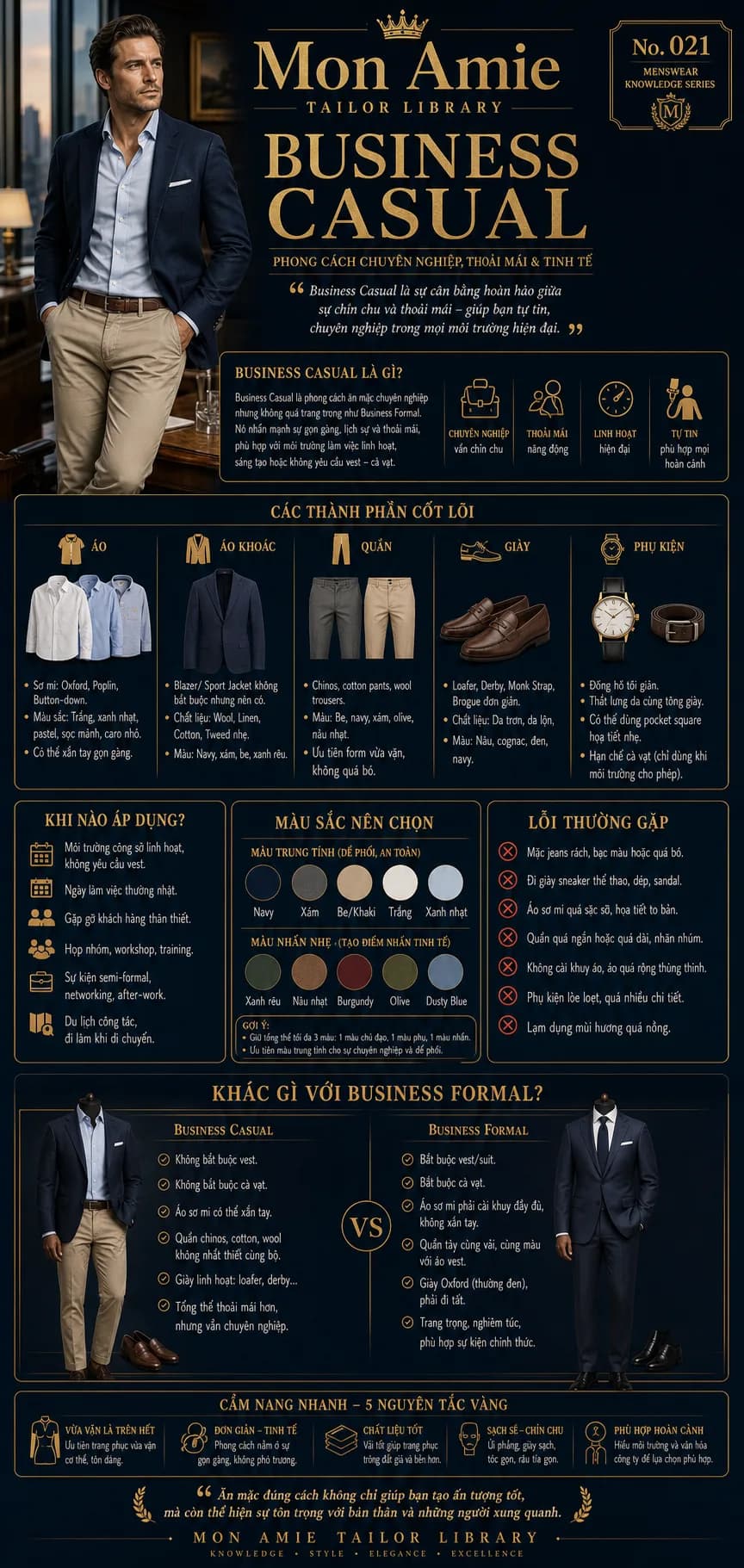
What is business casual? It is a way of dressing that stays professional without the ceremony of business formal — the balance between looking considered and feeling at ease. In flexible, creative or tie-free workplaces, it is the most sensible dress code there is: confident in the morning, still comfortable at the end of a long day.
What business casual is, and why it keeps gaining ground
Business casual rewards neatness, courtesy and comfort. Unlike the discipline of a full suit, it lets you mix separates freely — as long as the whole still reads as professional. Four things it gives you:
- Professional: polished enough for partners and clients.
- Comfortable: lighter cloths and easier cuts that keep pace with an active day.
- Flexible: suited to modern workplaces that do not impose rigid rules.
- Confident: adaptable to almost any situation, from the office to a networking evening.
At technology firms, agencies, startups and even banks on ordinary weekdays, business casual has quietly become the default for working men.
The core pieces of a business casual outfit
A proper business casual wardrobe turns on five groups of pieces:
- Shirts: oxford, poplin or button-down. Safe colours are white, pale blue, pastels, fine stripes or small checks. Rolling the sleeves neatly is entirely acceptable at your desk.
- Jackets: a blazer or sport jacket — not compulsory, but worth having, since it lifts everything else. Suitable cloths include wool, linen, cotton and light tweed, in navy, grey, beige or forest green.
- Trousers: chinos, cotton trousers or wool trousers. Favour beige, navy, grey, olive and light brown, in a cut that fits cleanly without clinging.
- Shoes: loafers, derbies, monk straps or simple brogues in smooth leather or suede, in brown, cognac, black or navy.
- Accessories: a understated watch, a leather belt matching the shoes, and perhaps a lightly patterned pocket square. Go easy on the tie — wear one only when the room calls for it.
When business casual is the right choice
The style suits most everyday working situations:
- Flexible offices where a suit is not expected.
- Ordinary working days.
- Meetings with clients you already know well.
- Team meetings, workshops and training sessions.
- Semi-formal events, networking, after-work gatherings.
- Business travel and days spent moving between workplaces.
What these have in common is simple: you need to look credible, but not ceremonial.
How to choose colours
Mon Amie's rule: keep an outfit to three colours at most — one dominant, one secondary, one accent — and lean on neutrals, which read as professional and combine easily.
- Neutrals (easy and safe): navy, grey, beige or khaki, white, pale blue. These should make up the bulk of your wardrobe.
- Soft accents (quiet character): forest green, light brown, burgundy, olive, dusty blue — used on a single piece such as a blazer, a pair of trousers or an accessory.
A classic formula: navy blazer, pale blue shirt, beige chinos, brown loafers — three colours, and polished enough for nearly any office in Vietnam.
Common mistakes to avoid
Business casual is relaxed, but never careless. The usual errors:
- Ripped, faded or overly tight jeans.
- Athletic sneakers, slides or sandals.
- Loud shirts with oversized patterns.
- Trousers that are too short, too long, or badly creased.
- Unbuttoned shirts, or garments several sizes too large.
- Flashy accessories and too much detail.
- Overpowering fragrance.
Avoid these alone and you will already be in the better-dressed half of any room.
How business casual differs from business formal
The two are often confused, but the line is fairly clear:
- Business casual: no jacket required, no tie required; sleeves may be rolled; chinos, cotton or wool trousers need not match the jacket; shoes are flexible — loafers, derbies. Easier overall, still professional.
- Business formal: a suit is required, a tie is required; the shirt is fully buttoned with sleeves down; trousers match the jacket in cloth and colour; oxford shoes, usually black, worn with socks. Serious and ceremonial, made for formal occasions.
Put simply: business formal is the uniform of ceremony, business casual is the everyday language of a professional man.
A word from Mon Amie's artisans
In the workshop, Mon Amie tells clients one thing above all: fit comes first. A made-to-measure blazer that sits correctly on the shoulder and waist will lift even the plainest chinos and shirt. Invest first in one good navy blazer and two pairs of neutral chinos; that is a business casual foundation you can wear all year. And keep the five golden rules in mind: fit, simple elegance, good cloth, cleanliness, and appropriateness to the occasion.
Dressing well is not only about the impression you make; it is also a form of respect — for yourself and for the people around you. If you would like a blazer or a full business casual outfit cut to your own proportions, we invite you to book an appointment at one of Mon Amie's five showrooms in Ho Chi Minh City, or to read about the tailoring process first.