
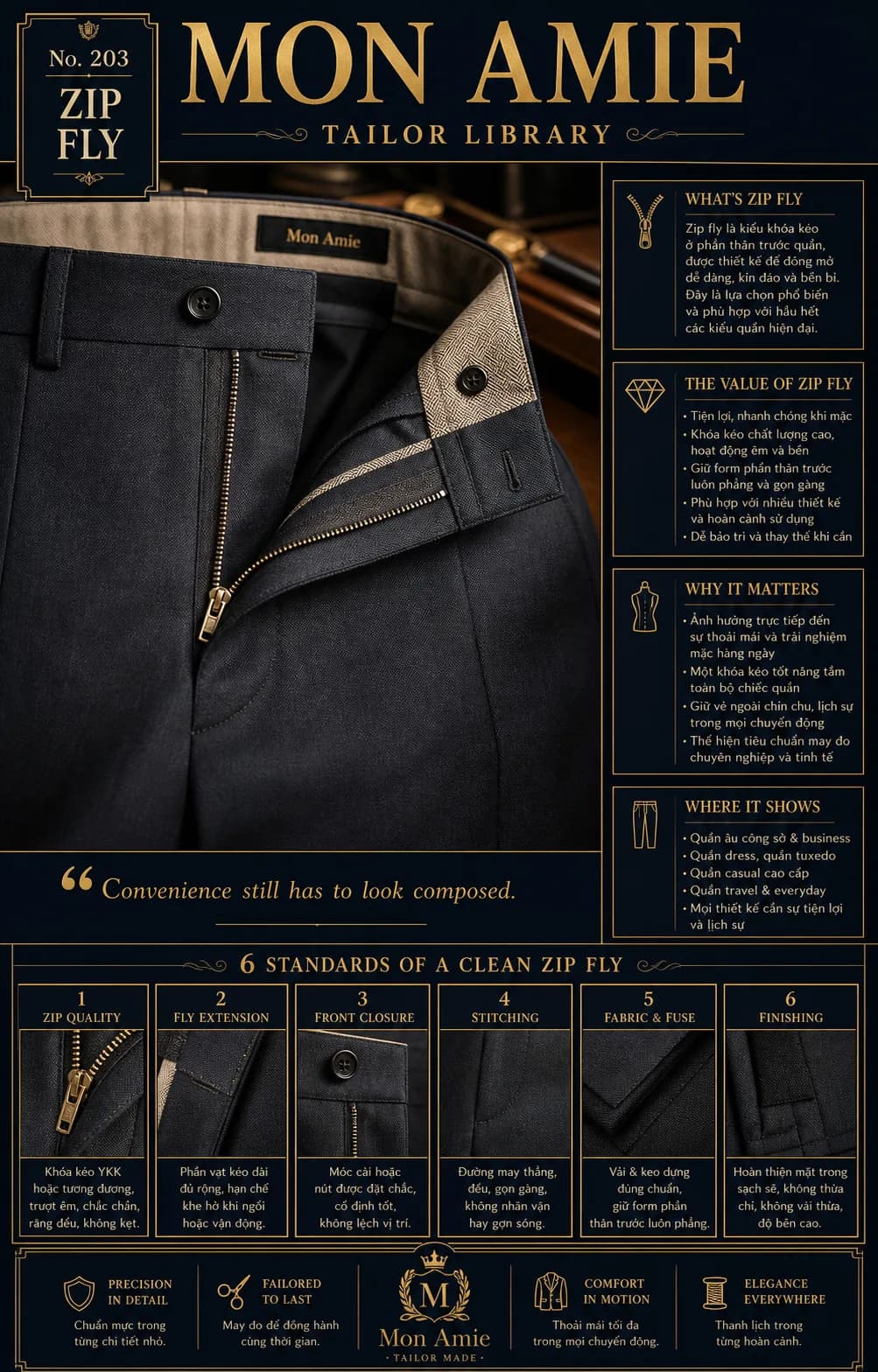
A zip fly is the zipped closure at the front of a trouser, designed to open and close easily, discreetly and durably. It is the common choice and suits almost every modern trouser. It sounds like an obvious detail, but as Mon Amie tells clients: convenience still has to look immaculate — and the quality of a zip fly says a great deal about the standards of the workshop behind it.
The value of a zip fly in a tailored trouser
A zip chosen and sewn correctly delivers five things:
- Speed and ease when dressing — the reason the zip fly has almost entirely replaced buttons in modern trousers.
- A quality zip that runs smoothly and lasts through thousands of openings.
- A front that stays flat and clean — the fly is where faults show most readily on a trouser.
- Compatibility with many designs and occasions, from office trousers to casual ones.
- Easy maintenance and replacement when needed — a practical advantage over a row of buttons.
Why this detail matters
The zip directly affects comfort and the daily experience of wearing a trouser. A good zip lifts the whole garment; a cheap one that catches or ripples will spoil an expensive suit. A correct zip fly also keeps the front looking neat and proper through every movement, and reflects the professional, refined standards of the tailor. In this trade, a workshop is judged by the places clients rarely look — and the fly is one of them.
Where the zip fly appears
Almost every modern trouser uses one:
- Office and business trousers
- Dress trousers and tuxedo trousers
- Fine casual trousers
- Travel and everyday trousers
In short: any design that calls for both convenience and propriety. The notable exceptions are certain strictly classical bespoke trousers and heritage jeans, which use a button fly — a subject Mon Amie will take up separately.
Six standards for a clean zip fly
Tailor Library poster No. 203 sets out the six standards Mon Amie applies when making a fly:
- Zip quality: YKK or equivalent, running smoothly and firmly, with even teeth and no catching. The brand of the zip is the first thing a knowing eye looks for.
- Fly extension: a fly extension wide enough to prevent any gaping when you sit or move.
- Front closure: a hook or button set firmly, holding its position, so the waistband closes flat above the zip.
- Stitching: straight, even and neat, with no twisting or rippling along the length of the fly.
- Fabric and fuse: correct cloth and fusing, keeping the front flat and free of bubbling over time.
- Finishing: a clean interior with no loose threads, no fraying, and real durability. A fine trouser must look fine inside out.
Four commitments behind a small detail
Those six standards resolve into four commitments of tailoring: precision in detail — exactness in the smallest things; tailored to last — made to keep you company through the years; comfort in motion — full ease in every movement; and elegance everywhere — grace in every setting. The difference in cost between a good zip and a poor one is trivial, yet it is the line between a trouser worn for five years and one discarded after a single season.
A word from Mon Amie's artisans
In the Mon Amie workshop, tailors check a fly by a simple habit: run the zip ten times in a row, then lay the trouser flat and view it at an angle under the lamp — if the fly line ripples even slightly, the trouser goes back to the machine. Because clients are not buying a zip; they are buying the assurance that every detail, including the hidden ones, has been done properly.
If you would like to feel the difference in a trouser attended to down to the last stitch of the fly, we invite you to book an appointment at one of Mon Amie's five showrooms in Ho Chi Minh City, and to read about the tailoring process to understand every stage behind it.