
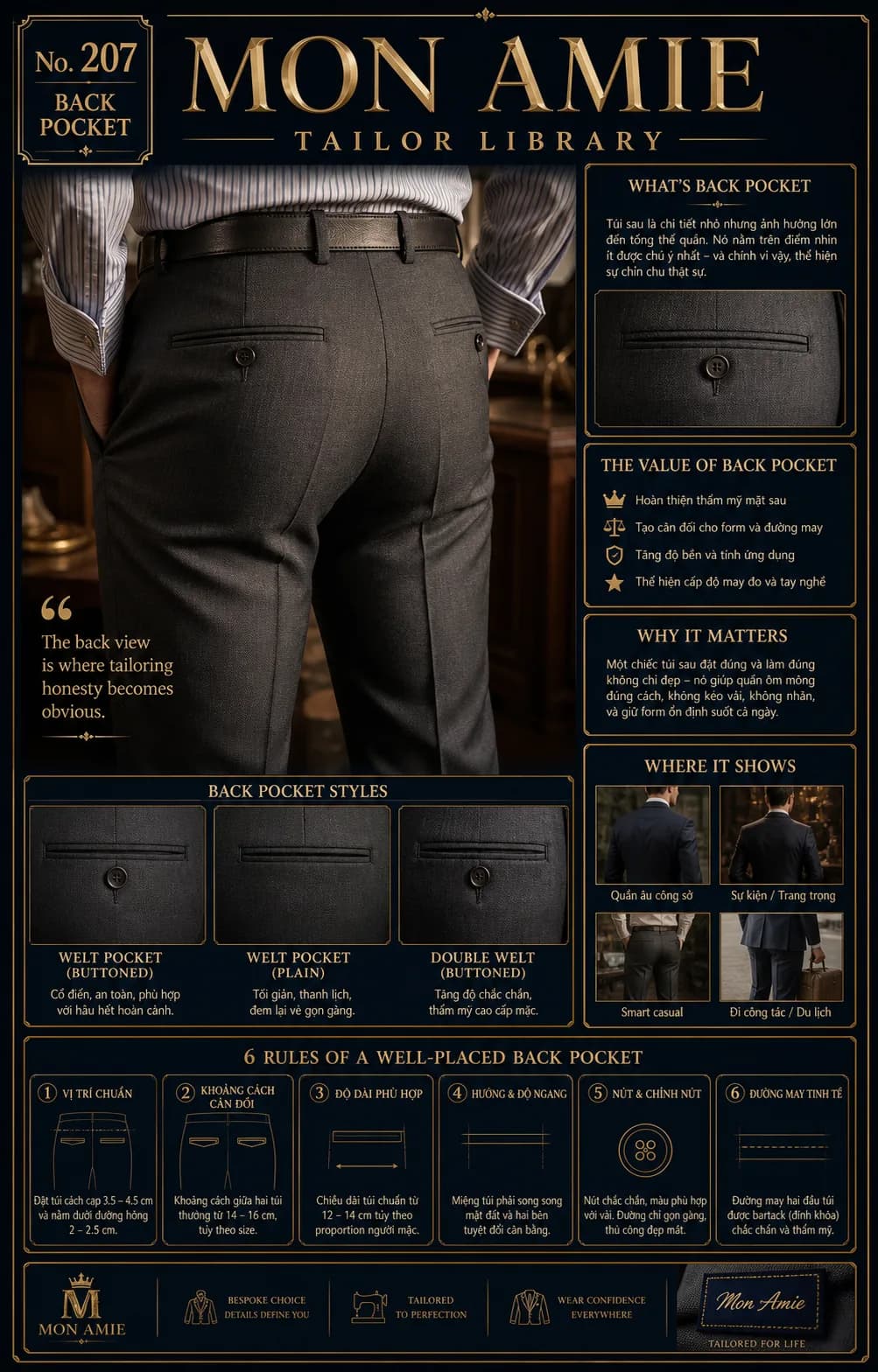
The back pocket sits on the rear of a trouser — a small detail with a large effect on the garment as a whole. It occupies the least observed view, and for exactly that reason it is where real care shows: anyone can fuss over the front to make an impression, but only a properly made trouser looks right from behind.
What the back pocket is, and why it matters
Tailors have a saying: the back is where the honesty of the stitching shows. The front of a trouser has plenty of cover — pleats, the pressed crease, the skirt of the jacket — while the back offers only cloth over the seat and two pockets. Back pockets placed and made correctly are not merely handsome: they let the trouser sit properly over the seat, without dragging or wrinkling, and hold their shape all day.
The value of a well-made back pocket rests on four points:
- It finishes the rear view — the part the wearer himself rarely inspects.
- It balances shape and seam lines — the two pockets are the visual anchors of the back.
- It adds durability and usefulness — a spot that takes strain when seated needs careful construction.
- It reveals the level of tailoring — a back pocket even slightly out of line is spotted at once.
Common back pocket styles
- Buttoned welt pocket: the classic, with a welted mouth and a fastening button — secure for a wallet and suitable almost anywhere.
- Plain welt pocket: minimal and elegant, giving the back a clean look — typical of formal suit trousers.
- Buttoned double welt: a double-welted mouth, more robust and visually more refined — a familiar choice on bespoke trousers.
Choose according to purpose: daily business trousers benefit from a button to hold the wallet; evening trousers may take a smooth double welt for the cleanest line.
Where back pockets appear
- Business trousers: the most used, needing both looks and durability.
- Formal occasions: perfectly flat pockets so the back reads as one clean plane under the jacket.
- Smart casual: a freer pocket style, though balance still counts.
- Travel and business trips: a buttoned pocket keeps belongings secure on the move.
Six rules for placing a back pocket
These are the figures a tailor works to when drafting the pattern — you can use them to check your own trousers:
- Correct position: the pocket sits 3.5–4.5 cm below the waistband and 2–2.5 cm below the hip line.
- Balanced spacing: the distance between the two pockets is usually 14–16 cm, depending on size.
- Appropriate length: a standard pocket mouth runs 12–14 cm, according to the wearer's proportions.
- Direction and level: the mouth must be parallel to the ground and the two sides absolutely even.
- Buttons and their placement: secure buttons in a colour suited to the cloth, with tidy stitching, handsomely done by hand.
- Refined stitching: both ends of the pocket firmly bartacked — durable and handsome at once.
These figures are not rigid: a tall man with a long seat needs the pockets set a little lower to keep the proportion, and a shorter, fuller man the opposite. This is precisely why made-to-measure trousers look "right" in a way that is hard to articulate.
A word from Mon Amie's artisans
During a fitting, Mon Amie's tailors always invite you to turn your back to the mirror and look over your shoulder — because the rear view is the part the whole world sees except you. Back pocket placement is set to each client's true seat measurement and body length, with both ends hand-bartacked, so that after hundreds of sittings and risings the pocket mouth is still as straight as on the first day.
So the back is as considered as the front
If you would like a trouser that looks well from every angle — including the one you cannot see yourself — we invite you to book an appointment at one of Mon Amie's five showrooms in Ho Chi Minh City, or call 0888.111.118. You may also consult our pricing to choose a suitable cloth, from Kevinlli to Canonico and Holland & Sherry.