
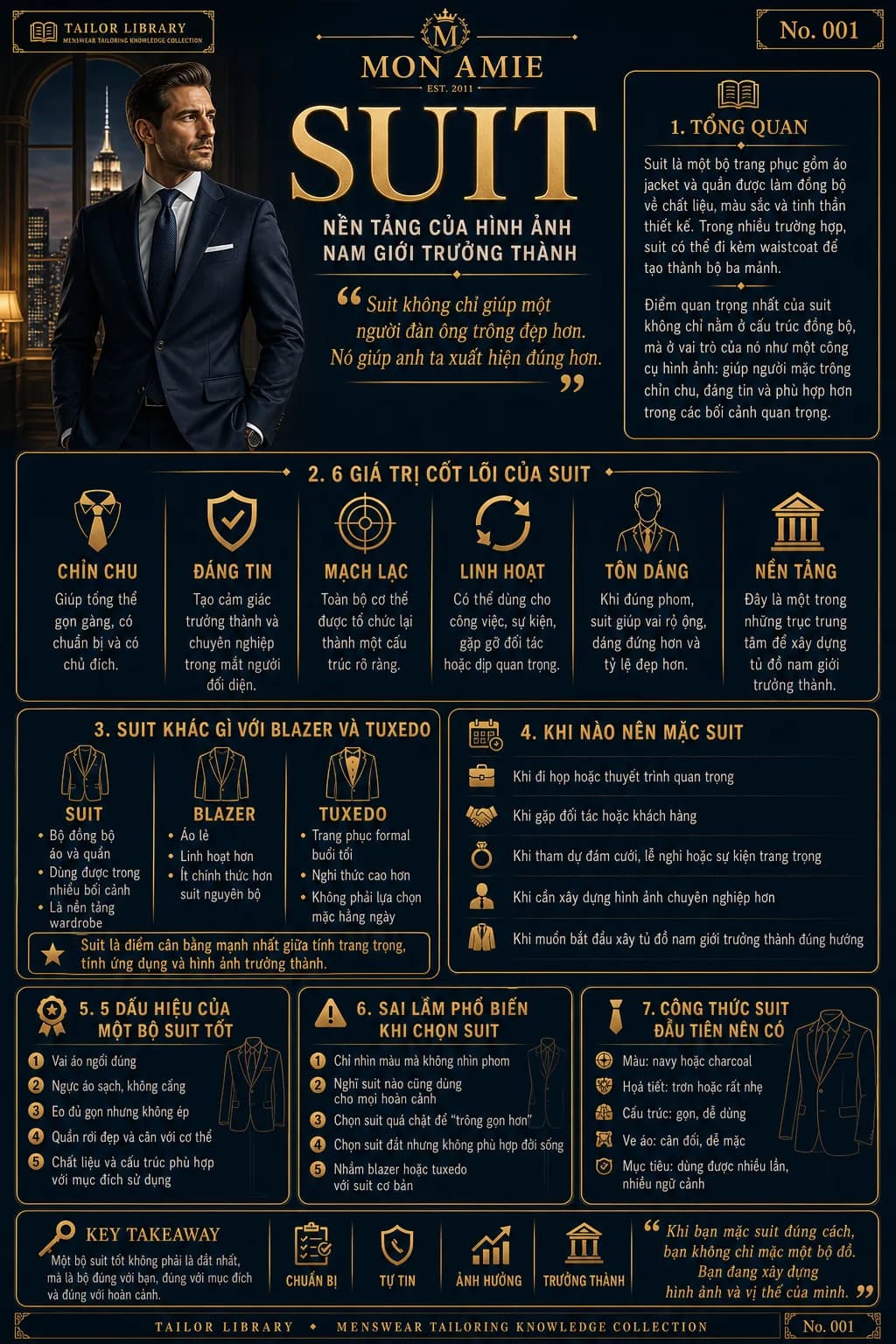
A suit is a jacket and a pair of trousers made to match in cloth, colour and design intent; in many cases a waistcoat is added to form a three-piece. Yet the greatest value of a suit lies not in that matching construction but in its role as a visual instrument: it makes the wearer look composed, credible and appropriate in the moments that matter. Put another way, a suit does not simply make a man look better — it helps him appear correctly.
What a suit is, and why it matters
The essence of a suit is coherence. Jacket and trousers are cut from the same length of cloth, from the same dye lot, so colour and drape align perfectly — something a separate jacket paired with separate trousers can never achieve. That coherence is what creates the impression of a single, unified whole: tidy, deliberate, and instantly more formal.
Within menswear, the suit is considered the foundation of a grown man's wardrobe. Before any other garment enters the conversation, a man who works, meets partners and attends events needs at least one suit with the right cut and the right cloth.
Six core values of a suit
At Mon Amie we usually summarise the case for investing in a suit in six points:
- Composure: the whole silhouette reads as tidy, prepared and intentional.
- Credibility: it conveys maturity and professionalism to the person across the table.
- Coherence: the body is organised into one clear, legible structure.
- Versatility: it serves work, events, client meetings and important occasions alike.
- Flattery: cut correctly, a suit broadens the shoulders, straightens the posture and improves the body's proportions.
- Foundation: it is the central axis around which a grown man's wardrobe is built.
How a suit differs from a blazer and a tuxedo
These three terms are often used interchangeably, yet each serves a different purpose:
- Suit: a matching jacket and trousers, usable across many settings, and the foundation of the wardrobe.
- Blazer: a standalone jacket, more flexible to combine but less formal than a full suit. A blazer suits smart-casual occasions, when you want to look polished without appearing ceremonial.
- Tuxedo: formal evening dress, considerably more ceremonial with its satin lapels and silk-braided trousers — and not something to wear day to day.
Placed on a single axis, the suit sits at the strongest point of balance between formality, usefulness and a mature image. That is why it should be the first garment you invest in seriously.
When to wear a suit
- For important meetings or presentations.
- When meeting partners or clients.
- At weddings, ceremonies and formal events.
- When you need to build a more professional image — during a promotion, say, or a move into management.
- When you want to start building a grown man's wardrobe on the right footing.
Five signs of a good suit
A good suit is not necessarily the most expensive one; it is the one that meets these technical criteria:
- The shoulder sits correctly, the shoulder line ending exactly at the shoulder bone, neither overhanging nor falling short.
- The chest is clean, with no pulling and no break lines when the jacket is buttoned.
- The waist is suppressed enough to shape the silhouette without constricting, leaving movement comfortable.
- The trousers fall well and in proportion to the body, with a clean line, neither tight nor billowing.
- The cloth and the construction match the intended use — office cloth differs from event cloth, which differs again from warm-weather cloth.
Common mistakes when choosing a suit
- Looking only at colour and not at cut — when cut decides eighty per cent of how a suit looks.
- Assuming any one suit will serve every occasion.
- Choosing a suit too tight in order to "look trimmer" — in practice, straining cloth only reveals flaws.
- Choosing an expensive suit that does not suit the reality of your life.
- Mistaking a blazer or a tuxedo for a basic suit, and wearing it in the wrong setting.
A formula for your first suit
If you are just beginning, do not experiment. Follow the formula that has proved itself:
- Colour: navy or charcoal — both easy to combine, flattering on Asian skin tones, and correct in nearly every setting.
- Pattern: plain, or very subtle.
- Construction: clean and easy to wear.
- Lapel: balanced and unfussy — a medium-width notch lapel is the safest choice.
- Objective: one suit you will wear many times, in many contexts, rather than one that looks good on a single occasion.
A word from Mon Amie's artisans
Clients coming to Mon Amie for the first time usually ask which cloth to choose, but the right question is: where will you wear this, and how often each month. Answer that, and colour, cloth and construction resolve themselves. And every tailor agrees on one thing: a well-fitting suit at a sensible price always looks better than an expensive one cut wrong.
When you wear a suit properly, you are not simply wearing clothes — you are building your own image and standing. Mon Amie, with five showrooms in Ho Chi Minh City, cloths ranging from Kevinlli (full suits from VND 4.8 million) to Canonico, Holland & Sherry, Dormeuil and Scabal, lifetime storage of your measurements and an alteration guarantee after delivery, is ready to accompany you from your very first suit. You are welcome to book an appointment or read about the tailoring process at Mon Amie — hotline 0888.111.118.