
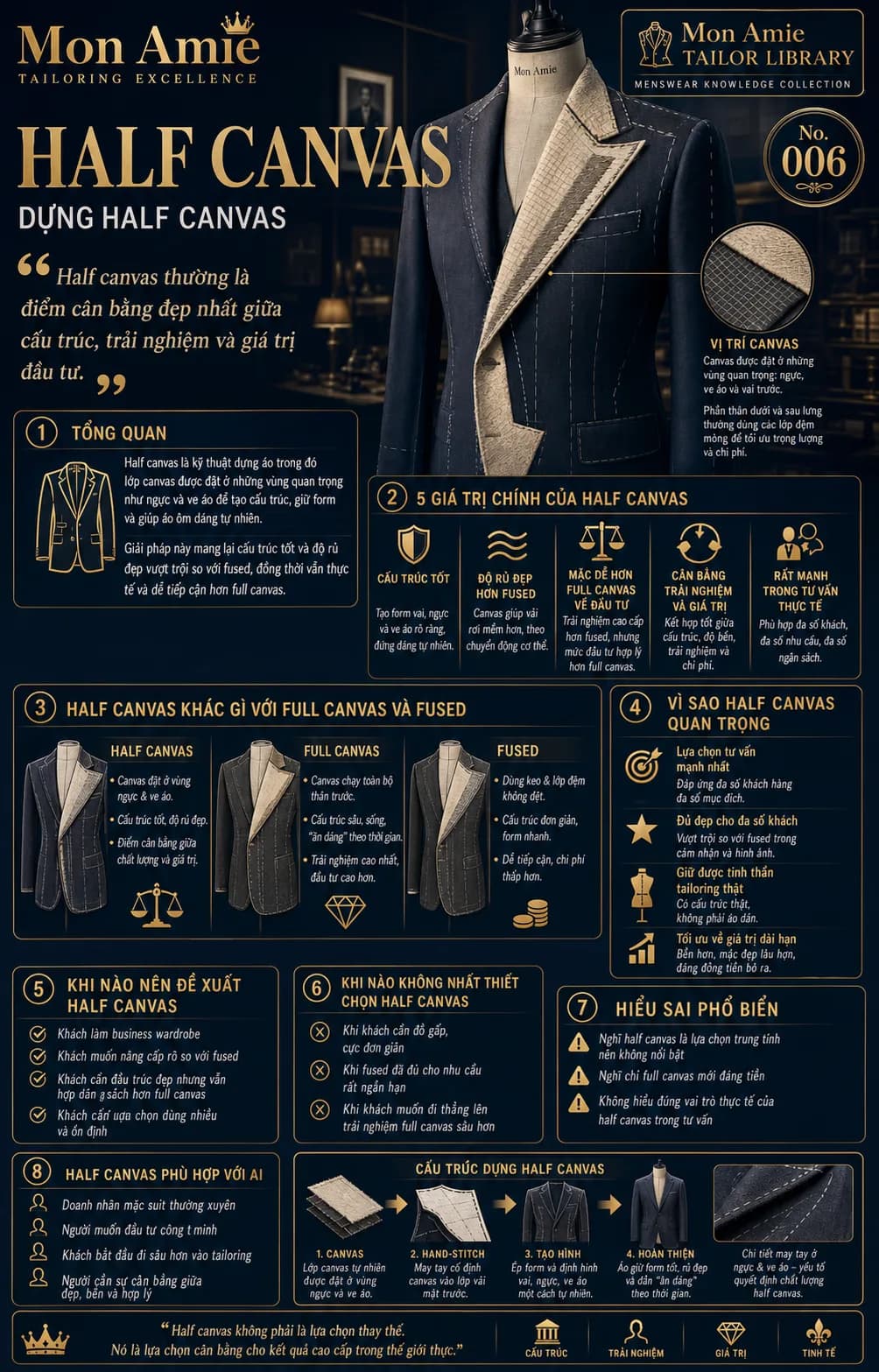
Half canvas is a jacket construction in which the canvas layer sits where it matters most — the chest, the lapel and the front shoulder — to create structure, hold shape and let the jacket follow the body naturally. For most made-to-measure clients, half canvas is the most attractive balance between structure, wearing experience and investment. That is why Mon Amie treats it as foundational knowledge for anyone entering the world of tailoring.
What half canvas is, and where the canvas sits
Inside a jacket, the "canvas" is the interlining that sits between the outer cloth and the lining, usually woven from natural fibres such as horsehair blended with wool. This layer determines much of the jacket's shape: how the chest stands, how the lapel rolls, how stable the shoulder feels.
With half canvas construction:
- The canvas is placed in the critical zones: chest, lapel and front shoulder — where clear structure matters most.
- The lower front and back use lighter interlinings to keep weight and cost sensible.
The result is markedly better structure and drape than a fused jacket, while remaining more practical and more accessible than full canvas.
Five core strengths of half canvas
Mon Amie's Tailor Library poster No. 6 sums up the value of half canvas in five points:
- Genuine structure: it shapes the shoulder, chest and lapel clearly, standing naturally rather than stiffly.
- Better drape than fused: canvas lets the cloth fall softly and move with the body, instead of lying flat like a glued panel.
- Easier to justify than full canvas: a clearly more refined experience than fused, at a more reasonable level of investment than full canvas.
- Balance of experience and value: a strong combination of structure, durability, feel on the body and cost.
- Exceptionally sound in real consultation: it suits most clients, most needs and most budgets.
How half canvas differs from full canvas and fused
The three most common constructions differ in how far the canvas travels — or whether there is any canvas at all:
- Half canvas: canvas at the chest and lapel; good structure, handsome drape; the balance point between quality and value.
- Full canvas: canvas running the full front of the jacket; deep, living structure that moulds to you with wear; the finest experience, at a higher investment.
- Fused: adhesive and non-woven interlining pressed onto the cloth; simple structure that takes shape quickly; accessible and affordable, but the cloth feels less alive and the adhesive can degrade after repeated cleaning.
Put simply, fused is the industrial choice, full canvas is the summit of tailoring, and half canvas stands in between — but it stands very firmly.
Why half canvas matters in made-to-measure
- The strongest recommendation: it answers most clients and most purposes.
- More than enough for most wearers: clearly superior to fused both in how it feels and how it looks.
- True to the spirit of tailoring: real structure built by a tailor's hands, not a glued shell.
- Optimal long-term value: more durable, better looking for longer, worth what you pay.
When to choose half canvas — and when it isn't essential
Consider half canvas when:
- You are building a business wardrobe and wear a suit regularly.
- You want a clear upgrade from the fused jackets you own now.
- You want handsome structure but are not ready for full canvas pricing.
- You need one suit that will be worn often and hold up over time.
Conversely, half canvas is not necessarily the answer when:
- You need a suit urgently for a very simple purpose — fused may be enough for a short-term need.
- You are already ready to go straight to the deeper full canvas experience.
Two misconceptions are worth clearing up: half canvas is not a "neutral choice that never stands out", and it is not true that "only full canvas is worth the money". In practice, half canvas plays a far larger role in tailoring than either idea allows.
How a half canvas jacket is built
Building half canvas in the workshop passes through four main stages:
- Canvas: the natural canvas layer is placed across the chest and lapel.
- Hand-stitching: the tailor secures the canvas to the front panel by hand, creating a soft, flexible bond.
- Shaping: the shoulder, chest and lapel are pressed and moulded into shape naturally.
- Finishing: the jacket holds its shape, drapes well, and gradually settles to your body with wear.
The hand-stitching at the chest and lapel is what truly decides the quality of a half canvas jacket — two garments sold under the same name can differ enormously at this stage.
A word from Mon Amie's artisans
When you compare two jackets, pinch the chest gently: a canvassed jacket feels like three separate layers, soft and springy, while a fused jacket feels flat and bonded, like a sheet of card. For a client commissioning his first suit for work, Mon Amie usually recommends half canvas — enough structure to hold its own in the boardroom, soft enough to wear all day without fatigue. Half canvas is not a substitute; it is the balanced route to a refined result in the real world.
If you would like to feel the difference between half canvas, full canvas and fused for yourself, the Mon Amie team at our five Ho Chi Minh City showrooms keeps samples on hand for direct comparison, with full made-to-measure suits from VND 4.8 million, an alteration warranty after delivery and measurements kept on file for life. You are welcome to book an appointment or read about the tailoring process first — hotline 0888.111.118.