
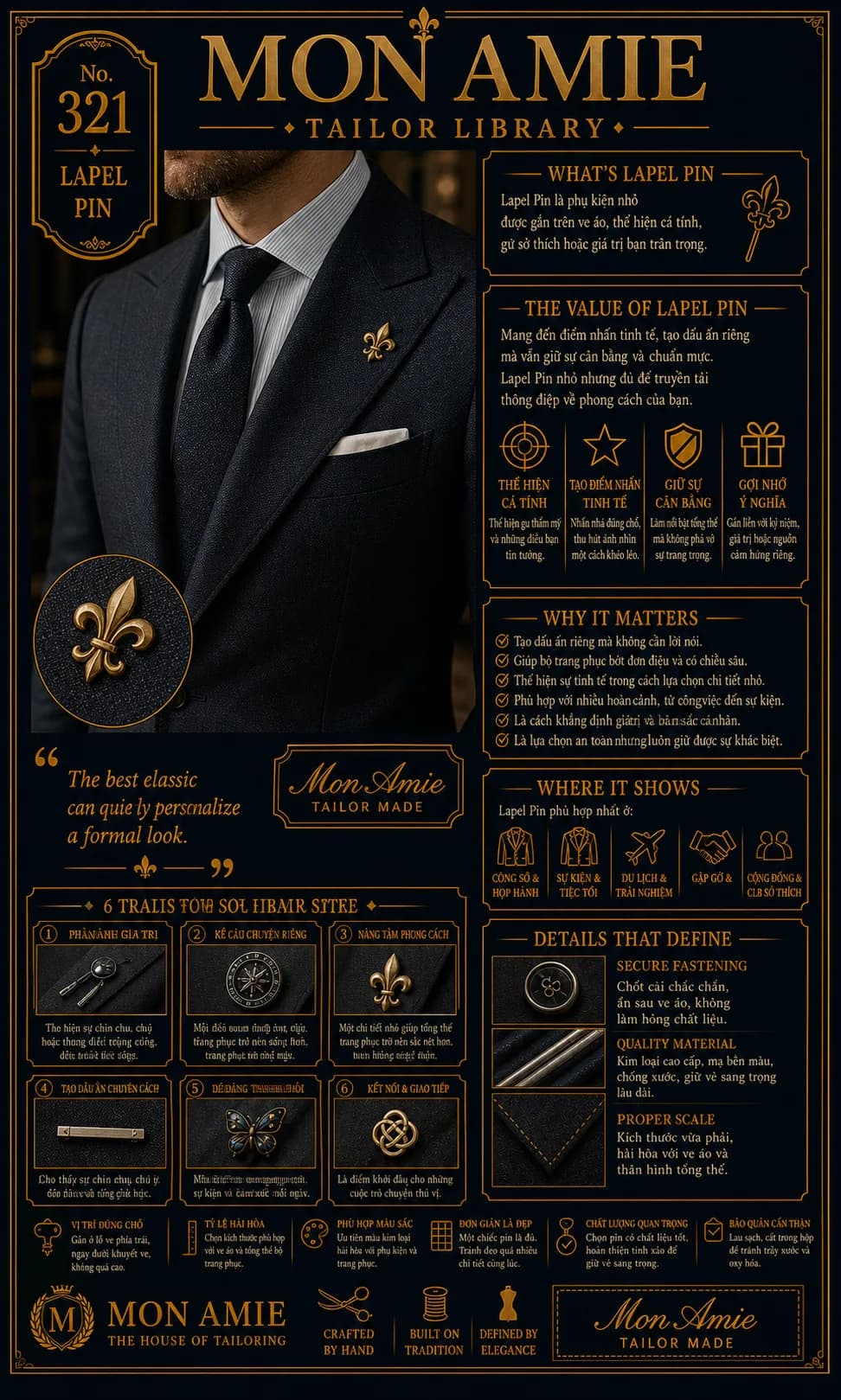
A lapel pin is a small ornament worn on the lapel of a jacket, expressing character, an interest or a value you hold dear. It is smaller than a button, yet it sits at eye level with the person in front of you, so it speaks far louder than its size suggests. This piece explains how to choose and wear one with restraint.
The value of a lapel pin
A lapel pin offers a refined accent and a personal mark while preserving balance and propriety. It is small, but enough to convey something of how you dress. Four points of value:
- Expressing character: it speaks of your eye and of what you believe in.
- A refined accent: placed well, it draws the gaze with tact.
- Keeping balance: it lifts the whole without disturbing the formality.
- Carrying meaning: it may be tied to a memory, a value or a private source of inspiration.
Six reasons to own a lapel pin
- It reflects your values: it shows care, intention and the things you hold in regard.
- It tells your own story: each design carries a meaning that brings an outfit to life.
- It raises the level: a small detail that sharpens the whole.
- It signals professionalism: evidence of care and attention to every detail.
- It is easily changed: change the pin and you change the spirit of the outfit, to suit the occasion and the mood of the day.
- It opens conversation: often the starting point for an interesting exchange.
Wearing a lapel pin properly
The poster sets out the practical rules, and this is where most men go wrong:
- The right position: on the left lapel, just below the buttonhole, never too high.
- The right proportion: choose a size in keeping with the lapel and the outfit as a whole. A narrow lapel calls for a correspondingly small pin.
- The right colour: favour a metal that harmonises with your other accessories, and avoid mixing gold with silver in the same outfit.
- Simplicity is beauty: one pin is enough; never wear several details at once.
- Quality matters: choose good material and fine finishing to preserve a sense of refinement.
- Store it carefully: wipe it clean and keep it in a case, away from scratches and oxidation.
A small note: if you are wearing a fresh boutonnière at a wedding, you do not need a lapel pin as well. The two occupy the same place and serve the same purpose.
How to recognise a good lapel pin
- Secure fastening: a firm clasp that hides behind the lapel and does not damage the cloth.
- Quality material: fine metal, durable plating, resistant to scratching and lasting in its refinement.
- Proper scale: a moderate size, in keeping with the lapel and with your build.
The occasions that suit a lapel pin best
The poster names five settings: the office and meetings, events and dinners, travel and new experiences, introductions, and communities or clubs. These are all occasions on which you wish to be remembered, and one deliberate small detail is usually far more effective than an outfit straining for attention.
A word from Mon Amie's artisans
When we make a jacket, Mon Amie always works the lapel buttonhole by hand whether or not you intend to use it, because it is a classic detail and it is where a lapel pin belongs. We recommend a butterfly clutch or a padded swivel back, and advise against the plain piercing pin, which leaves a permanent hole in fine worsted cloth.
If you would like a jacket whose lapel and buttonhole are made properly, so that an accessory sits exactly where it should, please book an appointment at one of Mon Amie's five showrooms in Ho Chi Minh City, or call 0888.111.118. You may also read about the tailoring process to see which handwork goes into each garment.