
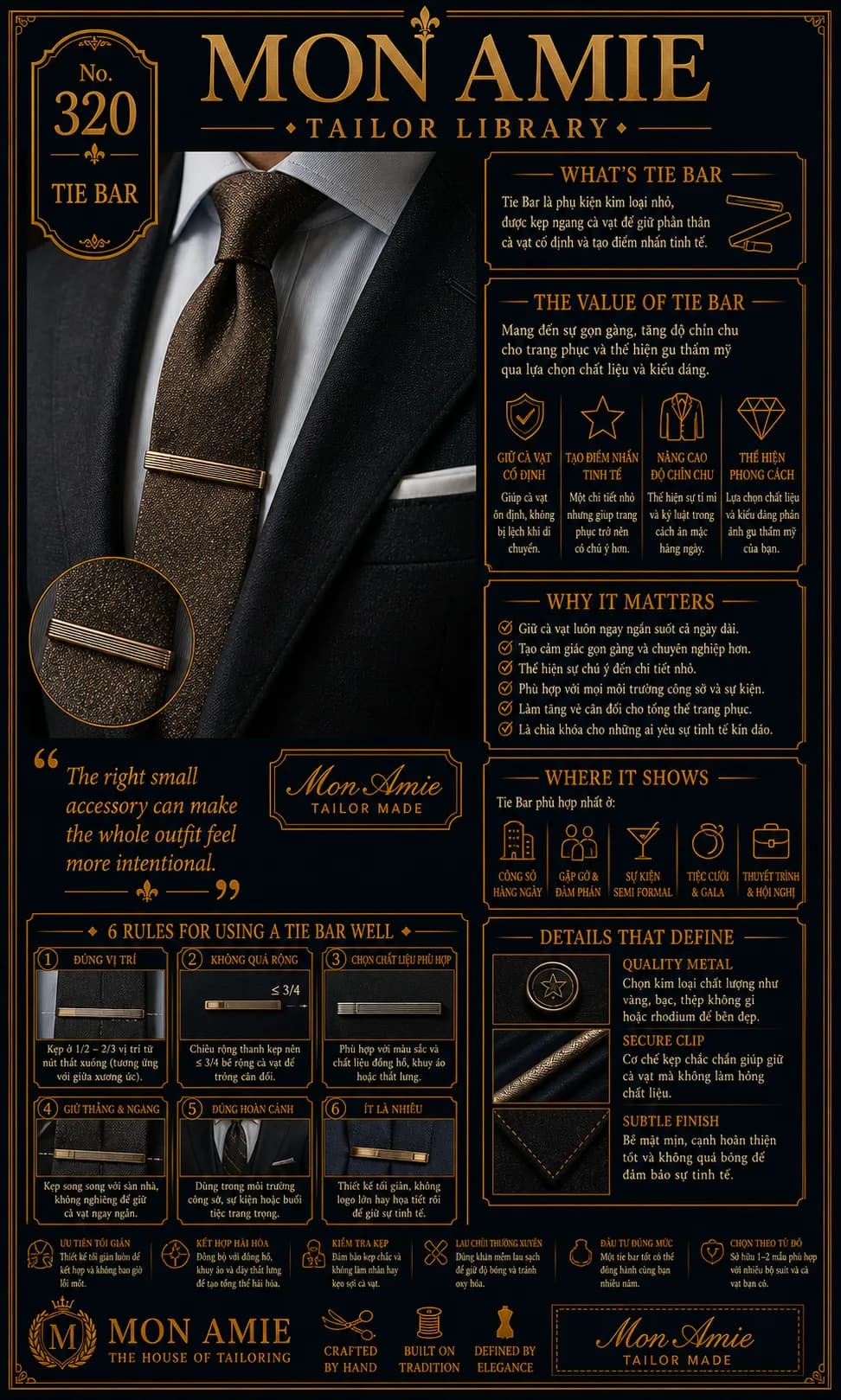
A tie bar is a small metal clip worn across the tie to hold the blade in place and add a quiet accent. It is small enough that many men overlook it, yet it is the detail that makes an outfit look deliberate. This piece sets out its value, the six rules for wearing one properly, and how to recognise a good clip.
The value of a tie bar
A tie bar keeps things tidy, raises the level of polish and reveals taste through the choice of material and shape. Four points of value:
- Holding the tie in place: the tie stays where it should, never swinging out of line as you move.
- A refined accent: a small detail that makes an outfit look intentional.
- Greater polish: it shows care and discipline in the way you dress each day.
- Expressing style: the material and shape you choose reflect your own eye.
Six rules for wearing a tie bar
- The right position: place it between one half and two thirds of the way down from the knot, roughly at the middle of the breastbone.
- Never too wide: the bar should be no more than three quarters the width of the tie to look balanced.
- The right material: it should sit well with the colour and finish of your watch, buttons or belt.
- Straight and level: clip it parallel to the floor, never at an angle, so the tie hangs true.
- The right setting: for the office, for events and for formal occasions.
- Less is more: choose a minimal design, without large logos or busy patterns.
One important technical point: the tie bar must clip through both the tie and the shirt placket. Clipped to the tie alone, it loses its function entirely and becomes a piece of decoration hanging in mid-air.
How to recognise a good tie bar
- Quality metal: gold, silver, stainless steel or rhodium for lasting good looks.
- Secure clip: a mechanism that grips firmly without damaging the fabric, which matters especially with woven silk ties.
- Subtle finish: a smooth surface, well-dressed edges and no excessive shine.
When a tie bar earns its place
The poster names five settings: the daily office, meetings and negotiations, semi-formal events, weddings and galas, presentations and conferences. What they share is that you are standing, moving and shaking hands, which is exactly when a tie is most likely to swing out of line.
A few habits worth keeping:
- Favour the minimal: a plain design always combines easily and never dates.
- Coordinate quietly: match it with your watch, buttons and belt for a unified whole.
- Check the grip: make sure it holds firmly without creasing the tie or pulling its threads.
- Clean it regularly: a soft cloth preserves the shine and prevents oxidation.
- Invest sensibly: a good tie bar will serve you for many years.
- Choose for your wardrobe: one or two pieces that suit most of the suits and ties you own.
A further note: with black tie, a bow tie takes no tie bar. And if you keep your jacket buttoned, the clip will spend most of its time hidden behind the lapels. That is perfectly normal, since its chief purpose is to keep the tie neat when you take the jacket off.
A word from Mon Amie's artisans
At Mon Amie we usually discuss the tie bar at the same moment as the width of the tie, because the two depend on each other. A tie of 7 centimetres calls for a bar of roughly 4.5 to 5 centimetres. For clients who travel often, a plain stainless steel clip is a modest investment that will last a decade.
If you would like advice in person on ties, accessories and the suit that goes with them, please book an appointment at one of Mon Amie's five showrooms in Ho Chi Minh City, or call 0888.111.118. You may also consult our pricing to plan your budget.