
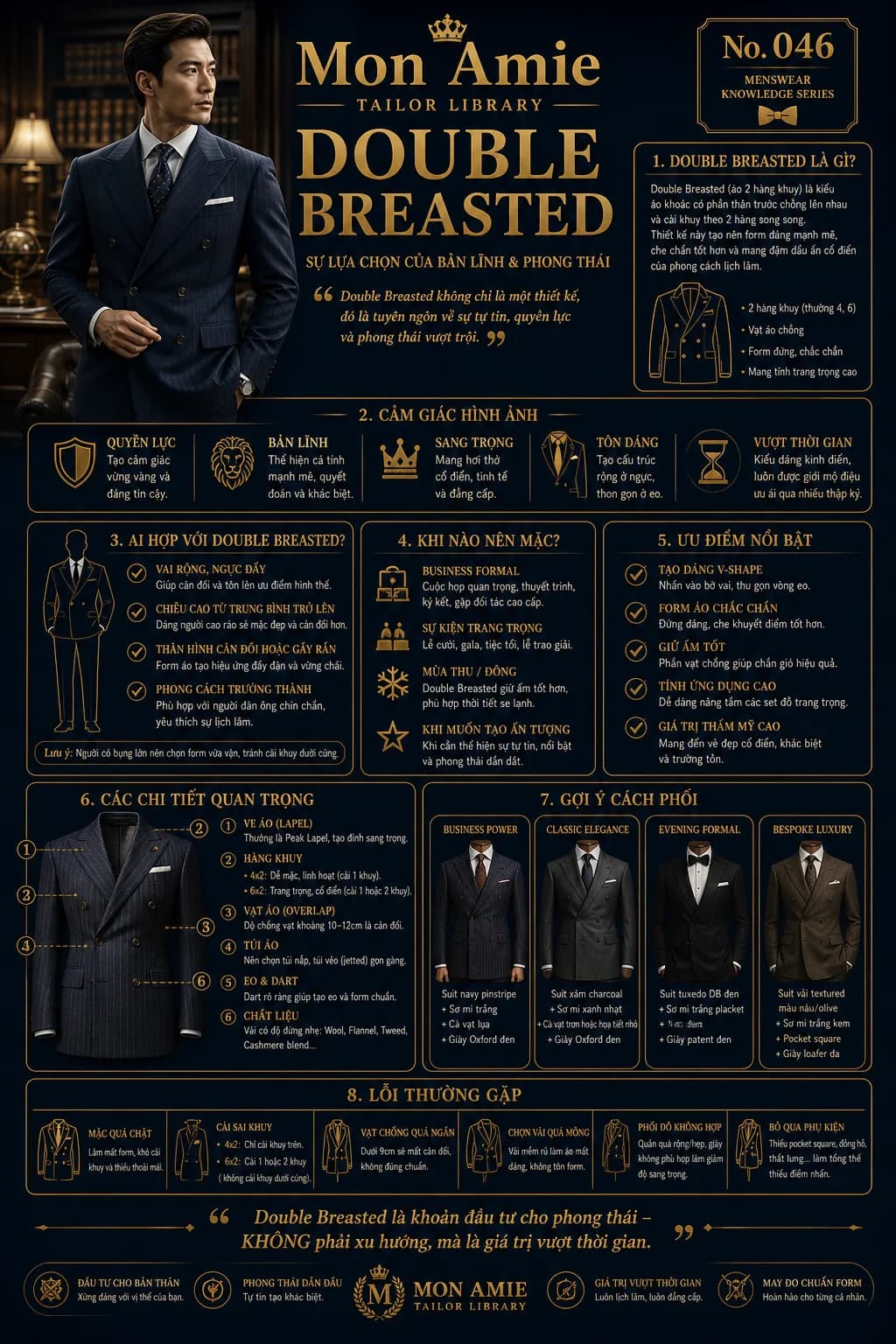
What is a double breasted suit? It is a jacket whose front panels overlap and fasten along two parallel rows of buttons — usually four or six. The construction creates a strong silhouette, better coverage, and carries the unmistakable signature of classic elegance. At Mon Amie, double breasted is more than a cut: it is a statement of confidence, authority and presence.
What a double breasted jacket is, and why it reads as presence
Unlike the familiar single breasted jacket, a double breasted front overlaps by roughly 10–12cm and fastens along two symmetrical rows of buttons. That construction gives it four defining traits:
- Two rows of buttons, typically four or six.
- An overlapping front panel that closes the chest completely.
- A structured shape that holds its line even in movement.
- A markedly higher degree of formality than a standard single breasted suit.
Visually, a double breasted jacket communicates five things clearly: authority — steady and dependable; presence — decisive, with strong character; refinement — a classic, considered air; flattery — broad through the chest, tapered at the waist; and permanence — a shape connoisseurs have favoured for decades.
Who wears double breasted best
Not every build draws out the full beauty of two rows of buttons. Our fitting room experience points to four profiles:
- Broad shoulders, a full chest: the overlapping front sits in balance and enhances what is already there.
- Average height and above: a longer frame keeps the button rows and lapels in proportion.
- A balanced or lean, firm build: the cut adds fullness and solidity.
- A mature sense of style: it suits the settled man who enjoys understated elegance.
One important note: if you carry weight around the middle, choose a close fit and never fasten the lowest button — a heavy overlap can otherwise make the waist look weightier.
When to wear a double breasted jacket
The cut shows its strengths in four settings:
- Business formal: important meetings, presentations, contract signings, senior partner introductions.
- Formal occasions: weddings, galas, dinners, award ceremonies.
- Autumn and winter: the overlapping front holds warmth well and suits cooler weather.
- When you want to make an impression: occasions that call for confidence, visibility and a leading presence.
Its clearest advantages: it builds a V-shape by emphasising the shoulders and drawing in the waist; its structure holds the posture and conceals minor flaws; the overlap blocks wind and retains warmth; it lifts formal outfits with little effort; and its aesthetic is classic, distinctive and enduring.
The details that matter in a double breasted commission
A fine double breasted jacket depends on six details:
- Lapel: usually a peak lapel — pointing upward, creating a refined apex and lengthening the torso.
- Button configuration: a 4x2 is easier to wear and more flexible (fasten one button); a 6x2 is more formal and classic (fasten one or two).
- Overlap: around 10–12cm keeps the front in proportion.
- Pockets: flap pockets or clean jetted pockets are the right choices.
- Waist and darts: well-placed darts create the waistline and hold the shape.
- Cloth: favour fabrics with gentle body — wool, flannel, tweed or a cashmere blend.
How to wear it, and the mistakes to avoid
Four proven combinations: Business Power — navy pinstripe suit, white shirt, silk tie, black Oxfords; Classic Elegance — charcoal suit, pale blue shirt, plain or small-patterned tie, black Oxfords; Evening Formal — black double breasted tuxedo, white placket shirt, black bow tie, patent shoes; Bespoke Luxury — textured suit in brown or olive, cream-white shirt, pocket square, leather loafers.
Six mistakes to avoid:
- Wearing it too tight — the shape collapses, the buttons strain, comfort disappears.
- Fastening the wrong buttons — on a 4x2 fasten only the upper button; on a 6x2 fasten one or two, and never the lowest.
- Too little overlap — under 9cm looks unbalanced and off-standard.
- Cloth that is too light — soft, draping fabric loses the shape entirely.
- Poor coordination — trousers that are too wide or too narrow, or the wrong shoes, cost you the elegance.
- Skipping accessories — without a pocket square, watch or belt, the whole loses its focal points.
A word from Mon Amie's artisans
With a double breasted jacket, precise fit matters more than with any other cut — half a size too generous and the overlap shifts, taking the entire character with it. Mon Amie suggests starting with a 6x2 configuration, peak lapels and a wool with body: it is the safest formula for a first double breasted jacket to deliver its full V-shape. Once you are comfortable, try a 4x2 in flannel for something more relaxed. Every commission at Mon Amie keeps your measurements on record for life and includes post-delivery alterations, so you can refine the fit until it is exactly right.
A double breasted jacket is an investment in bearing — not a trend, but lasting value. If you would like one cut properly to your frame, we invite you to book an appointment at one of Mon Amie's five showrooms in Ho Chi Minh City, or read about the tailoring process first — our hotline 0888.111.118 is always open.