
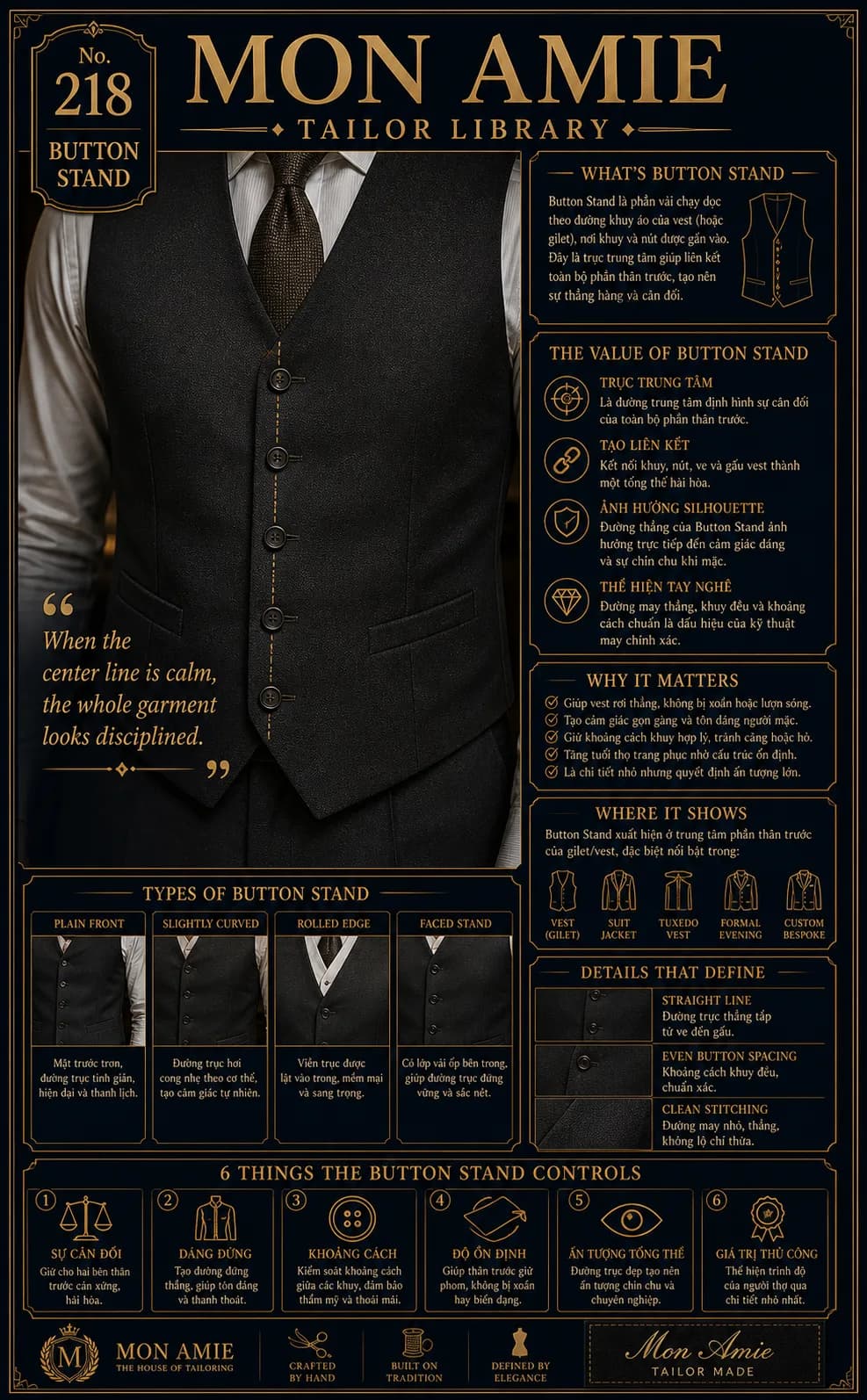
The button stand is the strip of cloth running along the buttoning edge of a jacket or waistcoat, where the buttons and buttonholes are set. It is the central axis that ties the whole forepart together, giving the garment its alignment and balance. It may sound like nothing more than a strip of cloth, yet the button stand is the visual backbone of a waistcoat — when that axis wanders, the entire outfit loses its discipline. Mon Amie invites you to understand why the detail matters and how to recognise one that has been properly made.
The value of the button stand
Four core roles explain why artisans give the button stand such attention.
- The central axis. The button stand is the centre line that governs balance across the whole forepart — every other line anchors to it.
- Bringing things together. It connects buttons, buttonholes, lapels and hem into a coherent whole rather than a set of loose details.
- Shaping the silhouette. The straightness of the button stand bears directly on how the garment reads and how composed it feels to wear.
- Evidence of skill. Straight seams, even buttons and correct spacing are the marks of precise construction.
There is an observation in the trade that holds true: when the centre line is quiet, the whole garment looks disciplined. The eye always seeks the centre first.
Why the button stand matters
- It lets the garment hang straight, without twisting or rippling along the buttons.
- It creates a trim look that flatters the wearer.
- It keeps button spacing sensible, avoiding pulling or gaping between buttons.
- It extends the life of the garment through stable construction — the button area takes the most strain every time you fasten and unfasten.
- It is a small detail that decides a large impression.
The button stand sits at the centre of the forepart on waistcoats and jackets, and is especially prominent on the three-piece waistcoat, the suit jacket, the tuxedo waistcoat, formal evening dress and bespoke commissions.
The main types of button stand
- Plain front. A plain face and a clean centre line, modern and elegant — the safe choice for a business waistcoat.
- Slightly curved. A centre line that follows the body with a gentle curve, natural and close without constraint.
- Rolled edge. The edge of the stand turned inward, soft and refined, often seen on handmade garments.
- Faced stand. A facing inside for reinforcement, keeping the line firm and sharp — suited to light cloth that needs more backbone.
The details that define quality
Three points by which to judge the button stand of a waistcoat.
- A straight line. The stand runs true from lapel to hem, without kinks and without drifting off centre.
- Even button spacing. Buttons set at equal, exact intervals — the eye catches a discrepancy of even a few millimetres.
- Clean stitching. Fine, straight seams with no stray thread around the buttons or along the edge of the stand.
Six things the button stand decides
- Balance. It keeps the two halves of the forepart symmetrical and harmonious about the centre.
- Posture. It creates a true vertical line that flatters the figure and lends the body an easy elegance.
- Spacing. It governs the distance between buttons, ensuring both good looks and comfort when you sit, stand and move.
- Stability. It helps the forepart hold its shape, resisting twisting and distortion over years of wear.
- Overall impression. A well-made centre line gives an impression of polish and professionalism at first glance.
- The worth of handwork. It reveals the tailor's level through the smallest detail — the place where technique cannot hide.
A word from Mon Amie's artisans
At a fitting, Mon Amie's artisans look at the button stand first: if the line lies still and straight and does not pull open when you fasten every button, then the chest and waist measurements and the front drape are correct. If the stand "smiles" — flaring open around the buttons — the garment is too close and needs adjusting, and Mon Amie's alteration guarantee is there so that the line returns to its proper stillness. Your measurements are kept for life, which is why the second waistcoat is always better than the first.
If you would like to see what a disciplined button stand feels like to wear, book an appointment with Mon Amie at one of our five showrooms in Ho Chi Minh City (Nguyen Trai, Ho Van Hue, 3/2 Street, Caravelle Hotel District 1, Nguyen Thi Thap) or call 0888.111.118. You may also read about the tailoring process to see how we build that centre line.