
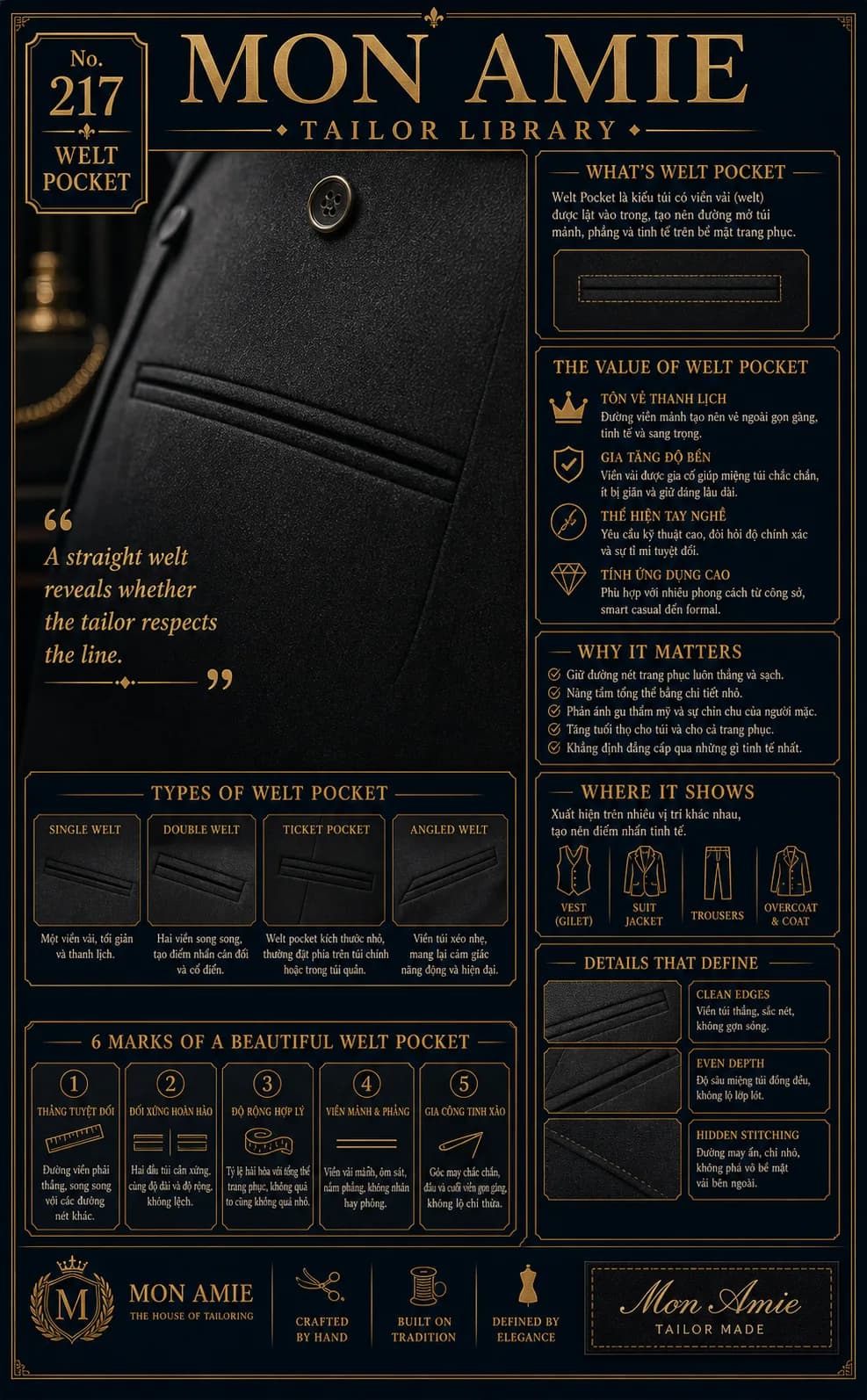
A welt pocket is a pocket whose fabric edging, the welt, is turned inward to create a slim, flat, understated opening on the surface of the garment. Unlike a flap or patch pocket, a welt pocket all but dissolves into the body of the garment, leaving only one or two fine lines behind — which is why it is considered the most refined pocket in tailoring. Mon Amie invites you to explore its value, its common variations and how to recognise one that has been beautifully made.
The value of a welt pocket
Four reasons the welt pocket is favoured on fine clothing.
- Elegance. The slim edge creates a neat, refined, luxurious look without breaking the flat run of the body.
- Durability. The reinforced welt keeps the pocket mouth firm, resistant to stretching and stable over years of use.
- Evidence of skill. A welt pocket demands high technique, precision and absolute patience — a single millimetre out of true shows instantly on flat cloth.
- Versatility. It works across styles, from business dress to smart casual to formal wear.
There is a saying in the trade: a straight welt tells you whether the tailor respects a line. That is why the welt pocket has always been the test of a workshop's skill.
Why the welt pocket matters
- It keeps the lines of the garment straight and clean.
- It lifts the whole through a small detail — the thing that separates a tailored suit from a ready-made one.
- It reflects the taste and the standards of the wearer.
- It extends the life of both the pocket and the garment.
- It states quality through the most understated means.
As for placement, the welt pocket appears on many parts of a garment: the chest and body pockets of a waistcoat, the breast pocket of a suit jacket, the rear pockets of trousers and the pockets of an overcoat — each a quiet point of refinement.
The main welt pocket variations
- Single welt. A single edging, minimal and elegant — usually seen on the breast pocket of a jacket, where the pocket square sits, and on waistcoat pockets.
- Double welt. Two parallel welts framing the pocket mouth, balanced and classical; also called a jetted or besom pocket, and standard on a tuxedo.
- Ticket pocket. A small welt pocket, usually set above the main pocket or inside a trouser pocket — a legacy of the days when a gentleman needed somewhere for his train ticket.
- Angled welt. A gently slanted welt that reads as energetic and modern, familiar on younger-cut waistcoats and jackets.
The details that define quality
Examining a welt pocket, an artisan judges three things.
- Clean edges. The welt runs straight and sharp, with no rippling along the length of the opening.
- Even depth. The pocket mouth holds the same depth from end to end, never revealing the lining within.
- Hidden stitching. Concealed stitching in fine thread that does not disturb the outer surface — from the outside you see cloth, not technique.
Six marks of a fine welt pocket
- Absolutely straight. The welt must run true and parallel to the other lines of the garment.
- Perfectly symmetrical. Both ends of equal length and width, with no drift — and the pockets on either side must mirror one another.
- Well-judged width. In proportion to the garment as a whole, neither too large nor too small.
- Slim and flat. The welt sits slim, close and flat, with no puckering or bulging.
- Fine execution. Firm corners, tidy ends to the welt, no stray thread showing.
- At one with the whole. The finest pocket is the one nobody notices — the eye registers only a clean, disciplined body.
A word from Mon Amie's artisans
In Mon Amie's workshop, the welt pocket is the stage where "near enough" has no place: the cloth is aligned on the grain before the opening is cut, and the welts are pressed and basted by hand so the two edges close like a single ruled line. On stripes and checks, our artisans must also match the pattern of the welt to the body — something only handwork can carry through completely. Every finished welt pocket carries the same alteration guarantee as every other detail of the suit.
If you would like to see a properly made welt in Canonico or Holland & Sherry cloth, book an appointment at one of Mon Amie's five showrooms in Ho Chi Minh City (Nguyen Trai, Ho Van Hue, 3/2 Street, Caravelle Hotel District 1, Nguyen Thi Thap) or call 0888.111.118. Read more about the tailoring process to see whose hands that pocket passes through before it reaches you.