
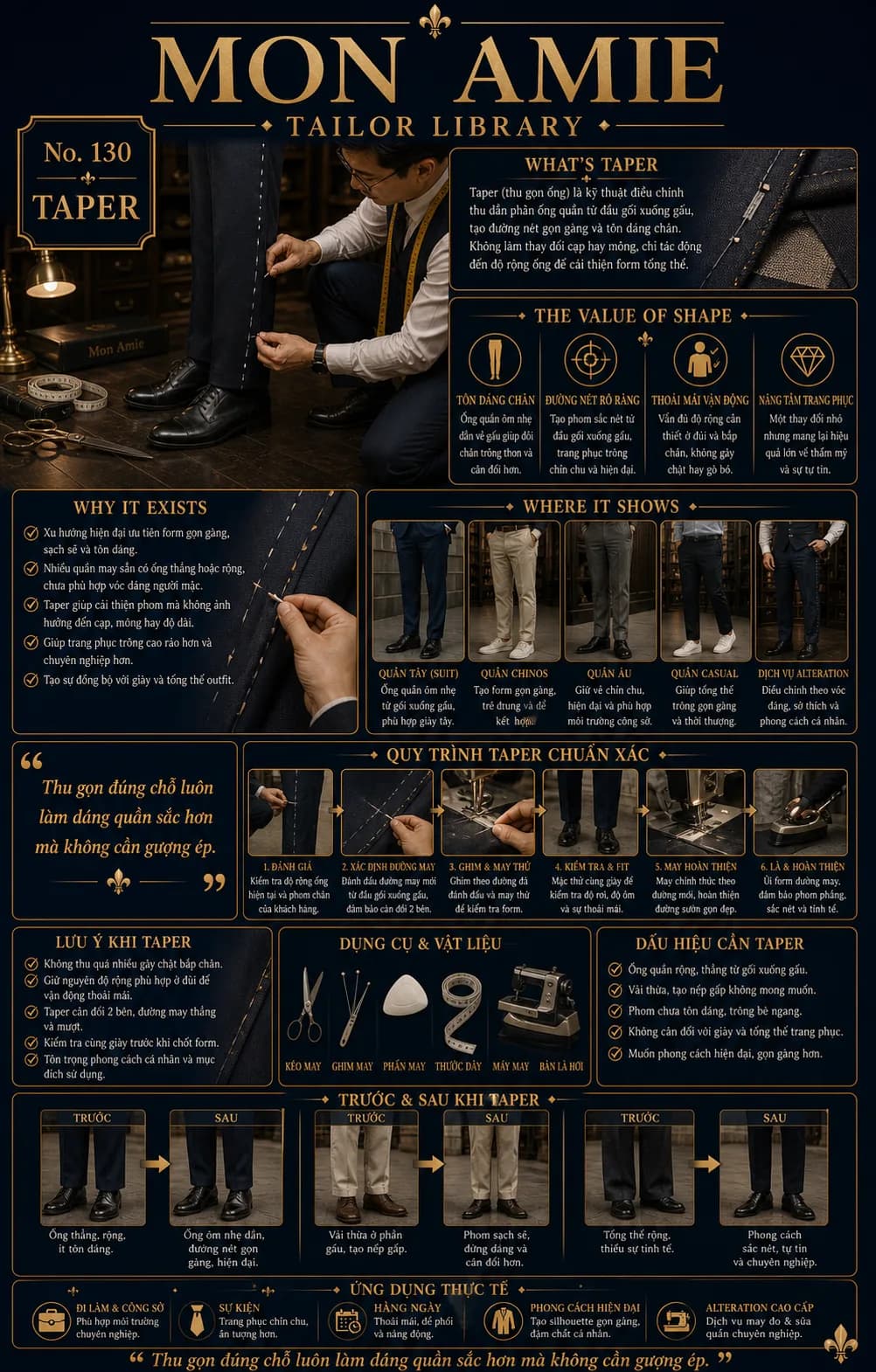
What is tapering? It is the technique of narrowing the trouser leg gradually from the knee down to the hem, creating a cleaner line that flatters the leg. The key point to grasp: tapering leaves the waistband and seat untouched, altering only the width of the leg to improve the overall shape — which makes it one of the safest and most effective alterations in tailoring.
The value of a well-shaped leg
A small change to the leg brings a large return in appearance and confidence. Tapering delivers four things:
- A flattering leg line: a leg that narrows gently towards the hem makes the leg look longer and better proportioned.
- A defined line: a crisp shape from knee to hem, so the trousers read considered and contemporary.
- Freedom of movement: done properly, tapering retains the width needed through thigh and calf, with no tightness or restriction.
- A better garment: the same pair of trousers, differing only in leg width, can make an entirely different impression.
Why tapering has become necessary
Modern taste favours a trim, clean, flattering shape. Yet many ready-made trousers are cut straight or full through the leg, at odds with the wearer's build — particularly for Vietnamese men, who are often shorter than a maker's standard measurements. Tapering addresses exactly that: it improves the shape without affecting the waistband, seat or length. The result is a taller, more professional line that sits properly with the shoes and the rest of the outfit.
Which trousers to taper
The technique suits nearly every kind of trouser in your wardrobe:
- Suit trousers: a gentle taper from knee to hem, sitting well over dress shoes — by far the most common case.
- Chinos: a neater, younger shape that is easy to combine.
- Business trousers: polished and current, well suited to the office.
- Casual trousers: a tidier, more contemporary overall look.
- Alteration work: shaped to each man's build, preference and personal style.
The tapering process, in six steps
A taper looks simple but demands precision at every stage:
- Assess: measure the current leg width and study the client's leg shape.
- Mark the new seam: chalk the new line from knee to hem, keeping both legs symmetrical.
- Pin and baste: pin along the marked line and baste it to check the shape.
- Fit: try the trousers with shoes on to judge drape, closeness and comfort.
- Final stitching: stitch the new seam and finish the inseam and side seam cleanly.
- Press and finish: press the seams so the shape reads flat, crisp and refined.
The tools are unremarkable — shears, pins, tailor's chalk, tape measure, machine and steam iron — but it is the tailor's hand that decides whether the side seam runs straight and smooth.
Signs your trousers need tapering, and the limits to respect
Consider tapering when: the leg runs wide and straight from knee to hem; surplus cloth folds unattractively at the hem; the shape does not flatter and reads broad; the trousers sit awkwardly with your shoes and the rest of the outfit; or you simply want a more modern, trimmer line.
Equally, there are principles a good tailor never abandons:
- Do not narrow so far that the calf is constricted.
- Retain enough width through the thigh for comfortable movement.
- Taper symmetrically, with a straight, smooth seam.
- Always check the result with shoes on before finishing.
- Respect the wearer's personal style and how the trousers will be worn.
A word from Mon Amie's artisans
At Mon Amie we often tell clients that narrowing in the right place sharpens a trouser line without forcing it. A good taper is one no observer notices — they simply see that the trousers fit you well. That is why every leg adjustment in our workroom is fitted with shoes on and studied for drape before the final stitching, in keeping with the alteration guarantee Mon Amie extends to every garment.
If your suit trousers, chinos or whole suit run wide through the leg and fail to flatter, visit one of Mon Amie's five showrooms in Ho Chi Minh City (Nguyen Trai, Ho Van Hue, 3/2 Street, Caravelle Hotel District 1, Nguyen Thi Thap) or call 0888.111.118. You are welcome to book an appointment for an assessment in person, and to read more about the tailoring process at Mon Amie.