
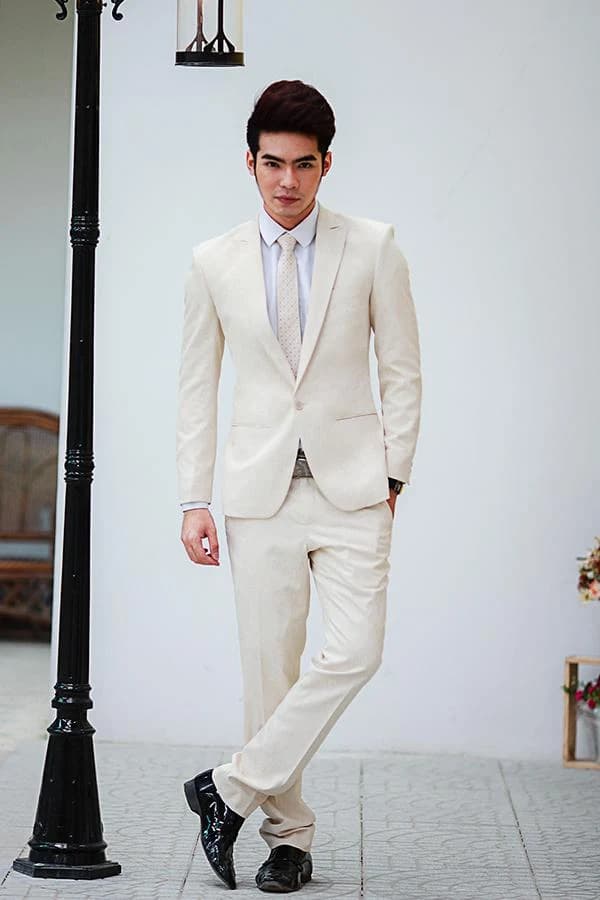
Wedding photos get looked at again for decades. What makes people pause when they flip through the album is usually not the bouquet or the backdrop, but a small detail on the groom: sleeves swallowing the hands, a button fastened in the wrong place, a suit color that soaks up all the light. These are the wedding suit mistakes that nobody notices in real life, but the camera sees everything. All seven below are avoidable if you know about them in advance.
Quick answer
Seven wedding suit mistakes: choosing a color from photos online, a shiny suit for a daytime ceremony, a tight fit without testing movement, sleeves and trouser hems at mismatched lengths, accessories in too many colors, buttoning wrongly, and letting the groom blend into the groomsmen.
1. Choosing the color from online photos, not from the light of the wedding
The color on a screen depends on how the image is color-balanced and on phone brightness, whereas a wedding has real light. An ivory suit like the Bạch Ngọc wedding suit feels light and clear; but under the yellow lights of a banquet hall, this tone tends to photograph with a color cast, and in harsh outdoor sun it tends to blow out. Deep navy, or a navy leaning toward cobalt, holds depth better in a hall, while pure black looks very elegant in the evening but swallows all the lines if photographed in the sun. The safe way is to look at fabric samples in the same kind of light as the wedding venue, then take a test photo with your phone before deciding.
2. Wearing a shiny suit with satin lapels for a daytime ceremony
Silk-sheen fabric and satin lapels come into their own under evening party lights: the gloss catches the light moderately, creating depth on a black ground. At a morning ancestral altar ceremony or a lunchtime garden party, the same surface reflects sun and flash, making the body of the jacket wash out white and the lapel line lose definition. By convention, a tuxedo is evening wear; in the daytime, a plain matte wool suit is still formal yet cleaner to the eye. If you hold the ceremony in two sessions, choose the suit for the session with the more important photos, or consider two suits, one for the daytime and one for the evening party.
3. Choosing the tightest fit without testing movement
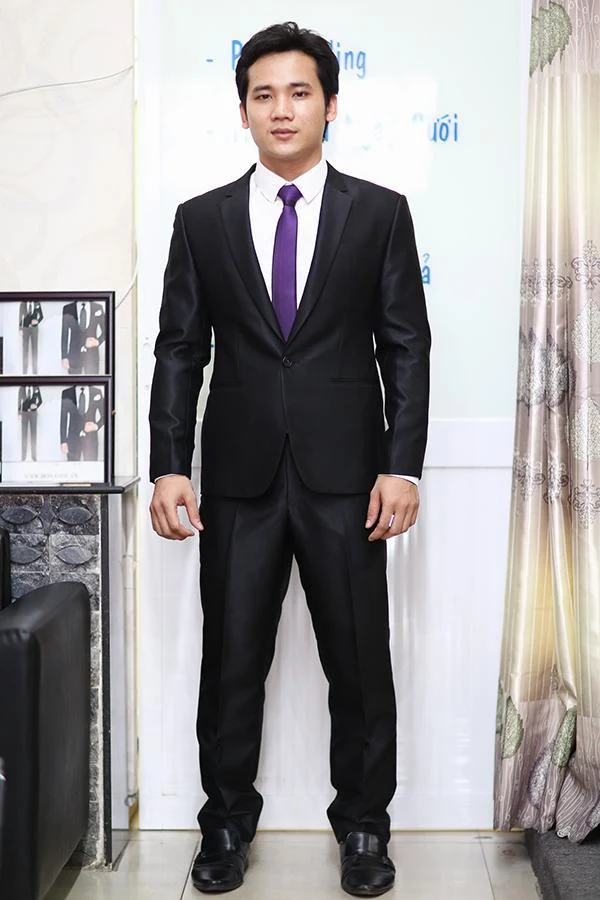
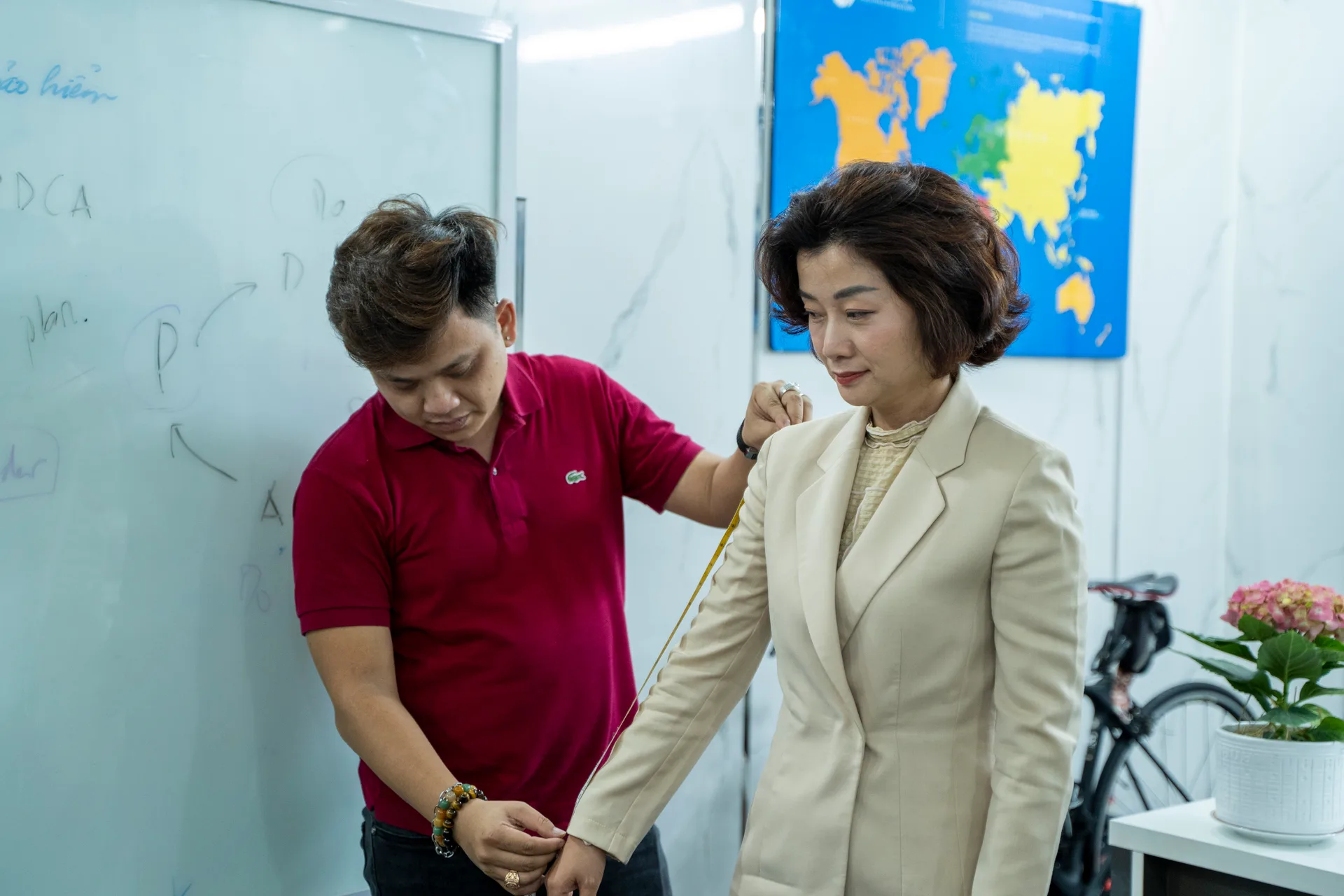
On the wedding day, the groom bows before the ancestors, raises a hand to lift a glass, embraces the bride, and sits down and stands up dozens of times. A suit that only fits when standing straight in front of a mirror shows immediately: diagonal creases pulling from the button, armholes tightening, the collar lifting away from the shirt collar. At the baste fitting, do all those movements right there in the showroom. Many grooms' weights change in the last few weeks, so tell the stylist and set aside a final fitting close to the wedding date. With the Groom Styling service, the fitting schedule is counted back from the wedding date so there is still time to adjust.
4. Sleeve and trouser lengths that don't match
A jacket sleeve should show about one to one and a half centimetres of shirt cuff when hanging straight, and the trouser hem should rest lightly on the top of the shoe, breaking with only one small crease. Wedding photos are often shot from a low angle or when you raise your hand holding flowers, so sleeves swallowing the hand or trouser hems stacking creases on the shoe show up very clearly. The error usually comes from being measured with different shoes or a different shirt. Bring the exact shoes and shirt you will wear on the wedding day to the fitting. If you need shoes, Mon Amie has dress shoe rental to go with the suit, with the price quoted by model when you get in touch.
5. Accessories in too many colors
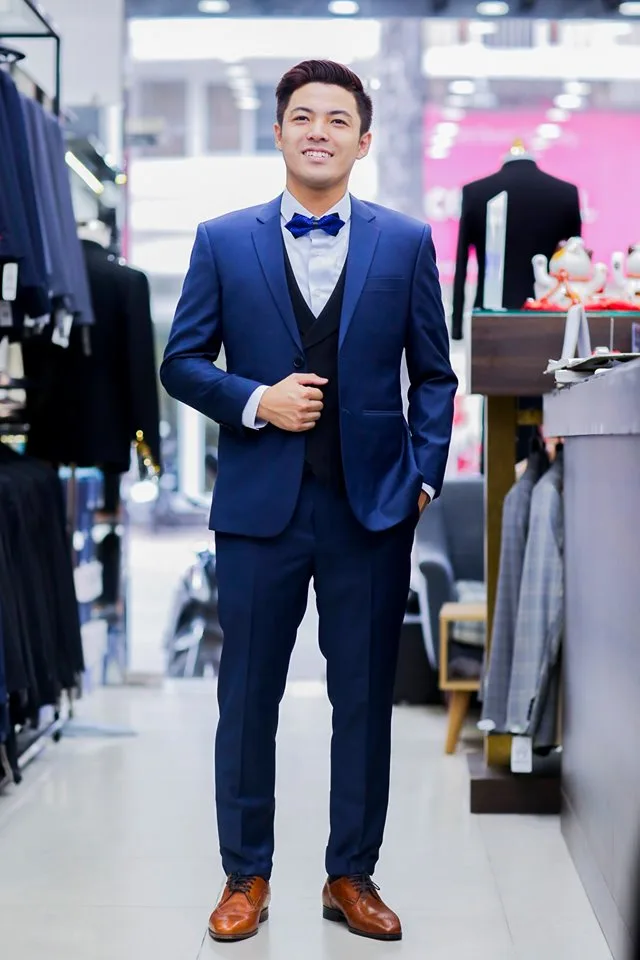
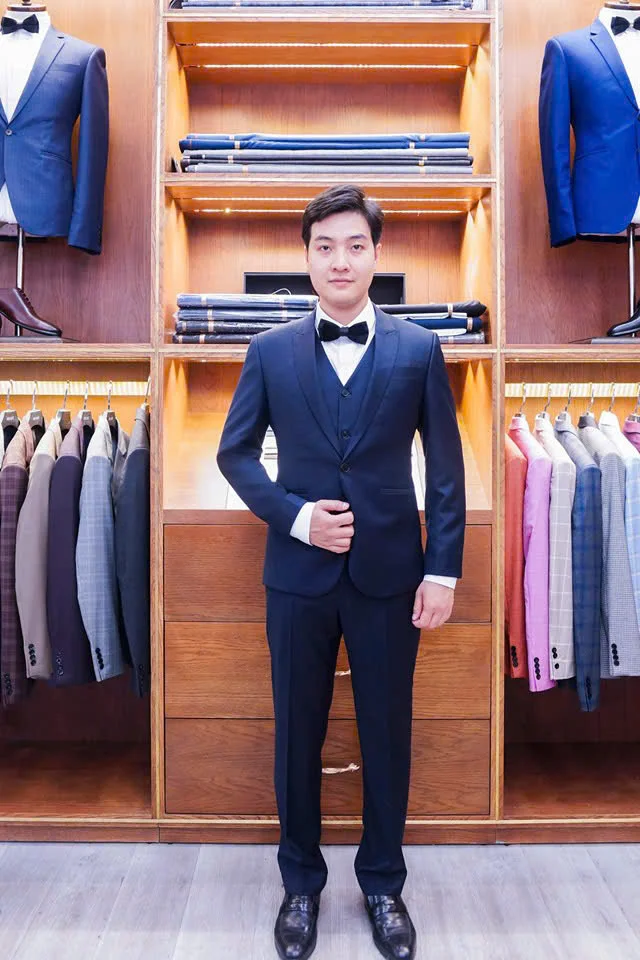
A tie or bow tie, a pocket square, a waistcoat, a boutonniere, cufflinks: one color for each and you've turned the groom into a Christmas tree. An easy rule to follow is to stay within two to three colors, and to remember that a bow tie and a tie are not worn together. The pocket square doesn't need to match the tie exactly; it only needs to be in the same tone or one deliberate shade off. The royal-blue suit with a black waistcoat and a blue bow tie, as in the photo, is a neat example: three colors, a clear theme, and no item competing with another.
6. Buttoning wrongly and not changing posture between sitting and standing
Two-button suit: fasten the top button and leave the bottom one open. Three-button suit: fasten the middle button, the top one optional, and the bottom one open. The same goes for the waistcoat: the last button is left undone. When you sit down at the banquet table, unbutton the jacket so the body isn't pulled; when you stand up, fasten it again before the photos. Fastening every button, the bottom one included, pulls the body of the jacket into an X shape and turns a good fit into a tight one. Conversely, leaving all the buttons undone is not always wrong, depending on the suit and the occasion; you can see when you can wear a suit unbuttoned.
7. Letting the groom blend into the groomsmen
Groomsmen wearing the same color, the same style and the same tie as the groom is a quick way for viewers of the photos not to know who the main character is. The groom should differ from the groomsmen in a few deliberate points: lapels, waistcoat, pocket square, boutonniere, or one shade deeper than the groomsmen. The groomsmen can use the same palette but paler, or the same color with one accessory fewer. Don't forget the families on both sides: ask beforehand what color the fathers plan to wear so it doesn't clash with the groom. Mon Amie's Groom Styling service includes options for the groomsmen and accessories coordinated to the wedding concept.
Quick summary table
| Mistake | Common when | Remember |
|---|---|---|
| 1. Choosing color from online photos | Choosing through a phone screen | Look at fabric in the actual light of the wedding venue |
| 2. Shiny suit in the daytime | A morning ceremony, a garden party | Satin lapels suit evening parties; in the daytime choose matte wool |
| 3. Too tight a fit | Wanting to look “neat” in photos | Test bowing, raising an arm, sitting; have a final fitting |
| 4. Sleeves and trouser hems mismatched | Measured with different shoes or shirt | Show 1–1.5 cm of shirt cuff; trousers touch the top of the shoe |
| 5. Accessories in many colors | Pairing each item separately | Keep to 2–3 colors; a bow tie and a tie are not worn together |
| 6. Buttoning wrongly | Forgetting to change between sitting and standing | Last button undone; unbutton when sitting, fasten when standing |
| 7. Blending into the groomsmen | The whole party dressed identically | The groom differs in one deliberate point |
Tips from Mon Amie's master tailors
- Try on with the exact shoes, shirt and tie or bow tie of the wedding day; take phone photos from eye level and from a low angle.
- Hang the suit in a ventilated place and don't fold it into a suitcase; if it needs to be flat, use steam instead of ironing directly onto the wool and the lapels.
- Keep your weight stable in the last weeks; if it changes a lot, tell the stylist before the final fitting.
- Take heavy things out of your jacket pockets for photos; a bulging pocket ruins a suit's line faster than any tailoring flaw.
- Say the wedding concept and venue from the start so the stylist chooses fabric, color and accessories together instead of patching things up.
Frequently asked questions
What color suit should a groom wear?
Choose by time and space. An evening banquet in a hall suits deep navy, cobalt or black; an outdoor daytime ceremony suits lighter tones such as silver-gray or ivory. Leave white and cream for the groom, so guests don't duplicate them.
Should I wear a suit to a wedding?
Yes, when the invitation says evening or formal. A dark or neutral suit that fits well and looks neat is enough. Avoid white and cream so you don't match the groom. You can read should you wear a suit to a wedding to know when you should and when you shouldn't.
Can a woman wear a suit to a wedding?
Yes. A women's suit tailored to her shape, in pastel or blue, worn with a silk blouse or a soft shirt, is entirely formal enough for a wedding party. Avoid white and cream, as with male guests.
Can a wedding suit be worn to work?
A plain navy or gray suit in matte wool, without satin lapels, can be worn to work as usual; just change the shirt and tie. Tuxedos, satin lapels or silk-sheen fabric should be kept for evening parties.
In closing
A groom doesn't need a complicated suit, just one that fits, suits the time of day and looks neat in the frame. If you're weighing color, fabric or accessories for the wedding day, book a consultation at the showroom so the stylist can settle each step with you, counted back from the wedding date.