

The first question corporate customers ask at the showroom is usually "how much for one suit?" It is a reasonable question, but it should come after five other questions, because these five decide how your suit uniforms sit on the body and how many times they will need altering. Before ordering suit uniforms, whoever handles HR or administration only needs to settle the five points below; the rest is up to the tailoring team.
Quick answer
Before ordering suit uniforms you need to settle five things: who wears them and in what working environment, how each person is measured, choosing cloth by how intensively it is worn, approving a trial sample before the whole batch is made, and planning for top-up orders along with care.
1. Settle who wears them, where, and for how long each day
Do not start from colour. Start from the list of wearers: how many men, how many women, who sits at a desk all day, who meets clients, who stands at a counter, who works outdoors and who in an air-conditioned room. Three groups with different intensities of wear will need three different cloth choices, even in the same brand colour. A common mistake is approving the sample on the basis of the leadership and then applying it to the whole company; the leaders sit in a cold room while the sales staff ride motorbikes all day. Along with that, define the occasion for wearing: every day, only on Mondays, or only at events, because each case decides how many sets each person needs.
2. Measure each person, do not apply shared sizes
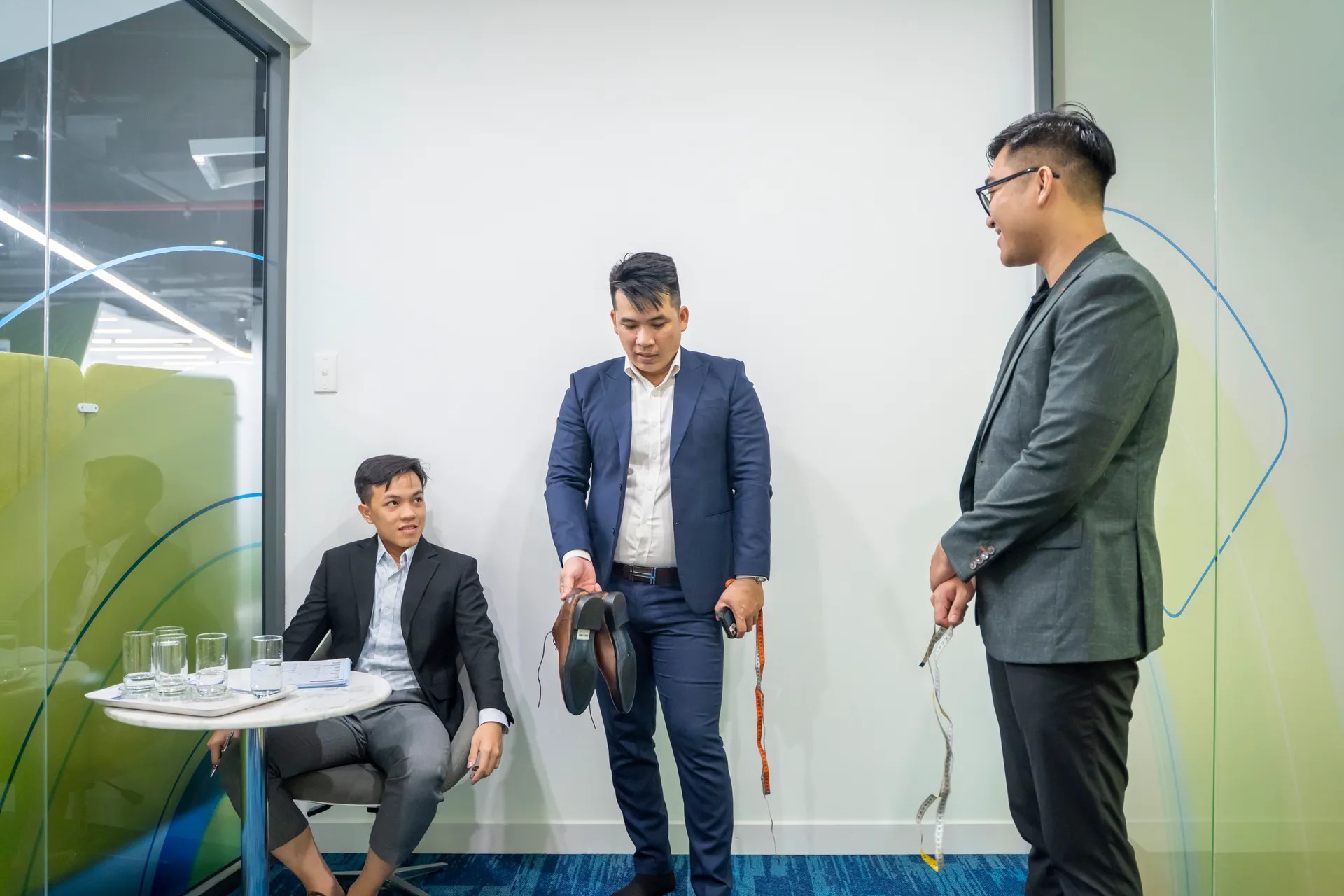
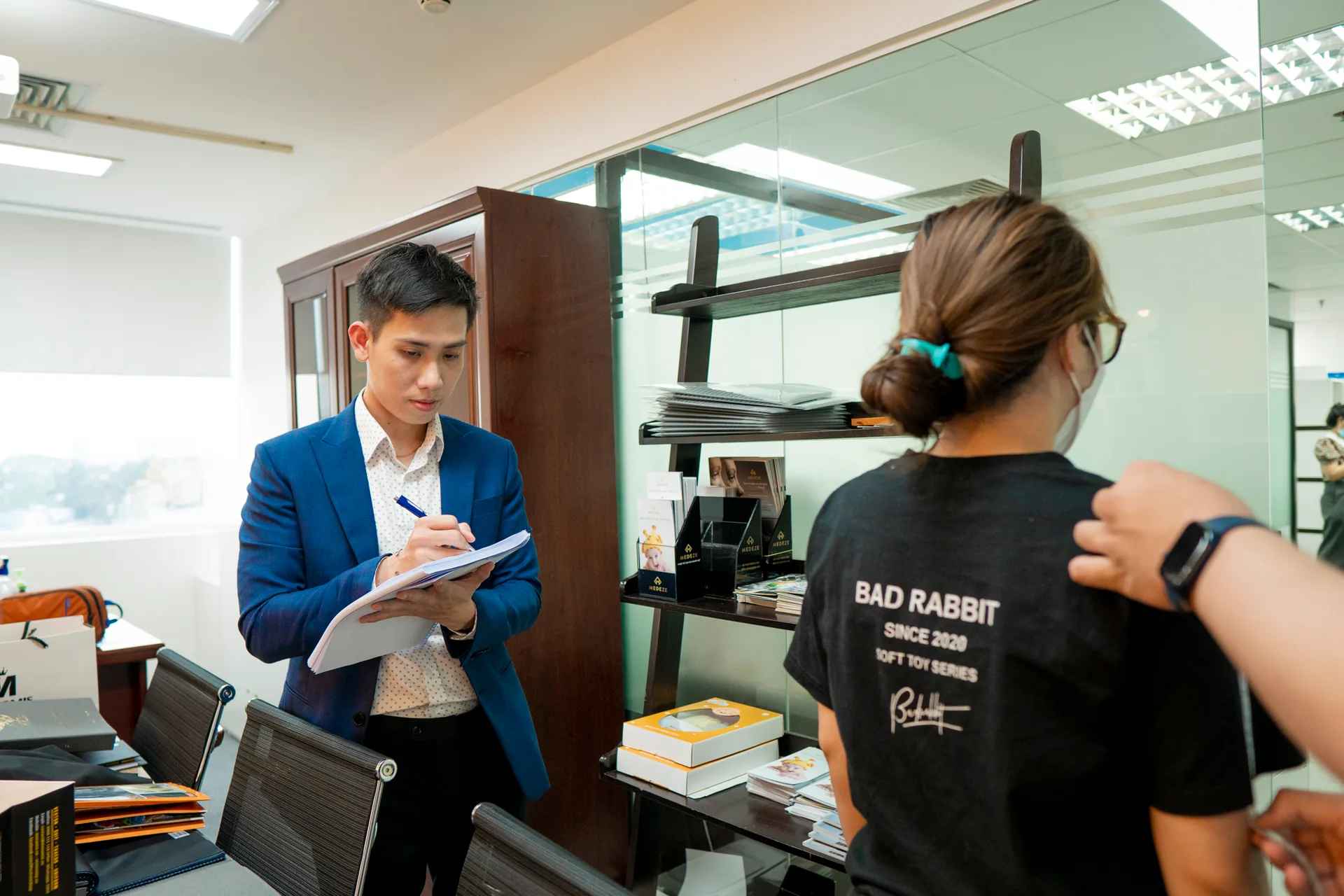
A suit uniform differs from a T-shirt in that it is a structured garment, with shoulders and lapels. A T-shirt one size off can still be worn; a suit jacket one centimetre off at the shoulder shows at once. Mon Amie measures each person individually: shoulder, chest, waist, hip, sleeve length, jacket length, thigh, trouser length, and records them on a measurement slip with name, position and height. A measuring session gives accurate results when the wearer is already in a shirt and standing straight as usual; some sessions also photograph each person's posture before measuring so the tailor can refer to their stance. Measuring early also lets you adjust the number of sets proactively while the list of wearers is still changing.
3. Choose cloth by intensity of wear, not only by price
Cloth decides how long a uniform lasts. A suit worn five days a week needs a blended wool that resists abrasion and creases little; a suit worn only at events can use a finer cloth. In Mon Amie's cloth library, the Essential line uses Kevinlli wool 40–70% in yarn counts from 100s to 140s, suited to uniforms worn regularly; positions that need a higher-level image can look at the Signature and Heritage lines. Scale-based offers are quoted separately at the survey, with no fixed public figure. Hold the cloth sample up to a window or under your office's real lights before approving: the same navy looks bluer under cool white light and blacker under warm yellow light. See also Mon Amie's cloth library.
4. Approve a trial sample before the whole batch is made
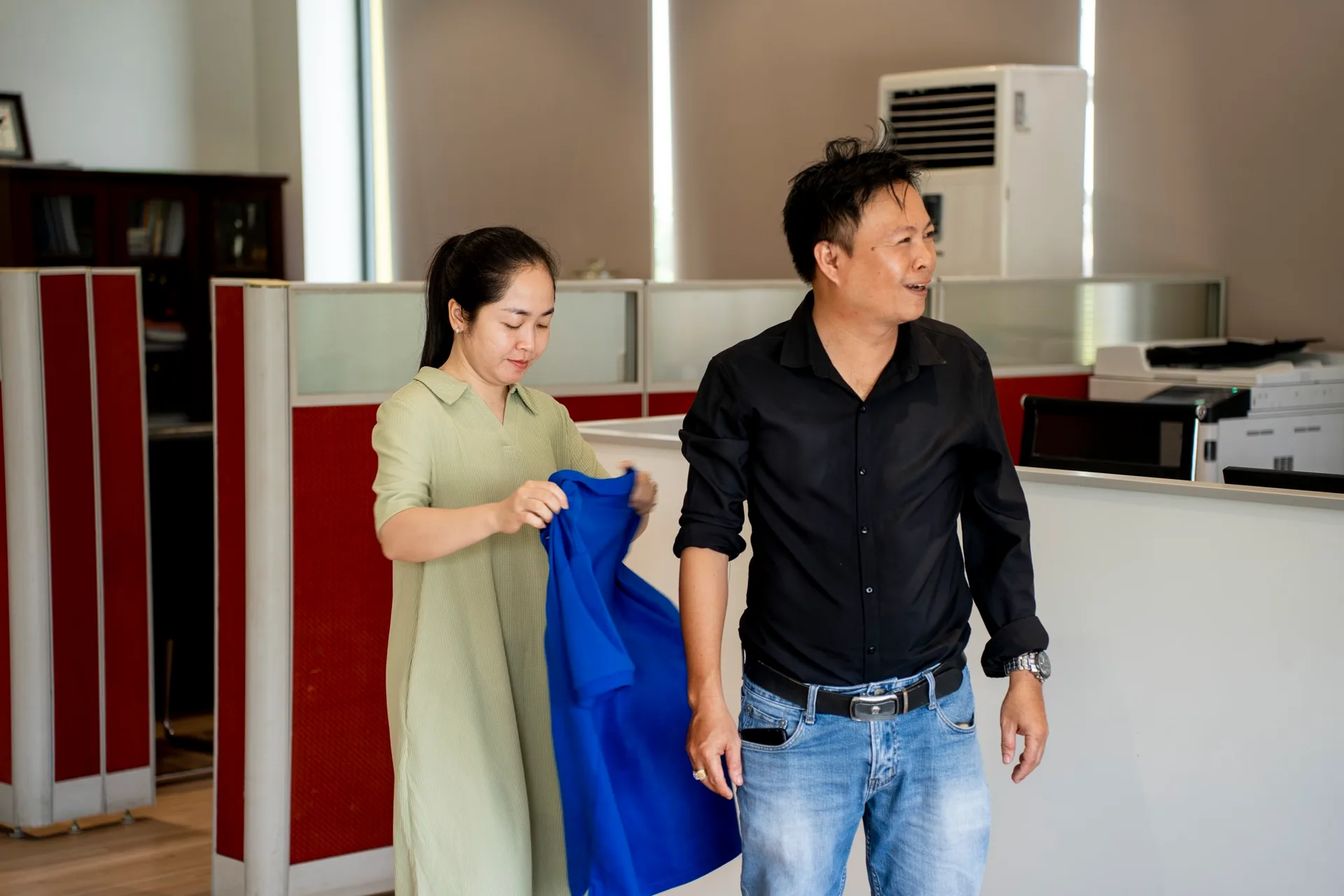
A trial on three or five people who represent the different body-type groups (tall and slim, average, fuller build, and both men and women) costs far less than altering a hundred sets. The trial sample must be worn for real: sit down, raise your arms, bend to pick something up, climb a flight of stairs, and only then reach a conclusion. Check four points: whether the shoulder juts out or collapses, whether the sleeve shows 1–1.5 cm of shirt cuff when the arm hangs, whether the trouser hem lightly touches the top of the shoe, and whether the waist pulls at the button when seated. Write comments on the slip person by person instead of a vague "feels a bit tight," so the tailor adjusts the right place. The article What is a Size Run explains how to use a trial size set, and the article What is Confirmation gives you a checklist before signing the made-to-measure order form.

5. Plan for top-up orders, delivery and care
Uniforms do not come in only one batch. New employees join, people gain or lose weight, people leave and return their garments; without saved measurements, every top-up order means measuring from scratch and easily ends up with a cloth lot that does not match the old sets. Mon Amie manages measurements for the whole team for top-up orders, so what you need is a wearer list updated for each batch. Set the care rules at the same time: hang on wide-shouldered hangers, dry-clean or wash in water as the label directs, do not dry in harsh sun. At delivery, check each set against the list: right name, right size, right number of pieces (jacket, trousers, waistcoat). The specific tailoring and delivery schedule will be given by the showroom at measuring; count backwards from the date you start wearing them.

Quick summary table
| What to know | Suited to | Key point |
|---|---|---|
| 1. Who wears them, where | HR and administration managers | Make the list by activity group, not by department |
| 2. Measure each person | Teams of any size | No shared sizes; measure once the shirt is on |
| 3. Choose cloth | Budget approvers | By intensity of wear; view cloth under real lights |
| 4. Approve a trial sample | Leadership, group representatives | Wear it for real: sit, raise arms, record each person's comments |
| 5. Top-up orders, care | Administration, asset managers | Keep measurements; check against the list at delivery |
Tips from Mon Amie's master tailors
- Give each person two suits to rotate. A suit that rests one day keeps its shape noticeably longer than one worn back to back.
- Order an extra pair of trousers for each set: trousers rub against the chair, so they wear out before the jacket.
- Tell the tailor which person has uneven shoulders or a slight stoop at the moment of measuring; a small note lets the jacket follow the body's real line instead of forcing it straight.
- Agree on shared shirts, ties and shoes before the measuring day. Measure over a thin shirt and wear a thick one, and the jacket will feel tight.
- Name one final approver for each stage; do not let a dozen people comment on one sample, because conflicting opinions will slow down the whole batch.
Frequently asked questions
How is making suit uniforms for a company different from a personal suit?
The measuring standard and construction are the same; the difference is managing many people at once: the same cloth roll, the same cut, the same delivery schedule, and saving measurements for the next batch. With a personal suit you can have several baste fittings to suit your own build; for a team, you need to agree common conventions first so as to avoid altering garments one by one. The article made-to-measure men's suits: 9 things to know helps you understand this foundation.
Can a group of about 5–20 people order suit uniforms?
Yes. A small team is still measured person by person like a large one; with fewer people, the tailor can baste-fit more thoroughly. See the article making small-quantity uniforms in suits to learn how to divide groups and choose cloth.
Can measuring be done at the company?
Yes. Mon Amie provides made-to-measure service at offices within Ho Chi Minh City; you should choose a meeting room large enough, with a mirror and a table for writing the measurement slips, and arrange for people to come to be measured group by group so as not to disrupt work. See also made-to-measure at home and in the office.
How is the price for suit uniforms quoted?
The price depends on the cloth line, the style and the quantity. Mon Amie has scale-based offers, quoted at the survey; you can look at the made-to-measure price list as a benchmark, and then the stylist confirms the exact figure at measuring.
These five things to settle before ordering suit uniforms do not take much time, but they decide whether the suit uniforms match expectations once worn. If you are preparing, book a survey visit or message Zalo 0888.111.118; the team will go over these five points with you before measuring the first suit, under the suit uniforms measured for each person service.