
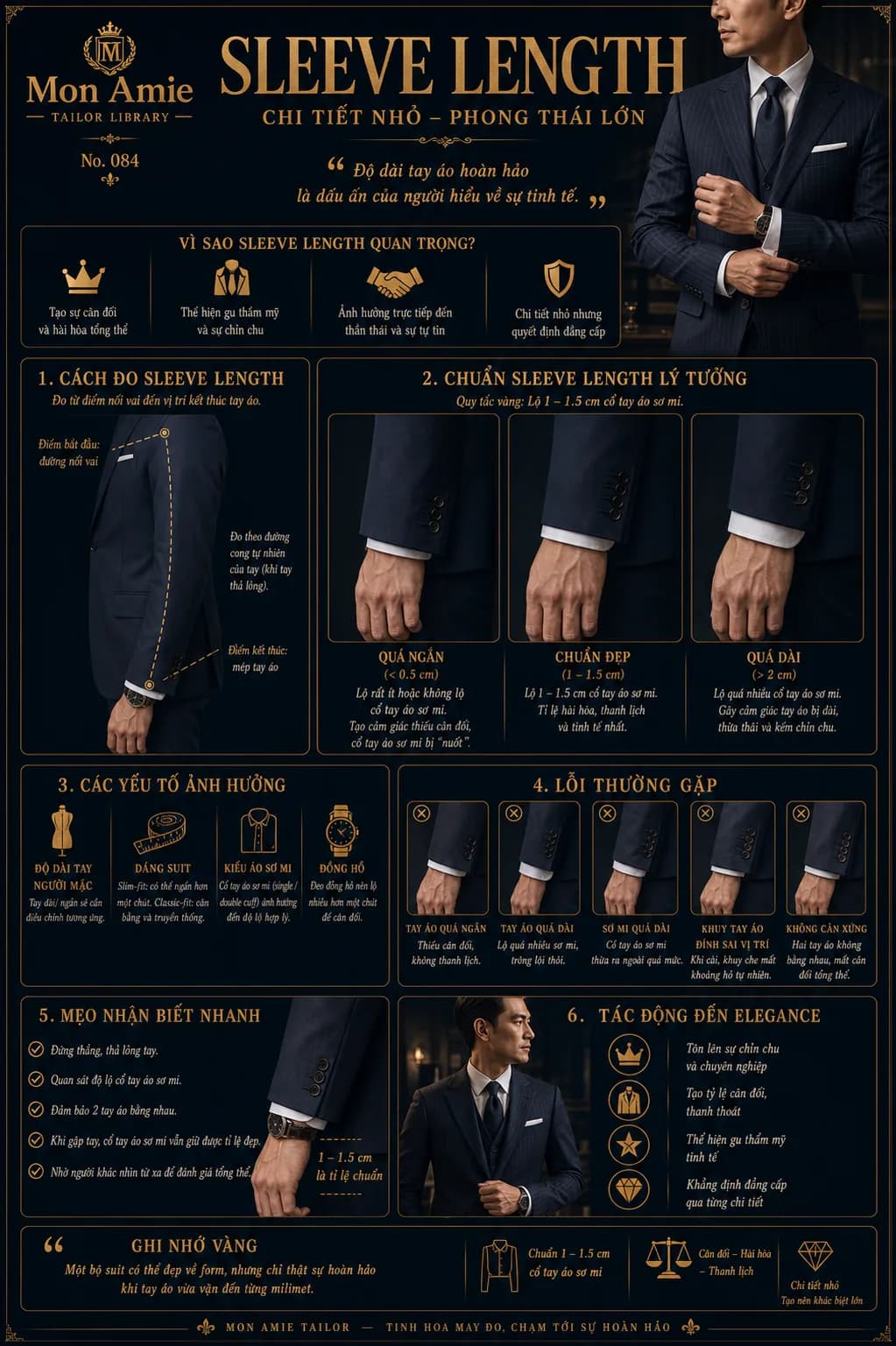
Sleeve length is the distance from the shoulder seam to the finished edge of the sleeve, and the standard the tailoring world accepts is to leave 1–1.5 cm of shirt cuff showing beneath it. A detail measured in centimetres, yet it accounts for much of how polished a suit looks. As Mon Amie often tells its clients, a perfectly judged sleeve is the mark of a man who understands refinement.
Why sleeve length matters so much
Within a suit, the sleeve is where other people's eyes settle again and again — when you shake hands, raise a glass, offer a card. A correct sleeve length delivers four clear benefits:
- It brings balance and harmony to the outfit as a whole.
- It signals the wearer's taste and attention to detail.
- It affects your bearing and your confidence directly.
- It is a small detail that decides the impression — the discerning notice it at once.
How to measure sleeve length correctly
The tailor measures from the shoulder point — where the shoulder seam meets the sleeve head — to the finished end of the sleeve. The essential thing is that the tape must follow the natural curve of the arm at rest, rather than being pulled straight. The human arm has a slight bend; measured flat, the reading loses a few millimetres and the finished sleeve falls short.
At a fitting, stand upright with your arms hanging loosely so the tailor can see exactly where the sleeve edge lands on your wrist.
The ideal standard: the 1–1.5 cm rule
The golden rule of the trade: the suit sleeve should end so that 1–1.5 cm of shirt cuff remains visible. There are three states you will encounter:
- Too little shown (under 0.5 cm): the suit sleeve runs long and all but swallows the shirt cuff, leaving little or nothing visible. The overall effect is unbalanced and lacking in sharpness.
- Correct (1–1.5 cm shown): a band of white shirt provides exactly the right transition between the jacket and the hand. This is the most harmonious, elegant and refined proportion.
- Too much shown (over 2 cm): the suit sleeve is too short and too much shirt protrudes, giving an impression of mismatched, surplus fabric and general untidiness.
Note that this standard assumes the shirt sleeve itself is the right length — a shirt should finish at the wrist bone. Adjusting a jacket to fit a badly cut shirt achieves nothing.
What determines sleeve length
There is no single figure for everyone, because sleeve length depends on:
- The wearer's arm length: long or short arms require corresponding adjustment; no standard size covers everyone.
- The cut of the suit: a slim-fit suit can carry a slightly shorter sleeve for a leaner look, while a classic fit keeps the more traditional, balanced length.
- The style of shirt cuff: a single cuff and a double cuff differ in thickness and length, which changes how much should show.
- A watch: on the wrist that carries the watch, allow a little more cuff for balance so the sleeve does not ride over the watch face.
Common faults with suit sleeves
Across thousands of alterations, these are the faults that recur most:
- Suit sleeve too short: unbalanced and inelegant.
- Suit sleeve too long: it covers the shirt entirely, looking careless and heavy.
- Shirt sleeve too long: far too much cuff protrudes and the proportion is broken.
- Sleeve buttons set wrongly: when fastened, the row of buttons hides the natural opening at the cuff.
- Sleeves of unequal length: in reality a man's arms often differ by a few millimetres, and a good tailor measures and cuts each side separately.
Quick ways to check your sleeves
You can assess this at home in a minute:
- Stand upright with both arms hanging naturally.
- Look at how much shirt cuff shows — 1–1.5 cm is the correct proportion.
- Confirm that both sleeves match.
- Bend the elbow gently: the shirt cuff should keep its proportion rather than disappearing inside.
- Ask someone to look from a distance for the overall impression — your own eye, looking down at your arm, is always at the wrong angle.
A word from Mon Amie's artisans
Mon Amie's experience is that when a client brings an old suit in for alteration, the sleeves are the item most often asked about — and the easiest to rescue, since almost every suit sleeve carries an inlay for letting out or taking in. Bring the shirt and the watch you actually wear when you come for a fitting, because the sleeve is judged against the real combination you wear rather than a figure on paper. On a suit made at Mon Amie, both arms are recorded for life and any adjustment after delivery is covered.
A suit may be beautifully shaped, yet it is only truly complete when the sleeves fit to the millimetre. If you would like your sleeves measured and set to the correct 1–1.5 cm by an artisan at one of Mon Amie's five showrooms in Ho Chi Minh City, do book an appointment or read about the tailoring process first — our hotline 0888.111.118 is always ready.