
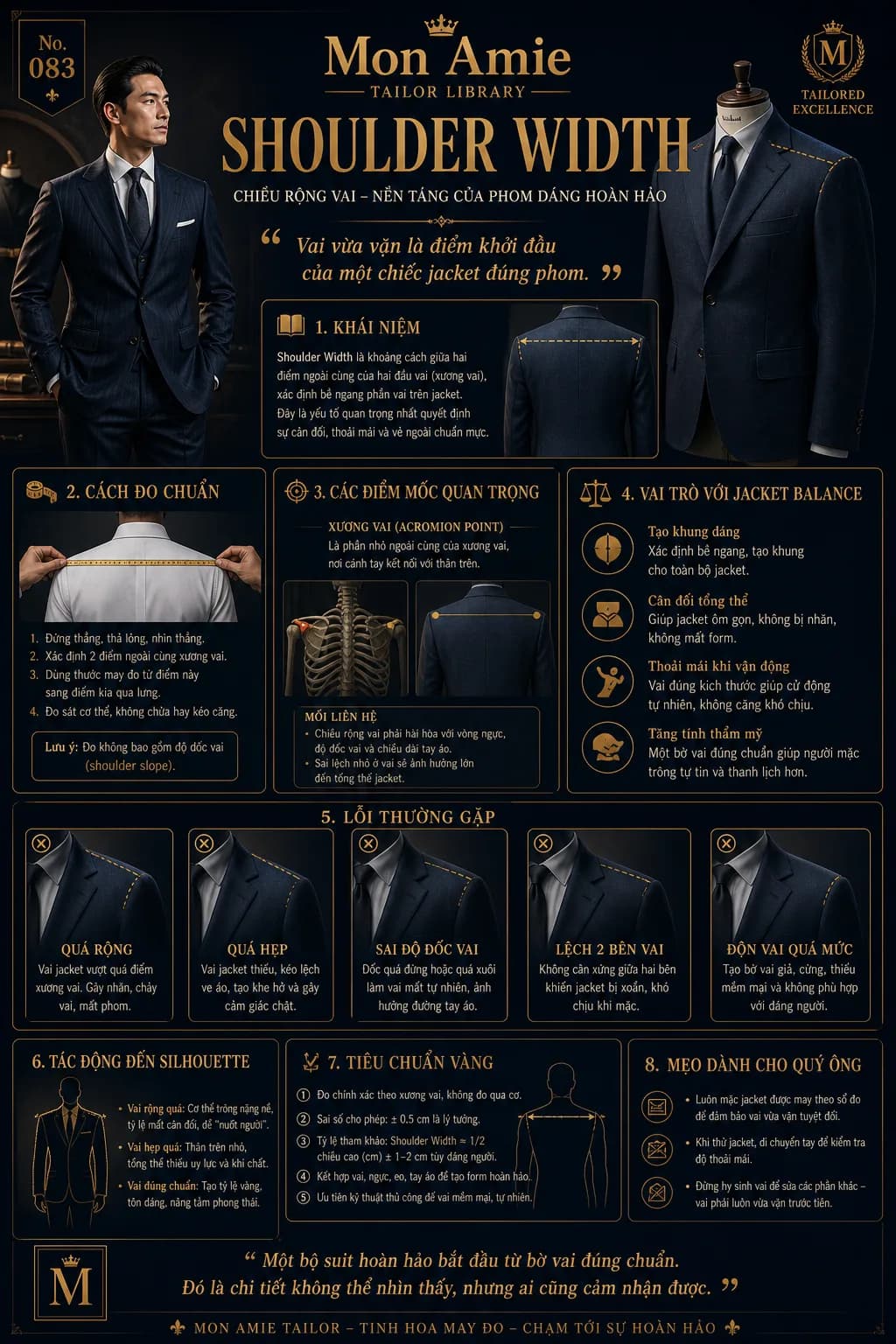
Shoulder width is the distance between the outermost points of the two shoulders, and it establishes the breadth of a jacket across the top. It is the single most important element in the balance, comfort and correctness of a suit. As tailors have always said, a well-fitting shoulder is where a properly shaped jacket begins — every other measurement can be altered, but the shoulder line almost never can.
What shoulder width means in tailoring
On the body, shoulder width runs from the shoulder bone on one side to the shoulder bone on the other, measured across the back. The critical landmark is the acromion point — the outermost projection of the shoulder bone, where the arm joins the torso. A good tailor measures to the bone, never to the muscle, because muscle changes over time while the skeleton stays constant.
Shoulder width does not stand alone. It must be in harmony with the chest, the shoulder slope and the sleeve length. A small discrepancy at the shoulder has large consequences for the whole jacket: a misplaced sleeve head, a gaping lapel, a twisted body.
How to measure shoulder width correctly
The proper procedure has four steps:
- The client stands upright, relaxed, looking straight ahead — shoulders untensed, chest not puffed.
- Identify the outermost point of the shoulder bone (the acromion) on each side.
- Run the tape from one point to the other, across the back.
- Keep the tape against the body, adding nothing and pulling it taut nowhere.
One important note: the shoulder width figure does not include the shoulder slope. Slope is recorded separately so the tailor can build the shoulder correctly — sloping and square shoulders demand entirely different treatment even when their width is identical.
The shoulder and jacket balance
The shoulder performs four duties on a jacket:
- It sets the frame: it defines the breadth and carries the structural load of the whole coat — a jacket hangs from the shoulders before it touches anything else.
- It creates balance: correct shoulders let the jacket sit cleanly, without creasing or collapsing when buttoned.
- It allows movement: a shoulder cut to the right size permits natural motion — reaching, shaking hands, working at a desk — with no uncomfortable pulling.
- It elevates the look: a well-built shoulder makes the wearer appear more confident and more elegant. It is the first impression others register, even if they cannot name it.
Five common faults at the shoulder
At a fitting, look closely for these five familiar faults:
- Shoulders too wide: the jacket extends past the shoulder bone, creasing and collapsing — the clearest sign is a shoulder line that breaks downward before it reaches the sleeve.
- Shoulders too narrow: the jacket falls short, pulling the lapels out of line, opening a gap at the collar and feeling tight and restrictive.
- Wrong shoulder slope: the shoulder is built squarer or more sloping than the real body, so it looks unnatural and the sleeve line suffers.
- Uneven shoulders: many men have shoulders of differing heights; if the tailor does not treat each side separately the jacket will twist and feel uncomfortable.
- Excessive padding: an artificial, rigid shoulder with no softness, unsuited to the wearer's build — a fault common in inexpensive ready-made suits.
Effect on the silhouette, and the gold standard
The shoulder shapes the wearer's silhouette directly. Too wide and the body looks heavy, the proportions collapse, the jacket appears to swallow the man. Too narrow and the upper body shrinks, losing presence and authority. Correctly cut, the shoulder creates the ideal proportion and raises the wearer's whole bearing.
Technically, this reduces to five standards:
- Measure to the shoulder bone, never over the muscle.
- A tolerance of about plus or minus 0.5 cm is the ideal.
- As a reference proportion, shoulder width is roughly half the height in centimetres, plus or minus 1–2 cm depending on build.
- Coordinate shoulders, chest, waist and sleeves together for a perfect line — never optimise one figure in isolation.
- Favour handwork at the shoulder so the line stays soft and natural rather than stiff with padding.
A word from Mon Amie's artisans
Years spent in the fitting room have shown us that most clients look only at the waist and the length of the coat and overlook the shoulder — which is the one part that can barely be corrected once the jacket is finished. When you try a jacket on, move your arms, reach forward, cross your arms, and judge the real comfort rather than standing still before the mirror. And never sacrifice the shoulder to compensate elsewhere: the shoulder must fit first, and the rest a tailor can resolve.
A perfect suit begins with a correctly cut shoulder — a detail few can name, but everyone can feel. At Mon Amie's five showrooms in Ho Chi Minh City, every client is measured to the bone and the figures are kept for life for the suits that follow. Do book an appointment or read about the tailoring process at Mon Amie; hotline 0888.111.118.