
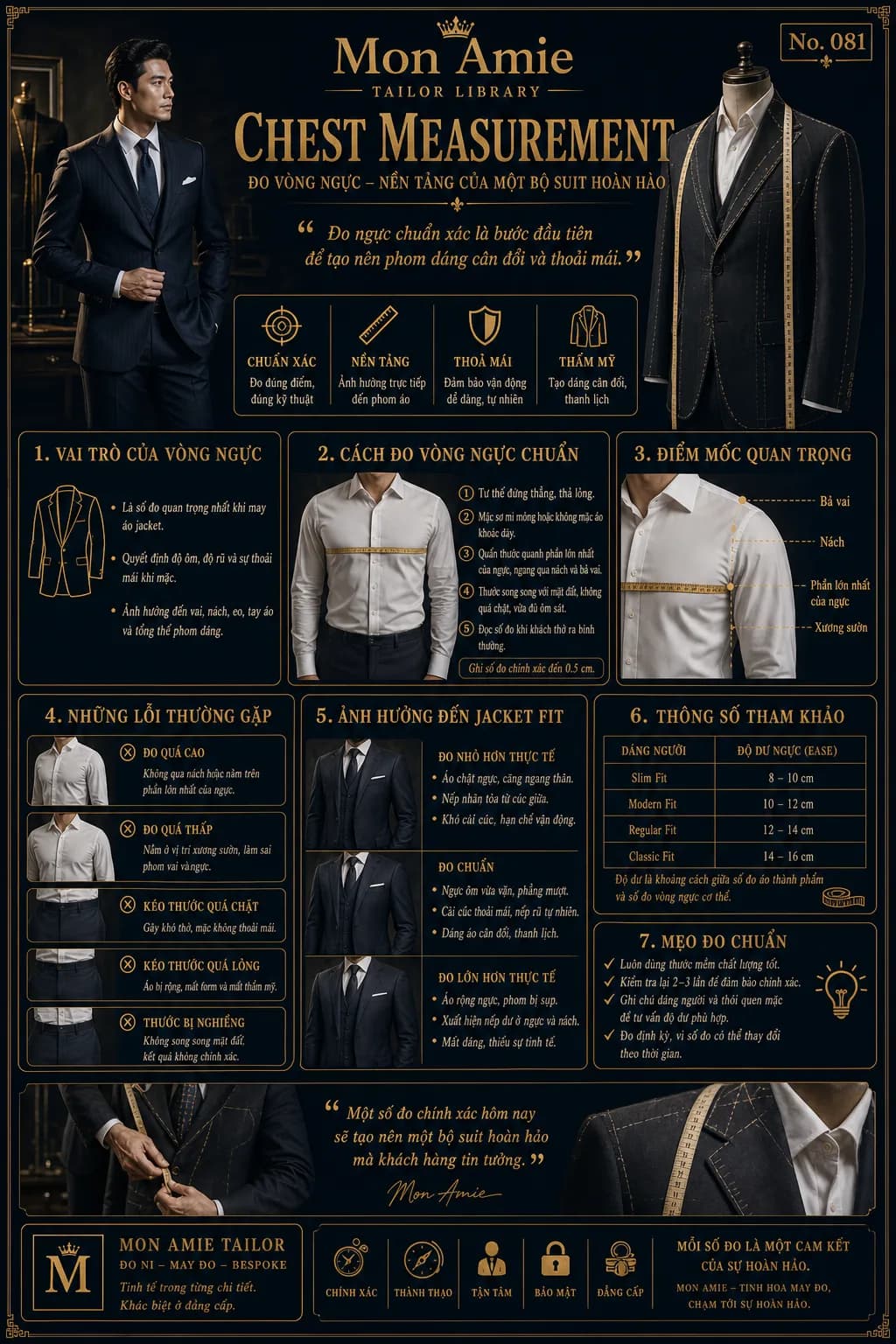
Chest measurement is the first and most important step in taking measurements for a suit. This single figure governs how closely the jacket sits, how it drapes and how comfortable it feels; measuring the chest correctly is the foundation of a balanced, elegant silhouette. In this piece, Mon Amie shares how a tailor takes the chest measurement properly.
The role of the chest in a suit
Of all body measurements, the chest matters most when making a jacket. The reason is simple: the upper body of the garment is built around the ribcage, so any error here spreads through the entire coat.
- The chest determines closeness of fit, drape and comfort in wear.
- It directly affects the shoulders, armholes, waist, sleeves and the overall silhouette.
- A chest reading that is off by a few centimetres can leave a jacket straining or swimming, even when every other measurement is exact.
That is why an experienced tailor takes the chest with four criteria in mind: accuracy (the right points, the right technique), foundation (it dictates the shape of the coat), comfort (you must move easily and naturally) and aesthetics (a balanced, elegant line).
How to measure the chest correctly
The proper procedure has five steps:
- Stand upright and relaxed — no puffed chest, no tensed shoulders.
- Wear a light shirt or nothing heavy over it, so the tape follows the real body.
- Pass the tape around the fullest part of the chest, across the armpits and shoulder blades.
- Keep the tape parallel to the floor, neither slack nor pressed into the skin.
- Read the figure as the client breathes out normally, without holding or deepening the breath.
The reading should be recorded to the nearest 0.5 cm. A small error here multiplies once the pattern is drafted, so a careful tailor never rounds off casually.
Key landmarks when measuring the chest
To keep the tape on its correct path, four landmarks must be identified:
- The shoulder blades — the rear edge of the tape's path.
- The armpits — where the tape crosses each side of the body.
- The fullest part of the chest — the correct position for the tape at the front.
- The ribs — the marker that tells you the tape has slipped too low.
Only when the tape sits on these landmarks and stays parallel to the floor does the figure genuinely reflect the circumference of the ribcage.
Common errors when measuring the chest
Even something as apparently simple as passing a tape around the body has its classic mistakes:
- Too high: the tape misses the armpits or the fullest part of the chest, giving a reading smaller than reality.
- Too low: the tape sits at rib level, distorting the shoulder and chest shape.
- Pulled too tight: the finished jacket restricts breathing and feels uncomfortable.
- Left too loose: the jacket ends up oversized, losing shape and elegance.
- Tape tilted: not parallel to the floor, so the result is inaccurate.
How the chest measurement affects the fit of a jacket
The consequences show most clearly on the finished garment:
- Measured too small: the chest is tight, the body pulls across, creases radiate from the middle button, the coat is hard to fasten and movement is restricted.
- Measured correctly: the chest fits cleanly, the cloth lies smooth, the button closes comfortably, the drape falls naturally and the line is balanced and elegant.
- Measured too large: the chest is loose, the shape collapses, surplus folds appear at the chest and armholes, and the coat loses both form and refinement.
Reference ease figures by fit
A finished jacket is never made to the exact body measurement — there is always an allowance known as ease, which lets you move. The amount varies with the style:
- Slim Fit: 8–10 cm
- Modern Fit: 10–12 cm
- Regular Fit: 12–14 cm
- Classic Fit: 14–16 cm
Ease is the difference between the finished chest of the jacket and the chest of the body. Choosing the right amount for a client's build and habits is where a tailor's experience speaks: a broad-chested, active man needs a different allowance from a slim man who prefers a lean line.
A word from Mon Amie's artisans
In the Mon Amie workshop we always use a good soft tape and check each figure two or three times. We also note each client's build and wearing habits so we can advise on the right allowance, because the same chest measurement suits different men at different levels of ease. Do have yourself measured again from time to time — the body changes, and a figure taken a few years ago may no longer hold. At Mon Amie your measurements are kept for life, so every subsequent commission is quicker and more precise.
An accurate measurement today becomes a suit you can rely on tomorrow. If you would like to be measured properly by an artisan at one of Mon Amie's five showrooms in Ho Chi Minh City, do book an appointment or read about the tailoring process first — our hotline 0888.111.118 is always at your service.