
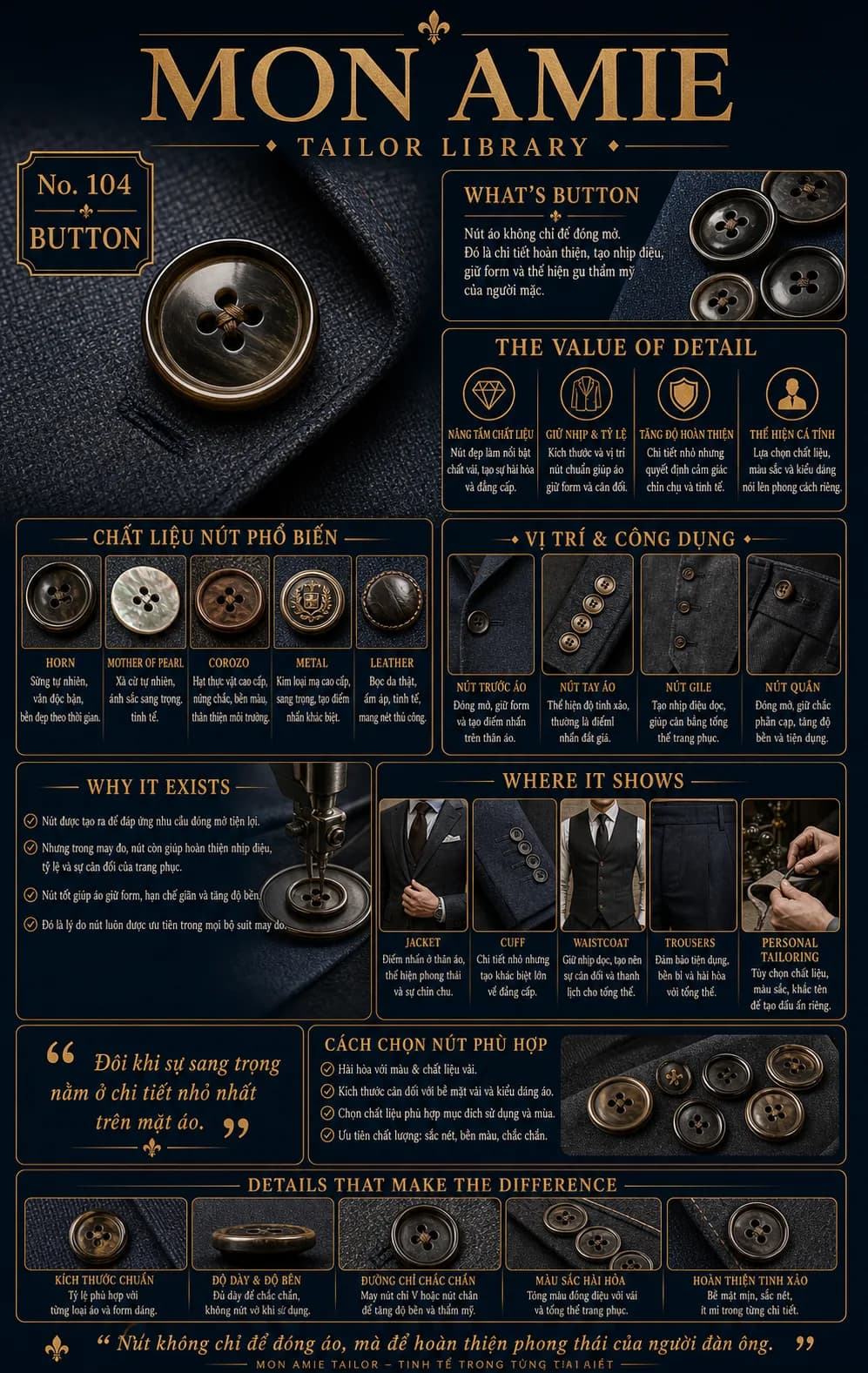
Suit buttons are not merely fastenings. They finish the garment, set its rhythm, hold its shape and express the wearer's taste. A row of buttons chosen in the right material and size, and attached with the right technique, can lift an entire suit into another class — and conversely, one cheap plastic button is enough to undercut the most expensive cloth.
The value of a small detail
In tailoring, a skilled maker never treats buttons as an afterthought. They carry four distinct values:
- They elevate the cloth: fine buttons bring out the fabric's character and give the whole a sense of harmony and quality.
- They set rhythm and proportion: correct button size and placement help the jacket hold its shape and balance the upper and lower body.
- They complete the finish: a small detail, but the one that decides whether a garment reads as considered and refined up close.
- They express character: the material, colour and style you choose speak of your own taste.
This is why bespoke houses around the world reserve a dedicated step in the process for the client to choose buttons, on equal footing with choosing cloth and lining.
Common suit button materials
Each material speaks its own language. The five most often seen in fine tailoring:
- Horn: made from natural horn, with unique grain — no two buttons alike — and ageing beautifully. The classic choice for business and evening suits.
- Mother of pearl: natural nacre with an elegant, refined lustre; often found on fine shirts and summer garments.
- Corozo: made from a fine plant seed, also known as vegetable ivory, taking dye firmly, holding colour and environmentally sound — a favourite of Italian workrooms.
- Metal: finely plated metal, luxurious and distinctive; inseparable from the traditional navy blazer.
- Leather-covered: wrapped in real leather, warm, refined and quietly handmade — right for tweed jackets and cold-weather clothing.
The general principle: natural materials always read deeper and more genuine than moulded plastic, both to the eye and to the hand.
Where each row of buttons sits, and what it does
On a complete suit, buttons appear in several places, each with its own role:
- Front buttons: they fasten the jacket, hold its shape and anchor the body of the coat — this is the row that determines the jacket's proportions.
- Sleeve buttons: a mark of craftsmanship and often the most telling detail; working cuffs are a hallmark of genuine tailoring.
- Waistcoat buttons: they create a vertical rhythm that balances the whole outfit in a three-piece suit.
- Trouser buttons: they fasten and secure the waistband, adding durability and convenience.
Buttons also reveal themselves in very ordinary moments: fastening the jacket as you rise, the cuff peeking out beside your shirt sleeve, or the waistcoat holding an elegant vertical line through the whole silhouette. Small details — but the observant always notice.
Why buttons matter so much in tailoring
Buttons exist to fasten conveniently — that is their original function. But in tailoring they take on more:
- They complete the rhythm, proportion and balance of the garment.
- They help the jacket hold its shape, limit stretching of the cloth and add durability over the years.
- They become a personal signature when the client chooses the material, colour and stitching.
That is why in any serious made-to-measure suit, buttons are considered carefully and never treated as the last thing bolted on.
How to choose the right buttons
When you sit down to choose, four principles will guide you:
- Harmony with the colour and texture of the cloth: buttons usually match the fabric's tone or sit a shade darker, and rarely contrast sharply.
- Size in proportion to the cloth and the cut: heavier fabrics and outerwear call for larger buttons than a smooth-faced suit.
- Material suited to purpose and season: horn for a year-round suit, mother of pearl for summer, leather-covered for winter.
- Quality first: crisp, colourfast and solid — a good button outlives even the lining.
Beyond the button itself, the way it is attached matters: a firm V-shaped shank stitch, or a shanked button, adds both durability and beauty; the button must be thick enough to be solid and resist cracking in use; and the finished surface should be smooth and crisply defined in every detail.
A word from Mon Amie's artisans
Sometimes elegance rests in the smallest detail on the front of a jacket. Mon Amie's experience is this: if you are torn between two buttons, choose the quieter one — a button should never speak louder than the cloth. And do fasten the jacket at your fitting: a correct row of buttons closes smoothly, lies flat and pulls no creases across the body. With every suit made at Mon Amie, your measurements and choices are kept for life, so on your next commission it is enough to say "the same as last time".
Buttons are not only there to close a jacket, but to complete a man's bearing. If you would like to choose everything from cloth to button yourself, we invite you to book an appointment at one of Mon Amie's five showrooms in Ho Chi Minh City, or to read the tailoring process — hotline 0888.111.118, full made-to-measure suits from VND 4.8 million (the Kevinlli line) through the Canonico, Holland & Sherry, Dormeuil and Scabal collections.