

Next week you have your graduation ceremony, in two weeks an internship interview, and your wallet is not thick. Standing in front of your wardrobe, you realise you have never owned a proper suit, apart from the jacket borrowed from your older brother that you wore in high school. Choosing a men's suit for a college student is not hard, once you understand that this is an investment to use many times, rather than something bought once for one occasion.
Quick answer
For a college student, choose a navy or charcoal suit in a regular fit, with two buttons, single-breasted, a notch lapel and a low-crease wool blend. That one suit is enough for graduation, interviews, presentations, friends' weddings and your whole first year at work. Prioritise quality and fit over the number of suits.
Why one right first suit matters more than five cheap ones
Students often think: "Buy two cheap ones, that will be enough." In reality, two suits in thin fabric with a crooked cut usually make you look less confident than having none. A good suit that stands well and changes accessories by occasion will serve at every important event of your early life. Once you are settled in work, you can add a second and a third, with more confident choices.
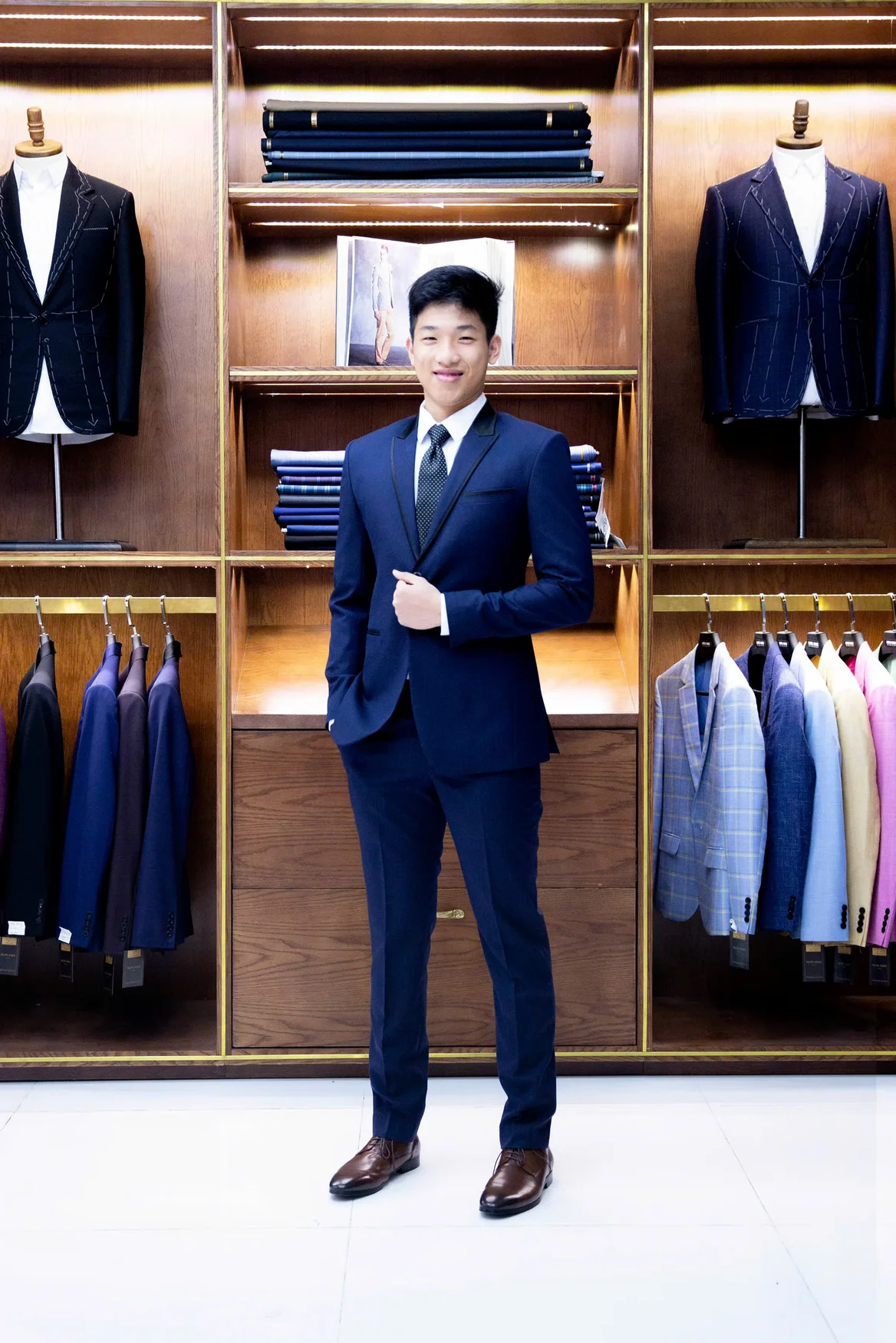
A men's suit for college students: what to choose for your first one?
Colour
- Navy: the all-round colour, works for graduation, interviews, wedding parties and work. It photographs well and suits every skin tone.
- Charcoal grey: a little more serious, suited to finance, law and banking.
- Black: best avoided as a first suit, because a black suit is easily associated with ceremonial dress and service uniforms.
Style
- Single-breasted, two buttons: common, easy to wear, suits everyone.
- Notch lapel: serious without being stiff.
- Side vents or no vent: neat and easy to move in.
- Regular cut, slightly fitted: neat at the shoulders, not too tight. Because a student's build is still changing, do not choose a cut that is too close-fitting.
Pattern
Choose plain or a subtle stripe. A large check, a bold stripe or a bright pastel will be recognised straight away by the third time you wear it.
Fabric: which kind for a student?
Students usually need fabric that is durable, low-crease and reasonably priced. A wool blend is the smart choice. At Mon Amie, the Essential line (VND 4.8 to 10 million for a complete jacket and trousers) uses Kevinlli cloth with 40 to 70% wool, 100s to 140s, built to the Mon Amie fit from the very first suit. If your budget is larger, the Signature line (VND 10 to 20 million) gives smoother cloth with a better drape, but for a first suit, Essential is a sensible starting point.
| Criterion | Choose | Avoid |
|---|---|---|
| Material | Wool blend, 40 to 70% wool | Shiny, thin fabric that creases easily |
| Colour | Navy, charcoal | Black, loud bright colours |
| Pattern | Plain, subtle stripe | Large checks, large patterns |
| Cut | Regular, slightly fitted | Too tight, heavily padded shoulders |
One suit for 5 occasions
- Graduation ceremony: worn under the gown, with a white shirt and a plain tie.
- Interview: a white or light blue shirt, with a navy or burgundy tie.
- Presentations and project defences: no tie, light blue shirt.
- Friends' weddings: add a pocket square and a patterned tie.
- First year at work: change the shirt and tie every day; the trousers can be worn separately with a shirt.
For careers that need a professional appearance from the day of the interview, read also what should students wear to an interview.
A student budget: how to invest wisely
- Suit first, then shirt, then shoes. One proper suit lifts the whole look.
- Buy two shirts, white and light blue, to rotate, rather than many odd shirts.
- One plain navy tie and one burgundy tie are enough for six combinations.
- One pair of black leather shoes is enough for most occasions. Brown shoes can come later.
- Do not chase trends. Heavily padded shoulders, skin-tight trouser legs and overly short cuts will go out of date.
Shirt, tie and shoes: three items to buy with the suit
A good suit needs three companion items, and students often forget them until the last day:
- Two shirts: one white, one light blue, both with a standard turndown collar, in crease-resistant cotton. These two pair with almost any tie.
- Two ties: one plain navy, one burgundy. A standard width of 7 to 8 cm. Avoid large patterns, cartoon prints and shiny ties.
- One pair of black leather shoes: Oxford or Derby with a round toe and a thin sole. Canvas shoes, sports shoes or thick rubber soles spoil the whole outfit, however good the suit is.
If you have some budget left, add a black leather belt to match the shoes. The total cost of all four items is usually far lighter than buying a second suit.
Keeping a suit durable while you are still studying
Students travel a lot by motorbike and with backpacks, so a suit needs proper care:
- Use a wide hanger instead of a wire hanger, so that the shoulders are not dented.
- Hang the suit outside the wardrobe for a few hours after wearing so that the moisture evaporates, then put it away.
- Do not machine-wash. Dry-clean only when really necessary, and prefer a light steaming to flatten it rather than ironing directly.
- Do not let a backpack press on the shoulders of the jacket when you ride. If you must carry one, fold the suit carefully or use a garment bag.
Tips from a Mon Amie master tailor
Students are at an age when the body is still changing: going to the gym, gaining weight, stopping football. Tell your stylist this when you are measured, so that the tailor leaves seam allowance at the back and waist for easy alteration later. A properly made-to-measure suit can be let out or taken in slightly as your shape changes, something a ready-to-wear suit finds hard to do. If you live far from the city centre or your class schedule is packed, use online tailoring: book a video call, be measured step by step or use measurements already on file, and receive the suit at home.
Common mistakes
- Borrowing a suit from your brother or your father. Shoulders and sleeves not fitting is the smallest matter. The hard part is that the whole suit is not yours, so it cannot build confidence.
- Buying a suit too loose to wear for a long time. A baggy fit makes you look older.
- Buying a suit too tight to follow trends. A few years later it will be out of date or no longer fit.
- Forgetting the trousers. Trousers of the right length, hemmed correctly, with straight legs are what make the whole suit look good.
Frequently asked questions
What colour men's suit should a college student choose?
Navy or charcoal grey. These two colours work for most of the important occasions of your early life and are easy to pair with accessories.
How should a high-school boy choose a suit for graduation or prom?
Choose a regular fit, in navy or grey, in a low-crease wool blend. Students are still growing, so leave some room in the body and sleeves for easy adjustment when needed.
How does a young man's suit differ from a middle-aged man's suit?
Young men's suits are usually closer-fitting, with neat shoulders and slightly narrower lapels, while middle-aged suits favour comfort and a high waistband. However, for a first suit, a regular fit is the safest choice.
How much is a young man's suit?
Mon Amie has the Essential line from VND 4.8 to 10 million for a complete jacket and trousers, in wool-blend cloth built to the standard fit. For details, see the made-to-measure price list.
Conclusion
Your first suit is like a key: small, but it opens the first doors of your life. If you are choosing one, book a measuring appointment to get advice on a first suit that fits your budget and your build.