

Take a calendar, circle the wedding date, then count backwards. If that day is ten weeks from now, in which week should the groom’s suit have its fabric confirmed, in which week the baste fitting, and when should it be collected? Most grooms only think about the suit when a few weeks are left. This article sets out a made-to-measure wedding suit timeline counted back from the big day, so that every milestone has a concrete task.
Quick answer
A made-to-measure wedding suit should be started early, ideally 10 to 12 weeks before the wedding, and passes through five milestones: concept consultation, fabric selection and measuring, baste fitting, adjustments and collection. The schedule below is a reference framework; Mon Amie will settle each milestone around your specific wedding date when you book.
Why count back from the wedding date?
A wedding suit differs from a work suit in one respect: the day it will be worn is fixed and cannot move. The roomier the schedule, the more space you have for three things: choosing fabric carefully, having enough fittings, and adjusting until it is perfect. The tighter the schedule, the more every choice gets squeezed. That is why Mon Amie’s wedding suit Groom Styling service builds a fitting schedule counted back from the wedding date, and commits to delivering on time.
Made-to-measure wedding suit timeline: five milestones counted back from the wedding date
The framework below is counted in weeks before the wedding (T minus n).
| Milestone | Suggested timing | What to do |
|---|---|---|
| 1. Concept consultation | T-12 to T-10 | Settle the wedding style, main colour, the bride’s dress colour and the venue; set the budget |
| 2. Fabric selection and measuring | T-10 to T-8 | Choose fabric and style, take more than 30 measurements, decide the arrangement for the groomsmen |
| 3. Baste fitting | T-6 to T-5 | First baste fitting; adjust shoulders, chest, waist and length |
| 4. Adjustments | T-4 to T-3 | Re-fit after adjustments, add accessories, try on with the shirt and shoes |
| 5. Collection | T-2 to T-1 | Collect the finished suit, final check, care |
The week figures are a general guide to help you picture the process. The actual time also depends on the fabric, the complexity of the style and how many people are being made for at once. The article how long does it take to make a suit has more detail on the schedule from measuring day to collection.
What to do at each milestone
Milestone 1: Concept consultation (T-12 to T-10)
This is when you and the bride agree on the mood of the wedding: classic or modern, indoor or outdoor, day or night. From there the stylist proposes fabric, colour and jacket style. Bring reference photos, the colour of the wedding dress and your planned budget. If the amount is unclear, the article how much does a wedding suit cost will help you work it out beforehand.
Milestone 2: Fabric selection and measuring (T-10 to T-8)
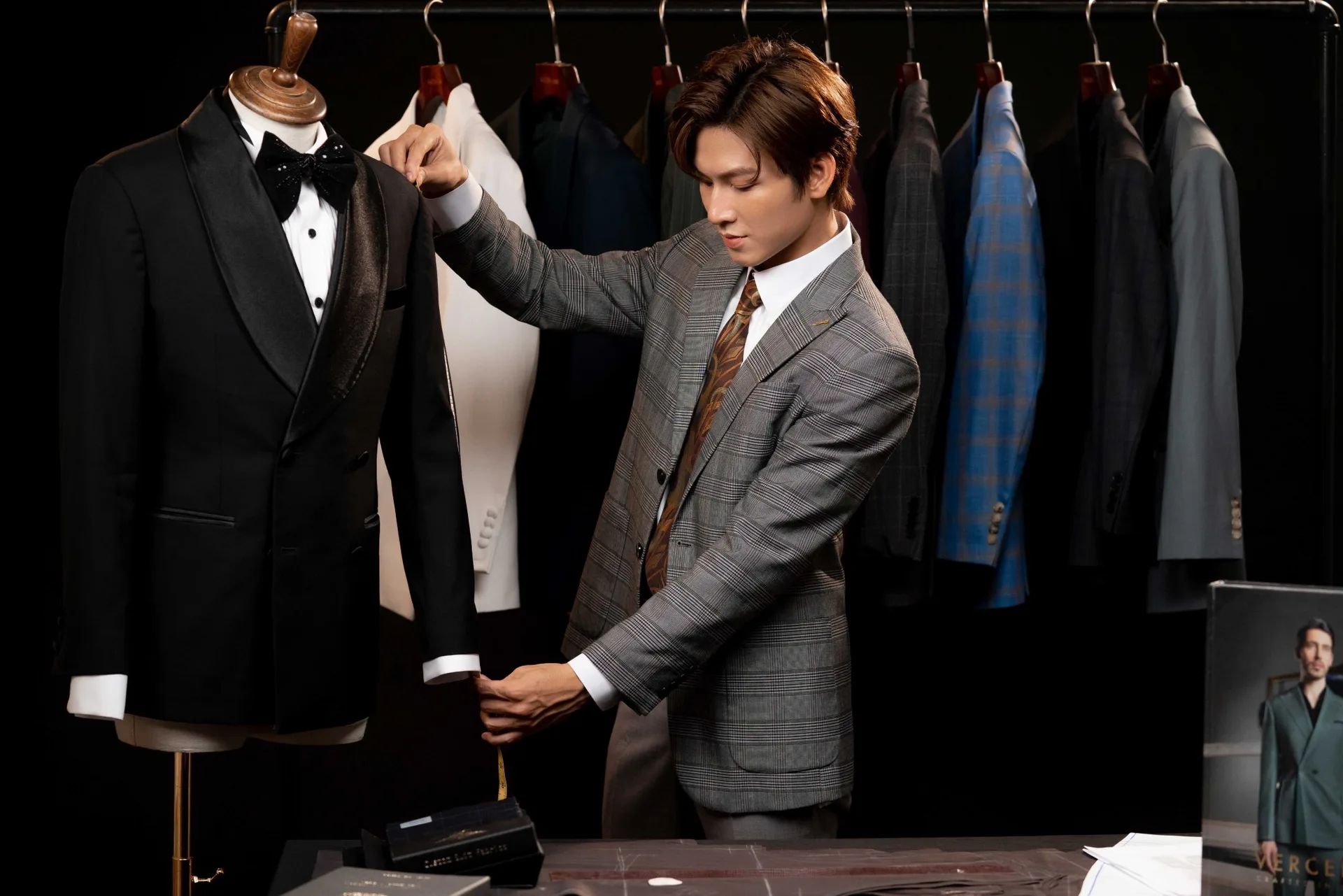
You choose fabric from the Italian and English fabric library and decide on the jacket style, whether to have a waistcoat and what type of lapel. The artisan then takes more than 30 measurements and keeps them for life. If you have a groomsmen party, this is also when the arrangement and each person’s measurements are settled, so have them come in the same session or use the online measuring service. A time-saving tip: send the stylist the list of groomsmen with their height, weight and where they live before the appointment, so that measuring can be arranged person by person instead of crammed into a single session.
Milestone 3: Baste fitting (T-6 to T-5)
The baste fitting is the first time you wear the unfinished suit. The master tailor checks the shoulders, chest, waist, sleeve length and body length, and marks the places that need adjusting. This is the most important step: anything that is off can still be fixed in time. Wear the shirt you will actually wear and the shoes you plan to wear.
Milestone 4: Adjustments (T-4 to T-3)
After the adjustments, you try the suit on again. At this point it is worth having accessories (a tie or bow tie, pocket square, cufflinks) to see the overall look. If your weight is changing because of a diet or training for the wedding, tell the tailor immediately, since a few kilos can make the suit tight or loose.

Milestone 5: Collection (T-2 to T-1)
Collect the finished suit, try it on one last time with the shoes and accessories, and check the buttons, trouser hem and lining. The collection date should be a few days before the wedding to leave room for minor adjustments. At home, hang the suit on a wide-shouldered hanger, avoid folding it, and store it somewhere dry.
What if time is already tight?
Not everyone has ten weeks. If only a few weeks remain before the wedding, do three things: choose fabric and get measured as early as possible, accept simplified details (fewer waistcoats, fewer customised details), and book the baste fitting from the very first session. You can also read the article “rush suit-making for an imminent event” in the Handbook category.
What usually delays a wedding suit schedule?
Most delays come not from the tailor but from the decisions. The three most common causes:
- The concept is not settled. The couple changes their minds about the party colours or the dress style when the suit is already in production, so the fabric has to change.
- A groomsman is replaced or has no measurements yet. One person measured late delays the whole party.
- A big weight change close to the wedding. A suit that fit last week may need adjusting again, and the last adjustment is always worth more than you think.
The simple way to avoid this: settle the concept and fabric first, draw up the groomsmen list early, and keep a buffer of one to two weeks between collection and the wedding day.
Checklist to prepare before the first measuring session
The first session will be much more productive if you bring these five things:
- Date, time, venue and style of the wedding. Indoor, outdoor, daytime or evening all affect the fabric and the style of the jacket.
- The colour of the bride’s dress and the main colour of the party. The groom’s suit needs to harmonise with the whole.
- Reference photos. A few photos of groom’s suits you like, including photos of a groomsmen party.
- Number of groomsmen and planned budget. From there the stylist proposes a matching arrangement or a mixed one.
- The shirt and shoes you plan to wear. These two items affect the collar, sleeves and trouser hem.
If you do not have all of it, that is fine. The stylist will help you complete each part in the first session, as long as the wedding date has been set.
Tips from Mon Amie's master tailors
The most relaxed grooms usually share one trait: they settle the fabric early. Once the fabric is chosen, every later step, measuring, baste fitting and adjusting, has its own time. If you choose the fabric late, you are easily pushed into the only option that is still in time.
One more small habit: note down your weight at the first measuring and tell the tailor if there is a big change. Many grooms lose a few kilos before the wedding from the stress of planning, and a suit that fit last week can show looseness at the waist on the final day. Just tell us early, and the master tailor will adjust it at the last fitting.
Frequently asked questions
When should I start a made-to-measure wedding suit?
Ideally 10 to 12 weeks before the wedding, so there is enough time to choose fabric, have the baste fitting and make adjustments. A tighter timeline can still be done, but the choices narrow.
How many fittings does a groom’s suit need?
At a minimum, a measuring session and one baste fitting, then a re-fit after adjustments and a final fitting when you collect. The exact number is decided by the master tailor according to how each suit fits.
Does a made-to-measure wedding suit include the groomsmen?
It can run on the same schedule as the groom’s. Mon Amie has arrangements for a groomsmen party, so measuring and fitting in the same round keeps the whole party coordinated and on time.
Do I need a shirt and shoes for the wedding suit fitting?
Yes. The collar, sleeves and trouser hem all depend on the shirt and shoes you wear. Fit with exactly what you will wear on the wedding day.
Is a made-to-measure groom’s suit different from a rental?
A made-to-measure suit fits you alone and lasts a long time; renting is cheaper at the start but does not fit you personally. Mon Amie offers both, and suit rental is rental for the occasion at the showroom. If you are weighing them up, the article “how much does it cost to rent a groom’s suit” in the Handbook category has a detailed comparison.
An invitation from Mon Amie
The most practical way to get a specific schedule is to give the stylist your wedding date from the very start. You can book a measuring appointment at a showroom, preview the made-to-measure process or call 0888.111.118 for advice on a fitting schedule counted back from the wedding date.