

“I'm a size 50 and it fits, so why do I still need to be measured?” That's what clients often tell us in the showroom, and it's also the line that opens the conversation about what custom tailoring is. A size 50 that fits your chest doesn't necessarily fit your shoulders, your back, or the slope of your shoulders. Tailoring to measure exists to close exactly that “almost fits” gap.
Quick Answer
Tailoring to measure means making clothes from the wearer's own body measurements instead of ready-made sizes. There are three levels: ready-to-wear (choosing a size), made-to-measure or MTM (adjusting a base pattern to your measurements) and bespoke (a pattern drawn from scratch, with several baste fittings). The higher the level, the greater the fit and personalization, and the price and time rise with it.
What is custom tailoring? Three levels: ready-to-wear, made-to-measure, bespoke
Picture three ways of buying a chair. There's one already built, one where you choose the size and the upholstery color, and one where the carpenter measures the room and makes it just for you. Clothes work the same way.
| Criteria | Ready-to-wear | Made-to-measure (MTM) | Bespoke |
|---|---|---|---|
| Pattern (the drawing used to cut the cloth) | Standard pattern by size, mass-produced | Existing base pattern, adjusted to your measurements | A pattern drawn for each individual |
| Measurements taken | A few key ones: chest, waist, height | Usually fewer than 15 measurements | Many measurements; at Mon Amie, more than 30 |
| Fittings | One try-on, then minor alterations | One fitting, or a try-on of a sample suit | Baste fittings, adjusted repeatedly until it fits |
| Personalization | Choice of size and color | Choice of cloth, style and details | Almost everything, including posture and uneven shoulders |
| Time | Take it home right away | Usually a few weeks | Usually longer because of the multiple fittings |
| Price level | Low at the time of purchase | In the middle | Higher |
Ready-to-wear: quick, but your body has to follow the garment
Ready-to-wear garments are cut to the “average” figure of each size. If your build is close to that, it works well. If your shoulders are much wider than your waist, or you have a fuller stomach, or long arms, you'll always have to compromise somewhere and then ask an alteration shop to fix it. Waist, hem and sleeves can be altered; shoulders and collar cannot.
Made-to-measure: the option in the middle
The tailor takes your measurements and applies them to an existing base pattern, adjusting length, chest and waist. You choose the cloth, the lapel style and the number of buttons. MTM suits people whose build is close to standard, who want a suit in the right style and don't want to spend time on many fittings.
Bespoke: a pattern made for one person only
At this level, the pattern is drawn from your own measurements and posture. The bespoke journey at Mon Amie consists of: meeting an artisan, taking more than 30 measurements, choosing cloth from the Italian and English fabric collection, then baste fitting and adjusting until it fits perfectly. Your measurements are kept for life, so next time you order you don't have to be measured from scratch. You can see the details on the bespoke tailoring page.
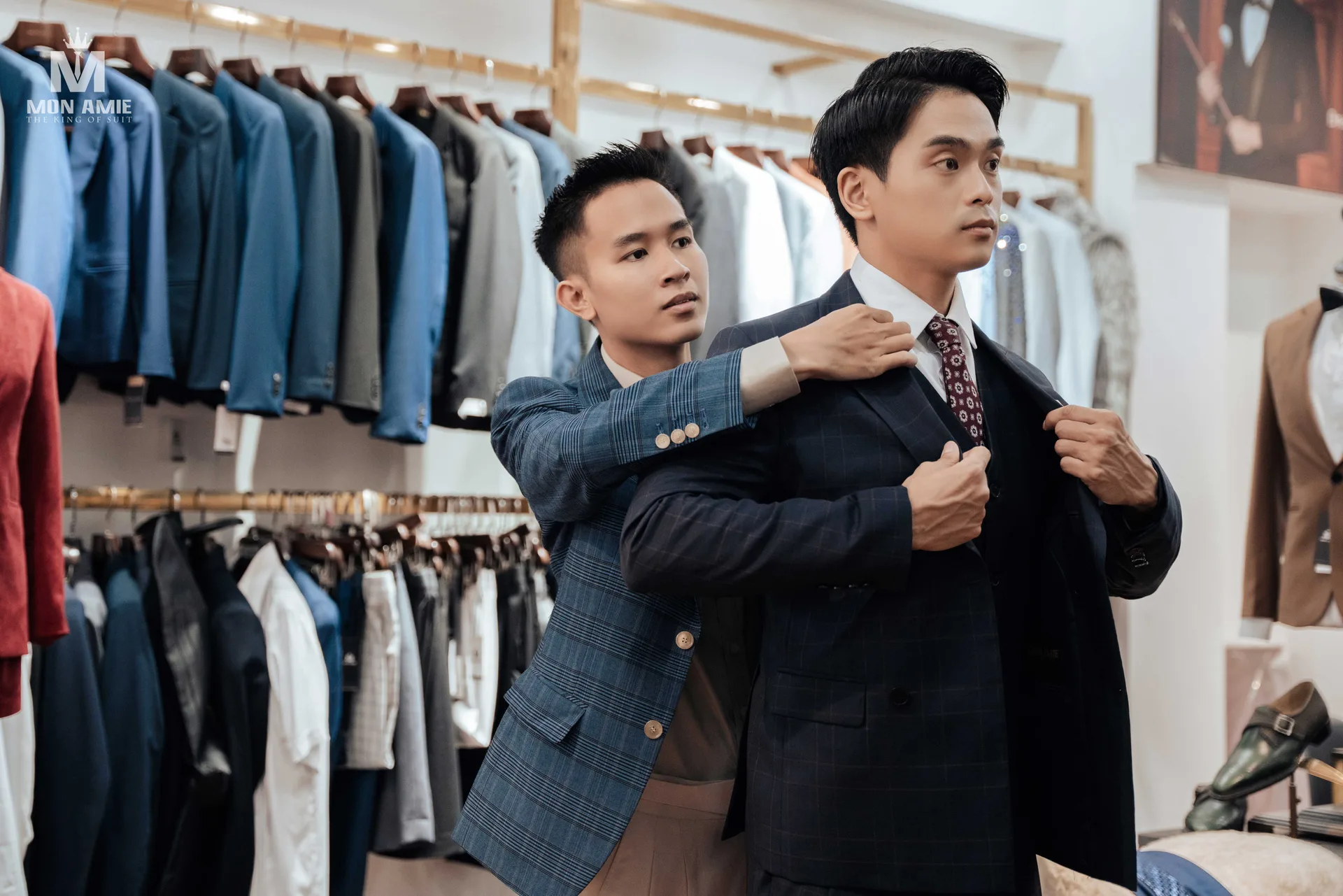
Example: the same person, three ways to buy
Imagine you're 1.72 m tall, with broad shoulders, a slightly full stomach and slightly long arms. With ready-to-wear, you try on several: size 50 fits the shoulders but is tight at the stomach; size 52 fits the stomach but is loose at the shoulders. You pick one and ask the shop to take in the body and shorten the sleeves; the shoulders remain the place where you compromise.
With made-to-measure, the tailor takes your measurements and applies them to the base pattern closest to your build, so the shoulders, stomach and arms are all adjusted to your measurements. Subtler characteristics, such as one shoulder sitting lower than the other, usually lie beyond what a base pattern can handle.
With bespoke, the tailor draws a new pattern from your actual posture: compensating for the uneven shoulder, leaving room for the stomach in just the right place, then doing a baste fitting to check it on your body. All three methods produce a suit jacket. What differs is how much you have to compromise: a lot, a little, or almost not at all.
Should you have a suit made or buy one off the rack?
There's no universal answer, only an answer for each person. You can ask yourself four questions:
- Do you need the suit this week? If so, ready-to-wear is the practical solution.
- Are your shoulders and chest “between sizes”? If a jacket fits the shoulders but is loose at the stomach, or fits the stomach but is tight at the shoulders, tailoring to measure will make a clear difference.
- Do you wear suits often or only occasionally? The more you wear them, the more fit is worth investing in.
- Is this for a big occasion such as a wedding or a major signing? Then fit is the whole problem, not something that's merely “nice to have”.
On price, a complete made-to-measure suit (jacket and trousers) at Mon Amie comes in three tiers: Essential from VND 4.8 to 10 million, Signature from VND 10 to 20 million, Heritage above VND 20 million. You can see the accompanying fabric classification in the price list; and if you want to know where that money goes, the article suit tailoring price: a cost breakdown answers it item by item.
Common mistakes when learning about made-to-measure vs bespoke
- Thinking tailoring to measure means “making by size”. If you only choose a size and then cut, that isn't tailoring to measure yet.
- Choosing cloth first and being measured afterward. The correct order is the reverse: your build determines the cut, and the cut determines which cloth suits.
- Skipping the baste fitting. The baste is the first trial garment, where the tailor looks at the jacket on you to adjust the shoulders, back and closeness of fit. This step is why bespoke fits better.
- Comparing the price of a made-to-measure suit with a ready-to-wear suit that goes by the same name. The two differ in both process and cloth quality, so the comparison has to be fair.
A tip from a Mon Amie master tailor: when comparing two tailors, don't just ask about price. Ask how many measurements they take, whether there is a baste fitting, and, if you gain or lose a few kilos later, whether the suit can be adjusted again. Those three answers say more than a price list.
If you want to understand more before booking an appointment, the article made-to-measure men's suits: what you need to know goes into each step.
Frequently Asked Questions
How does a ready-to-wear suit differ from a made-to-measure suit?
A ready-to-wear suit follows standard sizes: you choose the nearest one and make minor alterations. A made-to-measure suit is made to your own measurements and posture, so the shoulders, chest, back and sleeves all match. The biggest difference lies in the places an alteration shop can't touch, such as the shoulders and collar.
Does a ready-to-wear men's suit last long?
Yes, if the cloth quality and the fit are right. The issue isn't durability but the feeling of “almost fits”: many men can wear one but never feel truly comfortable. If you wear a suit to meetings every week, fit should be the priority.
How long does it take to have a suit made to measure?
It depends on the level and the number of fittings. The more baste fittings, the longer it takes, but in return the suit fits better. Tell the stylist the date you need to wear it when you book, so the fitting schedule can be arranged to match.
Should you have a suit made or buy one off the rack?
Buy off the rack when you need it quickly and your build is close to standard size. Choose made-to-measure when you wear suits often, your shoulders and chest sit between sizes, or you need one for a big occasion. Mon Amie also offers an online made-to-measure service for clients who live far away.
Final Thoughts
Once you understand the made-to-measure vs bespoke question, you'll see that tailoring to measure isn't a privilege of the wealthy but a way of buying clothes with fewer regrets, because clothes that fit are always worn more. If you're still unsure which level to choose, just book a measurement appointment and tell the stylist your budget plainly; we'll point out where the money is worth spending and where it isn't.