
“Twenty million for a suit: is it worth it?” It is a question we hear regularly in the showroom, often with a hesitant smile. The honest answer is: sometimes it is, sometimes not yet. This article does not try to persuade you to spend more. The aim is to show you what that money buys, so you can decide for yourself when a luxury made-to-measure suit is a sensible investment.
Quick answer
Mon Amie’s Heritage line starts above VND 20 million and goes up to VND 60 million per suit, made from cloth by Italian and English mills such as Canonico, Holland Sherry, Dormeuil and Scabal. The difference lies in smoother and more durable cloth, more careful structuring and the full made-to-measure experience. The investment is most worthwhile when you wear suits often and want one that lasts many years.
Three price tiers of made-to-measure suits and what each changes
Mon Amie divides made-to-measure suits (jacket and trousers as a set) into three lines. Each differs not only in price but in the kind of cloth and the reach of the experience.
| Line | Price for the full suit | Fabric | Suited to |
|---|---|---|---|
| Essential | VND 4.8 – 10 million | Kevinlli 40–70% wool (100s–140s) | A standard starting point with the Mon Amie cut |
| Signature | VND 10 – 20 million | Kevinlli 80–100% wool 140s–150s, Dolce & Taylor, Luciano, Salford, Vercelli | The most popular line |
| Heritage | Over VND 20 million, up to VND 60 million | Canonico, Holland Sherry, Dormeuil, Scabal | Top-tier cloth from Italian and English mills |
Signature is already the most popular line. Heritage is for those who want to go one step further in cloth quality and polish, not a requirement for having a handsome suit. The full details are on the made-to-measure price list.
Luxury made-to-measure suit: what makes a VND 20–60 million suit?
1. Cloth: most of the number
Cloth at this price comes from long-established mills in Italy and England. The wool fibre is finer and more carefully processed, giving a soft feel, a handsome drape, few creases and a shape that holds up after many wears. The “s” number (such as 150s, 180s) indicates how fine the fibre is: the higher the number, the finer the fibre and the smoother the cloth, but also the thinner it is and the more careful the care it needs. A high-grade cloth is not only handsome when new but still handsome after hundreds of wears.
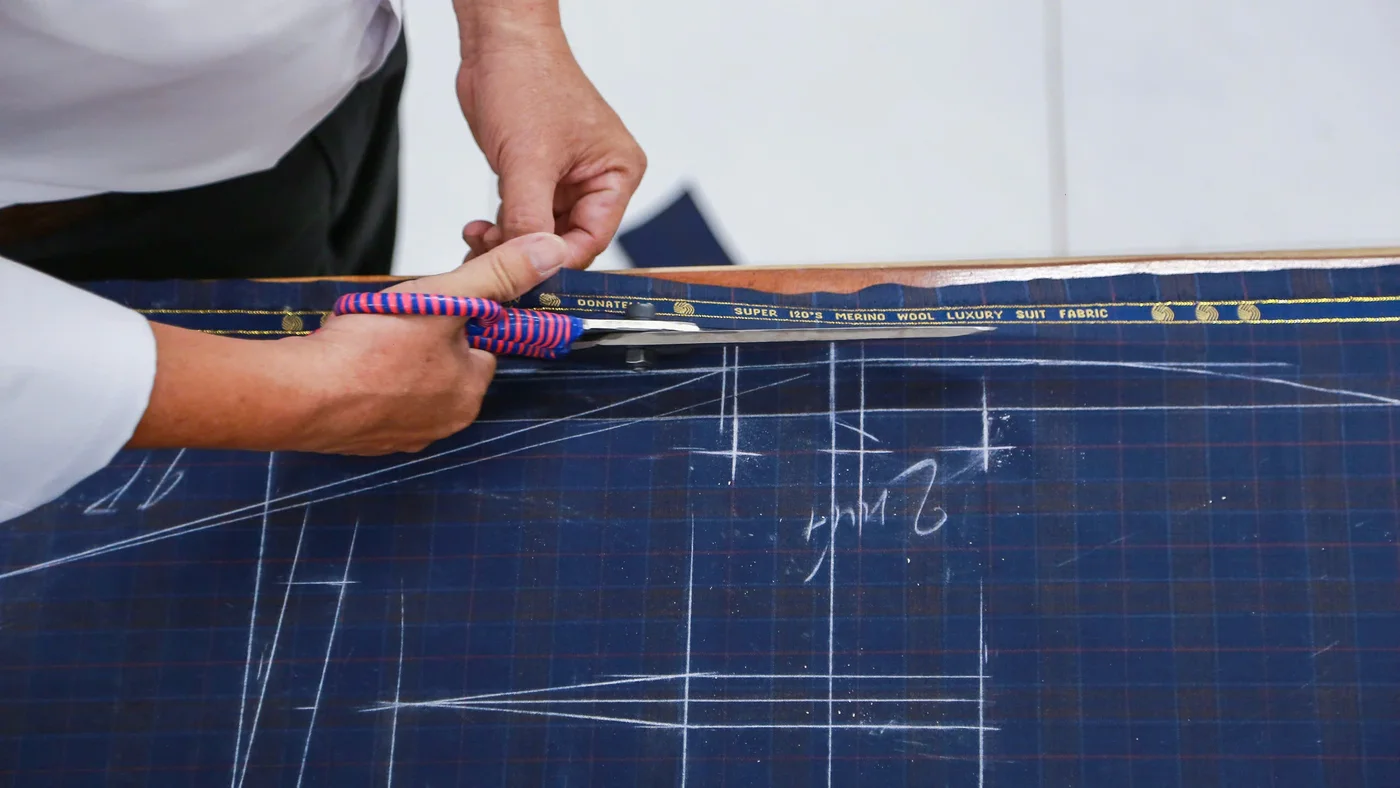
2. Structure: what you cannot see
What decides whether a jacket holds its shape is the inner layer of structure: at the chest, shoulders and lapels. Careful structuring helps the suit keep its shape after years, and the lapel rolls softly and naturally. That is why two suits that look the same in a photograph can still feel very different to wear. You can check this yourself with the article how to recognise a luxury men’s suit through 10 tailoring details.
3. Measurements and the number of fittings
With the bespoke tailoring service, the artisan takes more than 30 measurements and keeps them for life, then holds baste fittings and adjusts until it is perfect. This part does not appear on the label but it decides the fit. An expensive cloth made up without fitting well is still a suit that does not fit.
4. Craftsmanship and time
Cutting, structuring, sewing, fitting and adjusting all need a master tailor’s time. A carefully finished suit is one in which every seam, buttonhole and lining has been checked again. A long-term alteration warranty after you collect it comes with it, so the suit goes with you through changes in your build.
5. The complete experience
You meet a stylist and master tailor in person and choose cloth from the Italian and English fabric library. That is a very different way of buying a suit from taking a jacket off the rack.
When is this investment worth it?
Try calculating by the number of wears instead of the amount of money. Suppose a VND 30 million suit is worn 60 times a year for 5 years: that is 300 wears, roughly VND 100,000 per wear. This is only an illustrative example, but it shows that a suit worn regularly is not as expensive as the initial figure.
Heritage is worth it when:
- You wear a suit almost every week, for work, meetings, clients and events.
- Image is part of the job: business owners, executives, lawyers, presenters.
- You need a “foundation suit” to use for many years on important occasions.
- You know exactly the cut you want, so you do not need many fittings to decide.
Signature is enough when:
- You wear a suit a few times a month.
- You want smooth cloth that holds its shape at a reasonable price.
- You are building your wardrobe one suit at a time.
Caring for a luxury suit so it is worth the money
The investment is only complete when the suit lasts. High-grade wool is durable, but it still needs three simple habits:
- Let the suit rest. Do not wear the same suit two days in a row. Wool fibre needs about 24 to 48 hours to recover its elasticity and release moisture.
- Use a wide-shouldered hanger. A thin plastic hanger deforms the shoulders. A wooden hanger or one with thick shoulders keeps the shape for longer.
- Dry-clean at the right time and in the right place. A suit should be dry-cleaned only when really necessary, since each cleaning tires the cloth. Hanging it in the air and brushing it lightly with a soft-bristled brush is often enough for many weeks.
For those who wear suits often, a rotating pair of suits (two suits of the same line, alternated) lasts longer than a single suit worn every day. A sensible split is to use the Heritage suit for important occasions and a Signature suit for everyday work.
Mistakes when buying a luxury suit
- Buying expensive cloth but not measuring carefully. A VND 50 million cloth with a crooked shoulder is not as good as a VND 10 million cloth that fits.
- Choosing very thin cloth for daily wear. A fibre that is too fine looks handsome but wears out quickly if worn constantly. Choose cloth that is smooth but durable enough for your needs.
- Looking only at the label and the mill’s name. The name is only part of it. The structuring, the fit and the craftsmanship make the suit.
- Neglecting care. A luxury suit needs a wide-shouldered hanger, rest between wears and proper cleaning.

Tips from Mon Amie's master tailors
Master tailors always say that a handsome suit is the result of three things multiplied together, not added: cloth, cut and craftsmanship. If any one of them is zero, the whole suit fails. So if you can upgrade only one thing, upgrade the fit first (careful measuring, enough fittings), and then the cloth.
Second: do not choose Heritage just because you can afford it. Choose it because you know you will wear it. Once you wear it regularly, you will see the gap between top-grade and ordinary cloth show in the drape, the flatness and the feel to the touch. And if you are not sure, the Signature line is a wonderful stepping stone to get a feel for it first.
Frequently asked questions
How much does a luxury made-to-measure suit cost?
At Mon Amie, the Heritage line costs over VND 20 million and goes up to VND 60 million per suit (jacket and trousers), made from Canonico, Holland Sherry, Dormeuil and Scabal cloth. The Signature line at VND 10 – 20 million is also placed in the premium cloth group, with Kevinlli 80–100% wool.
How does a luxury suit differ from an ordinary made-to-measure suit?
It differs in cloth (finer, more durable fibre), structuring, measurements, number of fittings and finishing craftsmanship. From the outside the two suits may look alike, but the feel when worn and the durability over time are clearly different.
Which line should a business owner choose for a luxury suit?
If you wear suits often and image matters, Heritage is worth the investment. If you wear one a few times a month, Signature is a good balance between cloth quality and cost.
Is a more expensive men’s luxury suit always better?
Not necessarily. Price reflects the cloth and the labour, but a suit looks good only when it fits. A well-fitted suit at a moderate price looks better than an expensive suit that is cut off.
An invitation from Mon Amie
If you are weighing up the lines, pick up each cloth in your hand. You can preview them in the fabric library, consult the price table above and read the article the price of suit fabric: why it ranges from a few hundred thousand dong to millions. When you are ready, the bespoke tailoring service will take you through the whole journey from choosing fabric to the baste fitting.