
Many pairs of suit trousers go wrong on the piece of paper where the measurements are written, before the tailor has cut the first piece of cloth. The cause is usually not the tailor but the person measuring themselves: taking the waist at their current belt line rather than where the waistband will sit, or measuring the trouser length before putting shoes on. If you plan to measure for trousers at home, the seven measurements below are the framework you need, with how to take each one correctly.
Quick answer
How to measure for suit trousers at home calls for seven measurements: waist, hip, thigh, rise, trouser length, hem width (leg opening) and knee. Use a soft tape, stand naturally, measure at the exact waistband position you will wear, put on the shoes you intend to wear when measuring the length, and have someone help you for accuracy.
Preparing before you measure
- A soft tape measure (the tailoring kind), not a metal ruler or a construction tape.
- A helper. Measuring your own hip and trouser length alone is almost always wrong, because it is hard to keep the tape straight.
- Clothing: underwear or thin, close-fitting trousers. Don't measure over thick trousers, and don't measure while wearing jeans.
- The shoes you plan to wear with the suit, for the trouser length.
- Paper and a pen, noting down each figure as you measure it, not from memory.
- Time of measuring: when your body is in its normal state, not right after a big meal and not after heavy exercise.
The seven measurements you need
| Measurement | Where to measure | Key tip |
|---|---|---|
| 1. Waist | At the position where the waistband will sit | Stand comfortably; don't suck in your stomach |
| 2. Hip | The fullest part of the hip | Feet together, tape level |
| 3. Thigh | The widest point, just below the crotch | Stand naturally |
| 4. Rise | From the waistband to the chair seat when sitting | Sit upright on a hard chair |
| 5. Trouser length | From the waistband to the desired hem | In the shoes you will wear |
| 6. Hem width (leg opening) | The circumference of the hem in the style you want | Choose according to the leg shape |
| 7. Knee | Around the knee | Stand with your legs straight |
How to measure for suit trousers: each measurement step by step
1. Waist
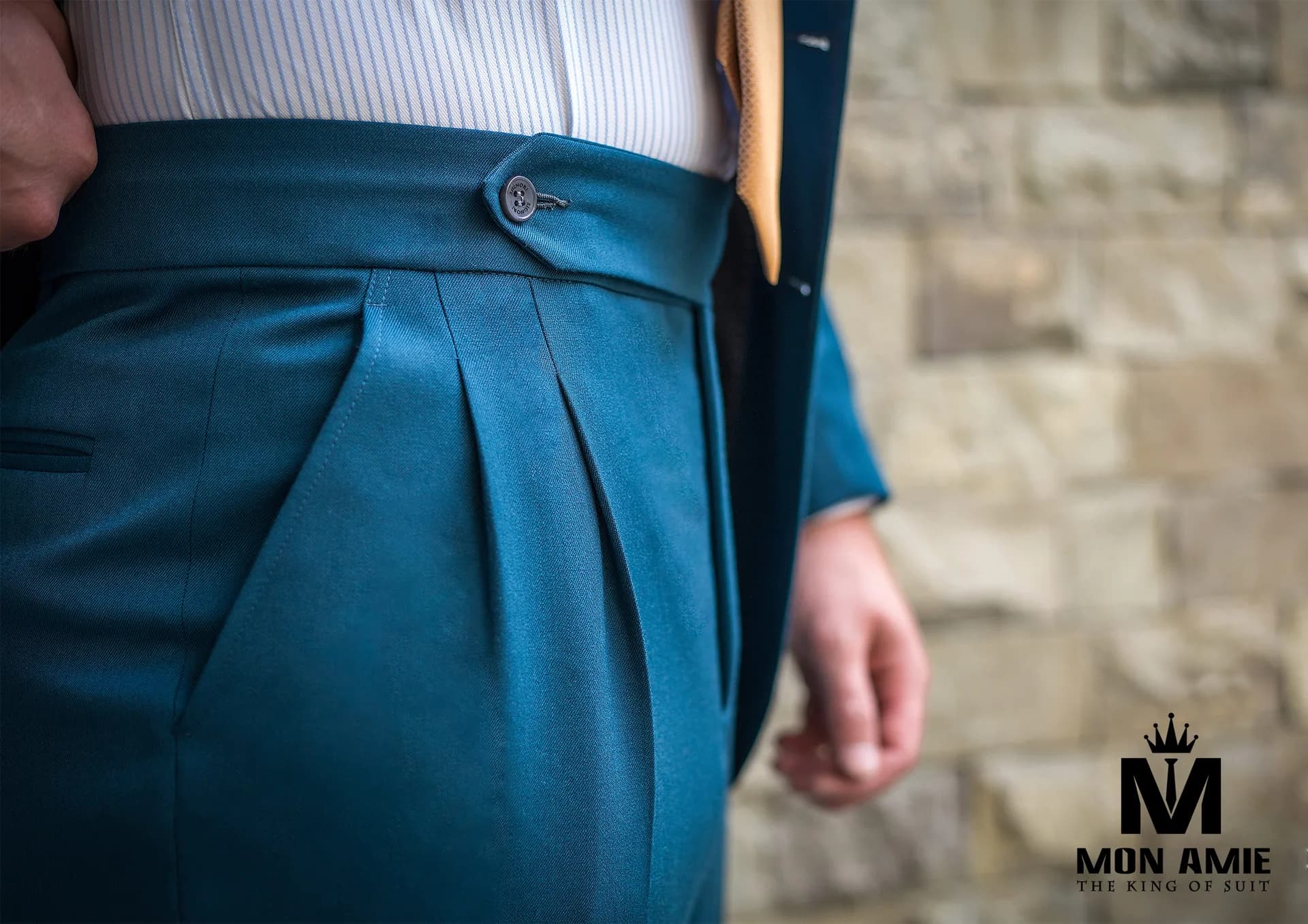
Decide first where the waistband will sit: at the navel (the most common), slightly above the navel (high rise) or slightly below the navel (low rise). Wrap the tape around at exactly that position, with the tape level and parallel to the floor, snug but not tight; you should be able to slip one finger under it. Stand straight and breathe normally. Don't suck in your stomach to “look better on paper”, because the trousers will feel tight when you sit or eat.
2. Hip
Stand with your feet together and measure around the fullest part of your hips, with the tape level. Ask your helper to keep the tape from drifting up or down at the back. Everyone's body is fullest at a different place, so slide the tape up and down to find the largest point.
3. Thigh
Measure around the thickest part of the thigh, just below the crotch crease. Stand normally without flexing, with the tape snug at a moderate tension. This measurement determines comfort in the thigh, and it matters particularly for those with large thighs or who sit a lot.
4. Rise
Many men skip this measurement, but it decides whether the trousers are comfortable when you sit. A common method: sit upright on a hard chair and measure from the waistband position at the side of the hip down to the chair seat. You only need to note the true measurement; the extra allowance for sitting comfortably is the tailor's job. Another way is to measure from the front waistband through the crotch to the back waistband on a pair of trousers that already fit. Both methods give you the rise, which is the term tailors use.
5. Trouser length
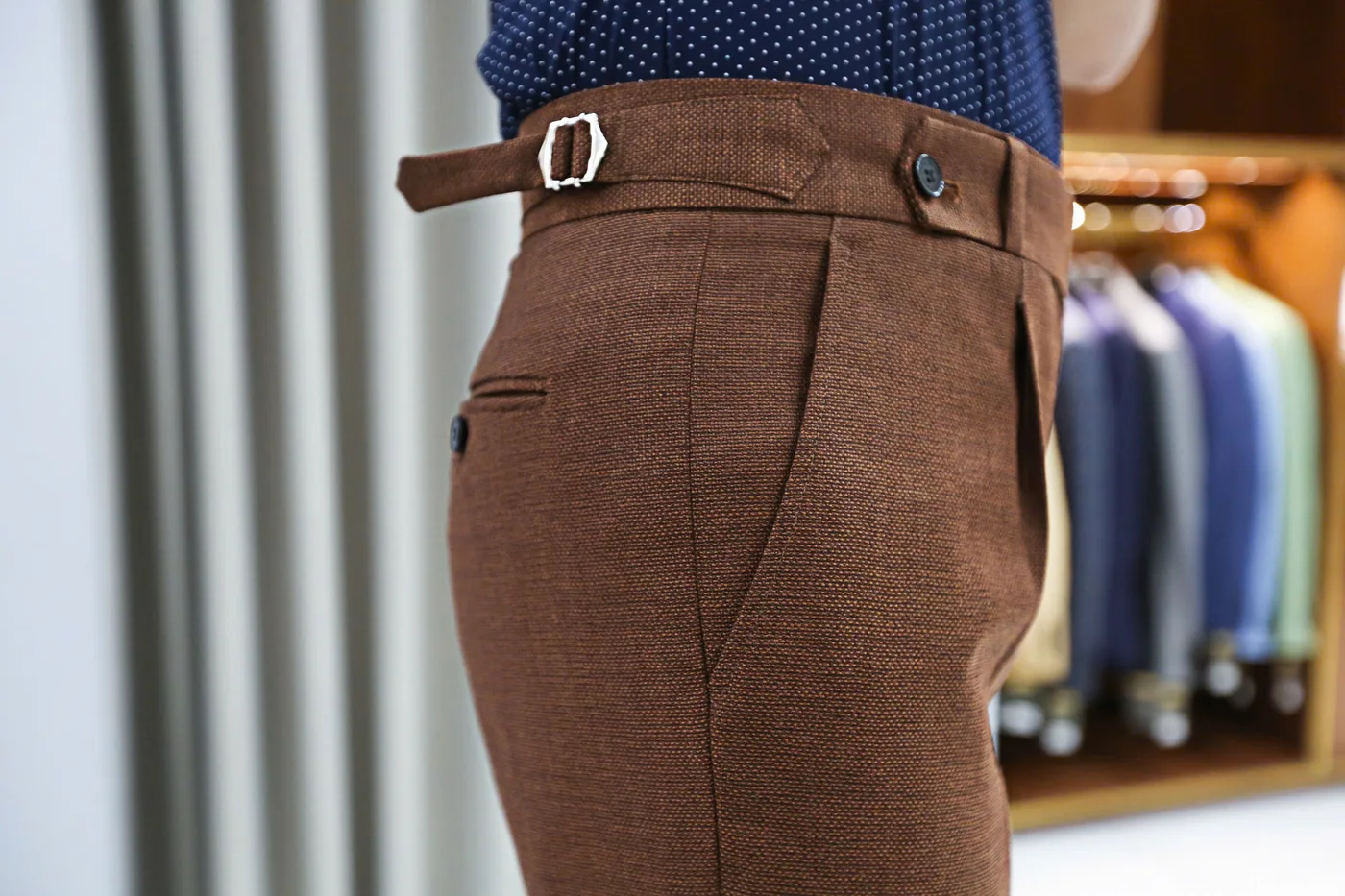
Put on the shoes you plan to wear. From the waistband position (at the side of the hip), measure straight down to the desired hem. The hem usually touches the top of the shoe, with a slight break or none. Decide beforehand what kind of break you like (see the section below), then measure accordingly. Have your helper write it down, to avoid misreading from an angle.
6. Hem width (leg opening)
This is a measurement of preference, not of your body. For reference: a slim, tapered leg usually has a hem circumference of about 36–40 cm, and a straight leg about 40–46 cm. Choose by body shape and shoes: a hem that is too narrow catches on the shoe, and one that is too wide makes the hem bunch up. The article men's trouser styles helps you choose a leg shape before you settle on the number.
7. Knee
Measure around the knee with the leg straight. This number helps the tailor decide the taper from the knee to the hem: a wide knee with a narrow hem gives a clearly tapered leg, while a knee and hem of nearly equal size give a straight leg.
Waistband position and break: two decisions beyond the measurements
Waistband position
- Waistband at the navel: common, comfortable, suits most builds.
- High waistband (above the navel): lengthens the legs visually, suits trousers with pleats and braces.
- Low waistband (below the navel): neat and youthful but prone to slipping, not suitable for a fuller stomach.
Break
- No break: the hem touches the top of the shoe without creasing. Neat, modern.
- Slight break: one small crease. Common and the easiest to wear.
- Medium or full break: several creases, classic, suits those who like a feeling of comfort but not suited to shorter men.
Checking against a pair of trousers that already fit
To double-check your numbers, you can measure a pair of trousers that already fit: lay them flat, measure straight across the waistband and double it for the waist, measure the hip across the widest point and double it, measure the length from the waistband to the hem, and measure the rise from the front waistband through the crotch to the back waistband. Compare with your self-measured figures; if any figure is off by more than 1–2 cm, measure that one again. For a jacket, a similar method is described in how to take measurements from a ready-made jacket.
Common mistakes when measuring yourself
- Measuring the waist at the old belt line instead of where the waistband will sit. The error can reach several centimetres.
- Sucking in your stomach or holding your breath while measuring, so the trousers are tight when you sit.
- Measuring over thick trousers, which makes the numbers larger than reality.
- Measuring the length barefoot or in sandals, so the hem ends up too short or too long for your shoes.
- Skipping the rise, which leads to trousers that are tight or slip down when you sit.
- A twisted or tilted tape when measuring the hip and thigh.
- Trusting a single measurement. Measure twice, and if the results differ, measure again.
Tips from a Mon Amie master tailor
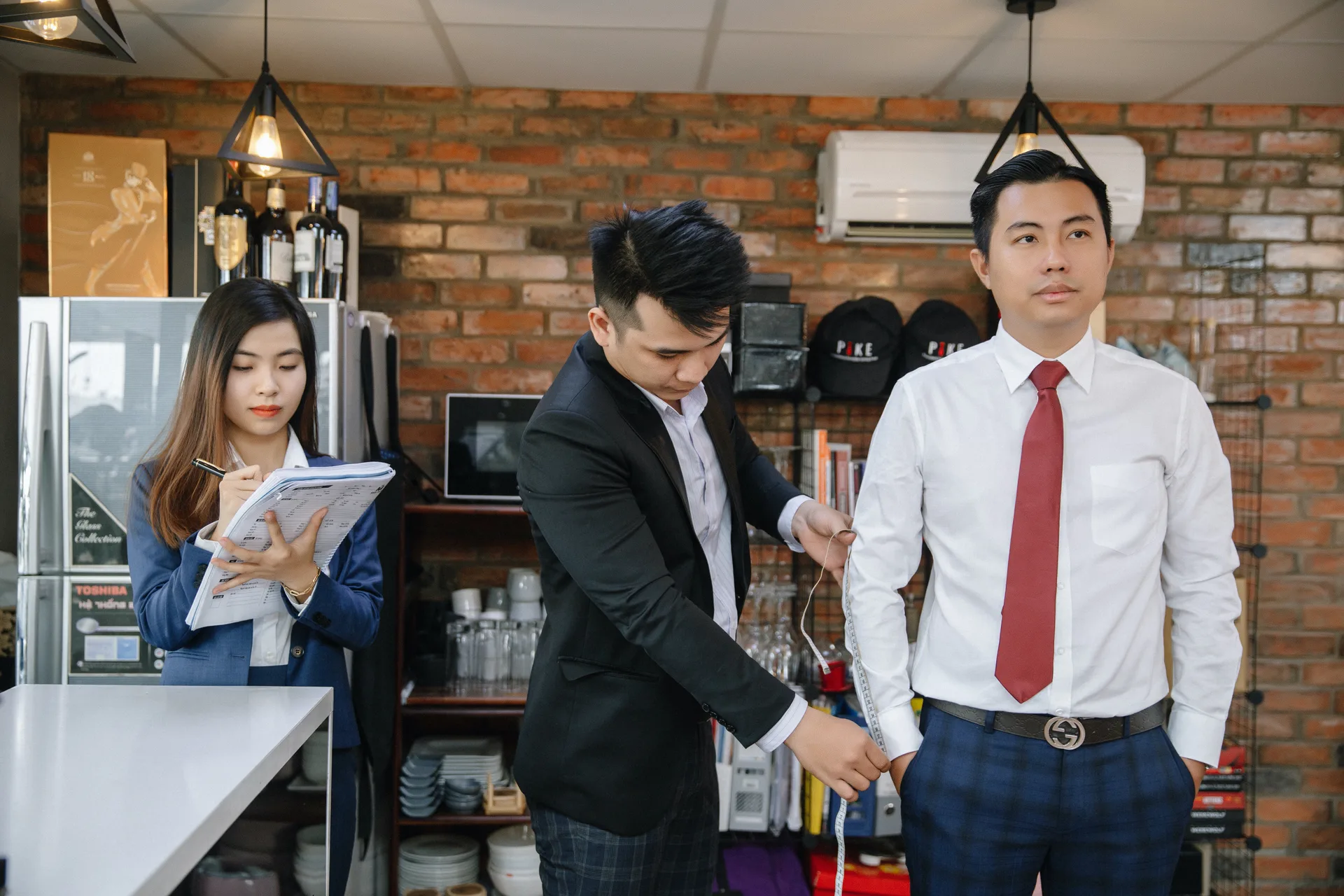
Self-measured numbers are only a starting point; a true fit comes from the baste fitting. Mon Amie takes more than 30 measurements in its bespoke tailoring experience and keeps them for life, including lower-body measurements. If you aren't confident measuring yourself, there are two convenient routes: online tailoring, with step-by-step measuring guidance over a video call or using your stored measurements, and at-home tailoring, where an artisan comes to your home, office or hotel in Ho Chi Minh City.
Frequently asked questions
Is measuring for trousers at home different from measuring for a suit jacket?
Yes. Trousers need the waist, hip, thigh, rise, length, hem and knee. A jacket needs the shoulder, chest, waist, jacket length, sleeve length and many other measurements. The two sets differ and should be taken separately, with a helper for both.
How is measuring suit trousers different from measuring regular dress trousers?
The method is the same, but suit trousers go with a jacket, so the waistband, pleats and break need to match the silhouette of the jacket. Suit trousers usually have a moderately high waistband and a rise long enough to be worn all day with a waistcoat or jacket.
What are long-rise men's trousers, and how do you measure the rise?
A “long rise” means the length of the trouser rise, from the crotch seam up to the waistband. Trousers with a long rise have a higher waistband and are more comfortable when you sit, suiting a fuller stomach or a classic style. To measure, sit on a chair and measure from the waistband down to the seat, or measure a pair of trousers that already fit.
Is measuring trousers at home accurate?
It can be good enough as a starting point if you use a soft tape, get a helper and measure at the correct waistband position. But the final fit still comes from the baste fitting and adjustments.
Conclusion
Knowing how to measure for suit trousers is not difficult: seven measurements taken in the right place and posture, plus two decisions about the waistband and the hem, are enough to give you a reliable measurement sheet. If you would rather have a master tailor measure for you, book a measuring appointment at a showroom or have an artisan come to you.