
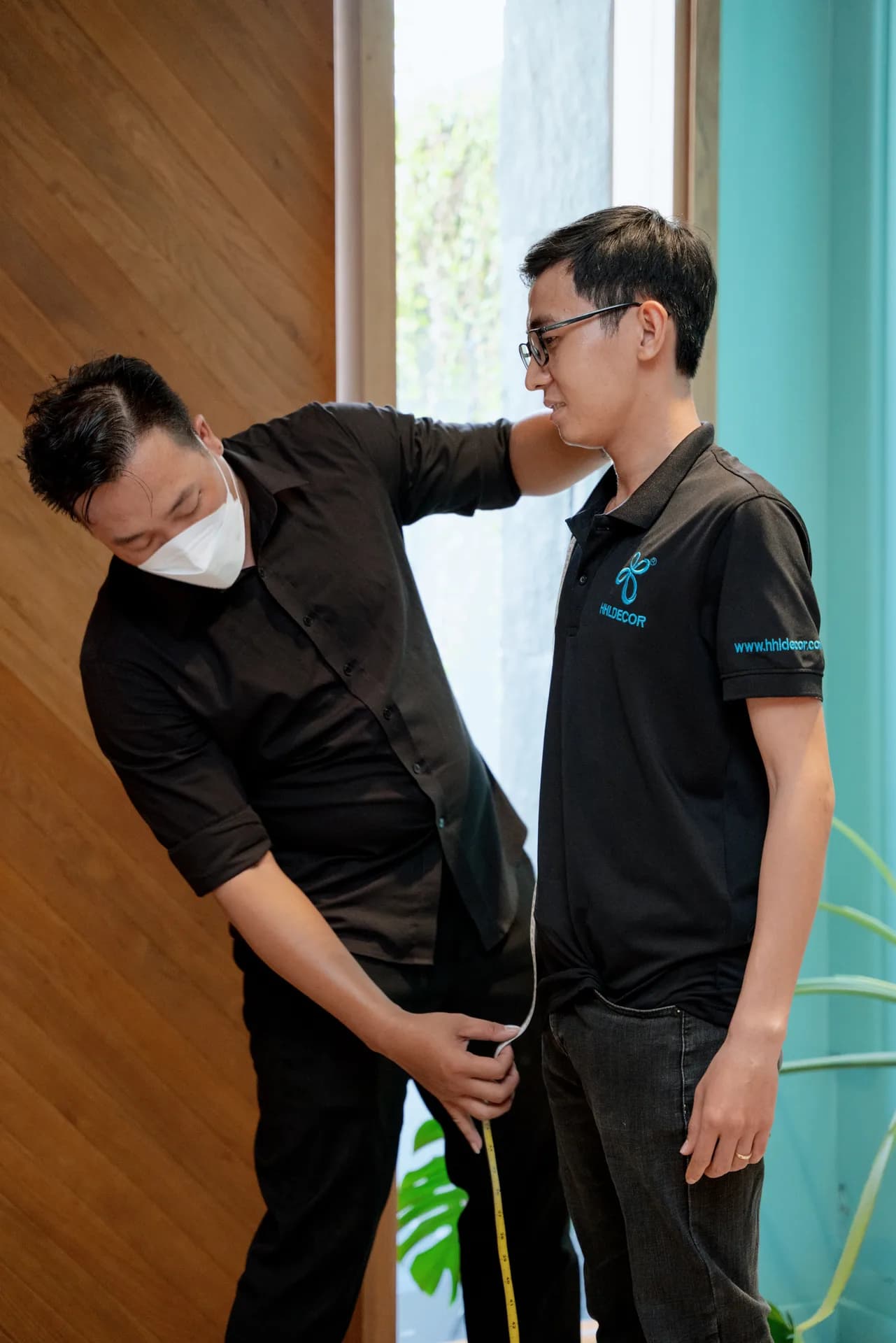
Picture a fifth-floor meeting room cleared out, tables and chairs pushed into a corner, staff lining up department by department. If on that day everyone is asked just one question, “what size are you?”, then three months later the company will have a team wearing the same colour of jacket, but jackets that are loose in some places and tight in others. Whether company uniform suits look good is largely decided at that measuring session. This article walks through each step, from the survey to managing measurements for add-on orders.
Quick answer
Making company uniform suits properly takes six steps: surveying the need, approving cloth and samples, measuring each person individually, making and fitting, handing over against a list, and keeping the measurements for additional orders. The difference lies in measuring each person rather than applying a common size.
Why must uniform suits be measured individually?
A suit jacket is the least forgiving garment when it comes to fit. A T-shirt one size too big is still wearable, but a suit that is loose at the shoulders or tight across the chest shows from far away. When buying in standard sizes, companies usually run into three problems:
- Smaller people wear jackets that are too loose in the shoulders and sleeves, and look as if they have borrowed the clothes.
- Tall people or those with broad shoulders are tight across the chest, restricted in the arms, and short in the trousers.
- People with a distinctive build (belly, uneven shoulders, long legs) struggle to find a size that fits and settle for something close.
Measuring each person solves all three, and has a benefit that few people mention: staff feel the suit was made for them, so they wear it more consciously. Mon Amie takes uniform suits and premium uniforms on exactly that principle: every member is measured individually, with no common sizing. If you want an overview of the service, the bespoke uniform page sets it out in full.
Six steps to making company uniform suits
Step 1: Survey the need
Before talking about cloth or style, settle the basics:
- Who will wear it: leadership, sales, reception or the whole company; men, women or both.
- Working environment: air-conditioned office, frequently out and about, business travel.
- Brand image: main colour, level of formality, with or without a logo.
- Budget and expected quantity.
Mon Amie surveys in order to choose the right cloth line and cut, avoiding anything too high for the need or too low for expectations.
Step 2: Approve cloth and samples
Approve on real cloth and a sample jacket, not from photos. The human eye sees the colour of cloth on a screen differently from under office lighting. The same navy can look much lighter or darker under fluorescent lamps. It is best to settle all of these at once: colour, pattern, cloth composition, lapel style, number of buttons, and the style of trousers or, for women, the skirt. The article premium office suit uniforms suggests how to choose by job role.
Step 3: Measure each staff member individually
This is the session that decides everything. Mon Amie's measuring team comes to the company and measures people one by one, recording each on an individual measurement sheet. Each person is measured for the basic dimensions such as shoulder, chest, waist, hips, jacket length, sleeve length and trouser length, together with notes on posture. An effective measuring session needs:
- A ready list of staff (full name, department, gender) so that measuring follows an order.
- A room that is large enough and well lit, with a place for staff to change or to try on a sample jacket.
- A person in charge on the company side to deal with absentees or shift changes.
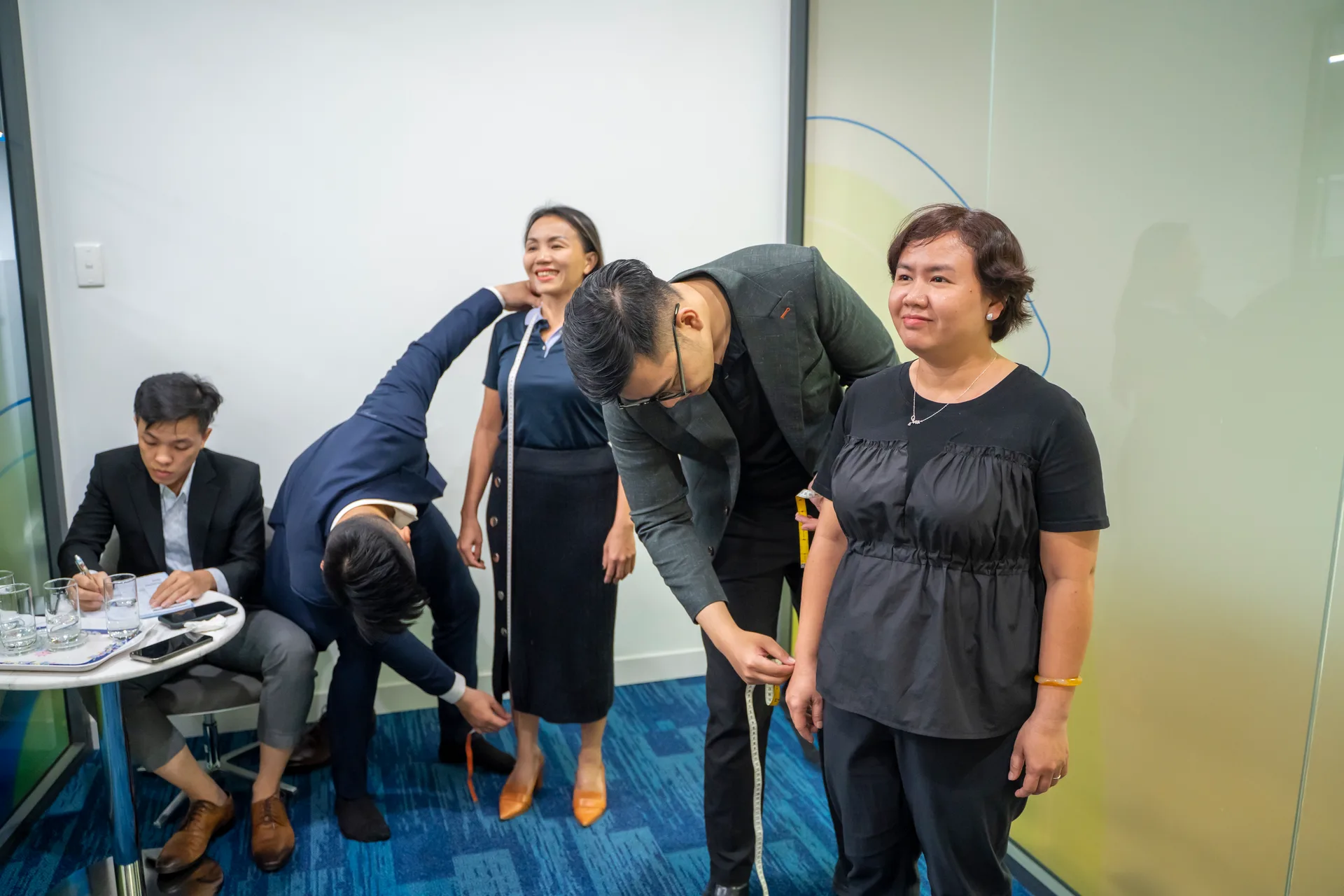
Step 4: Make the suits and hold the fitting
After measuring, each suit is made to the individual measurements. For large quantities, the fitting session is the final check: staff try on the suit, and the master tailor adjusts the shoulders, sleeve length, waist and trouser length. This is a step that standard sizing never has, and it is why made-to-measure uniforms have real presence when worn.
Step 5: Hand over against the list
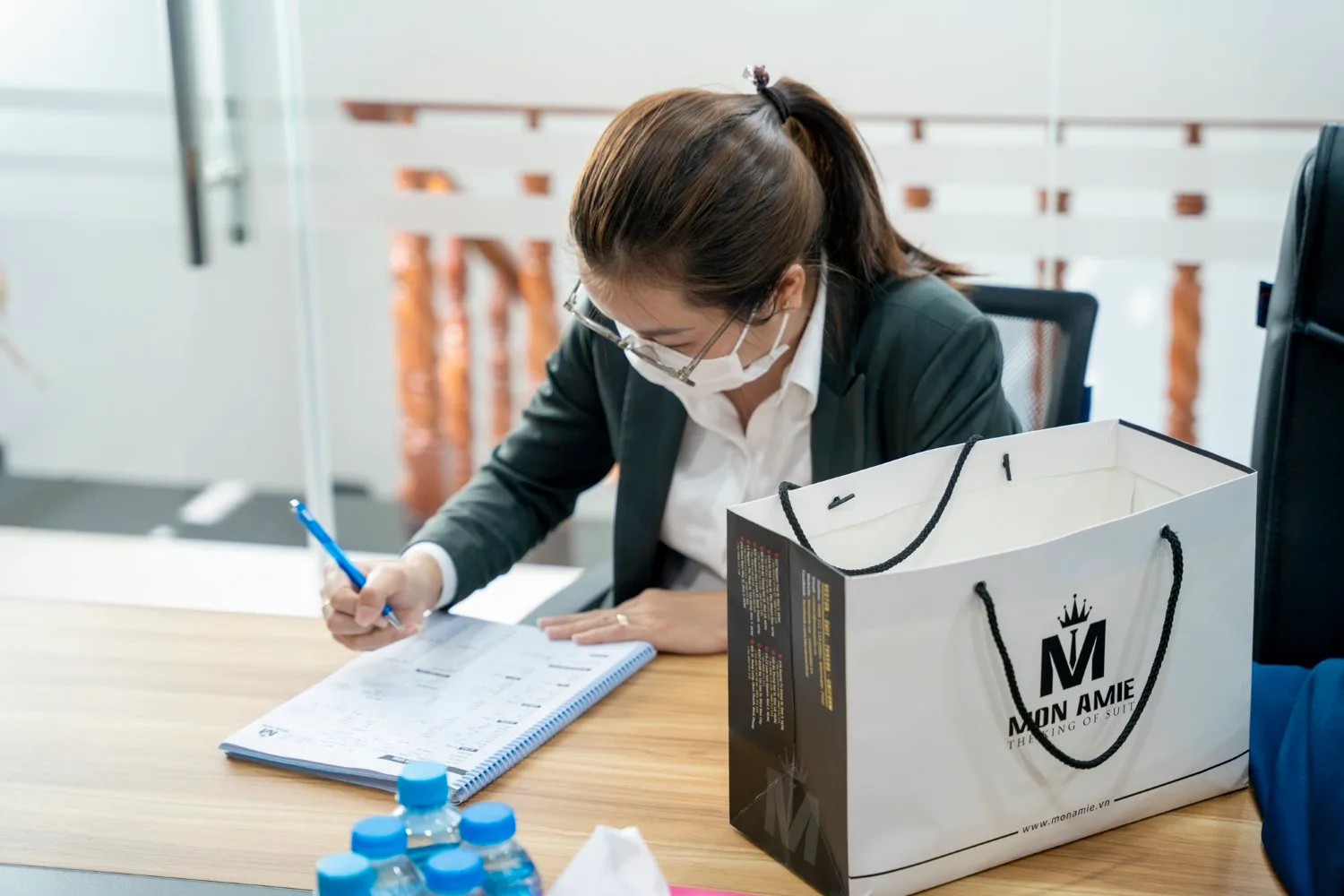
Each uniform should be labelled with the staff member's name or staff code and handed over against the original list. The recipient signs for it, and the company's person in charge keeps a record. Suits that need further adjustment are noted separately and an appointment is made.
Step 6: Keep measurements for additional orders
A business always has new hires, people changing roles, people whose build changes. If every additional order means measuring from scratch, or using estimated sizes, the uniform drifts out of line over time. Mon Amie manages the measurements of the whole team for later orders, so for existing staff who need more suits, the company only needs to give the name. New staff are measured as an addition, and then join the shared measurement archive.
How to store and update measurements for staff
An effective measurement register has the following columns:
| Information | Why it is needed |
|---|---|
| Full name, staff code, department | To identify people and match each suit to the right person at handover |
| Date of latest measurement | To know when re-measuring is needed |
| Main measurements | So that additional orders do not need measuring from scratch |
| Notes on posture | Uneven shoulders, belly, long legs: the tailor needs to know in order to cut |
| Number of suits delivered, delivery date | To track the life cycle of the uniform |
| Status | Active, left, changed position |
For people whose weight or build has changed within six months to a year, re-measure. The old measurements still serve as a base, but need to be verified with a baste fitting.
Common mistakes when making company uniform suits
- Approving cloth from photos. Colours in real life differ from the screen; look at the real cloth under office lighting.
- Fixing the quantity too tightly. Allow a few extra suits for new hires and for anyone who needs alterations.
- Not measuring everyone together. If only some are measured and the rest are added piecemeal, the colour of the cloth can differ between batches because they come from different lots.
- Skipping the fitting session. Staff whose jackets sit out of shape will make the whole team look uneven.
- Not keeping measurements. This is the most expensive mistake, because every additional order then costs time to re-measure.
Tips from Mon Amie's master tailors
When measuring in bulk, the master tailor always observes posture before picking up the tape: which shoulder is higher, whether the back is stooped or straight, how far the belly protrudes. Measurements only give numbers; posture explains why a jacket tends to pull. So if the company has people with a distinctive build, say so beforehand so that more time can be set aside to measure them carefully.
If you want to know how to read a uniform quotation before deciding, you can see the article how to read a company uniform quotation.
Frequently asked questions
For uniform suits in Ho Chi Minh City, does Mon Amie come to the company to measure?
Yes. The measuring team comes to the company, measures each staff member in turn and records an individual measurement sheet. All you need to prepare is the staff list and a room that is large enough.
Is making men's uniform suits different from women's?
The process is the same, but the cut differs: women's suits have waist darts, their own sleeve lengths, and their own trousers or skirt. Men and women can still share the same cloth colour and lapel to keep the image coordinated.
What do we need to prepare before the measuring session for a company uniform?
A staff list (full name, department, gender), a room that is large and bright enough, a person in charge on the company side and the uniform style already settled. If anyone has a distinctive build, tell us beforehand so that more time can be set aside to measure them carefully.
Can new hires have additional suits made that match the team?
Yes. New staff are measured individually, added to the shared measurement archive and have suits made in the same cloth and the same style to match the existing team.
Closing thoughts
A team wearing suits that fit each person says something about the business before they even open their mouths. If you are considering it, see Mon Amie's made-to-measure process or book an appointment for a consultation for your business.