Dressing business casual well is not a matter of simply being less formal; it is a matter of choosing each piece with intent: a well-cut shirt, an odd blazer, chinos or wool trousers, versatile leather shoes and a neutral palette. In this article, Mon Amie walks you through each layer — from shirt to accessory — so the whole reads comfortable yet unmistakably professional.
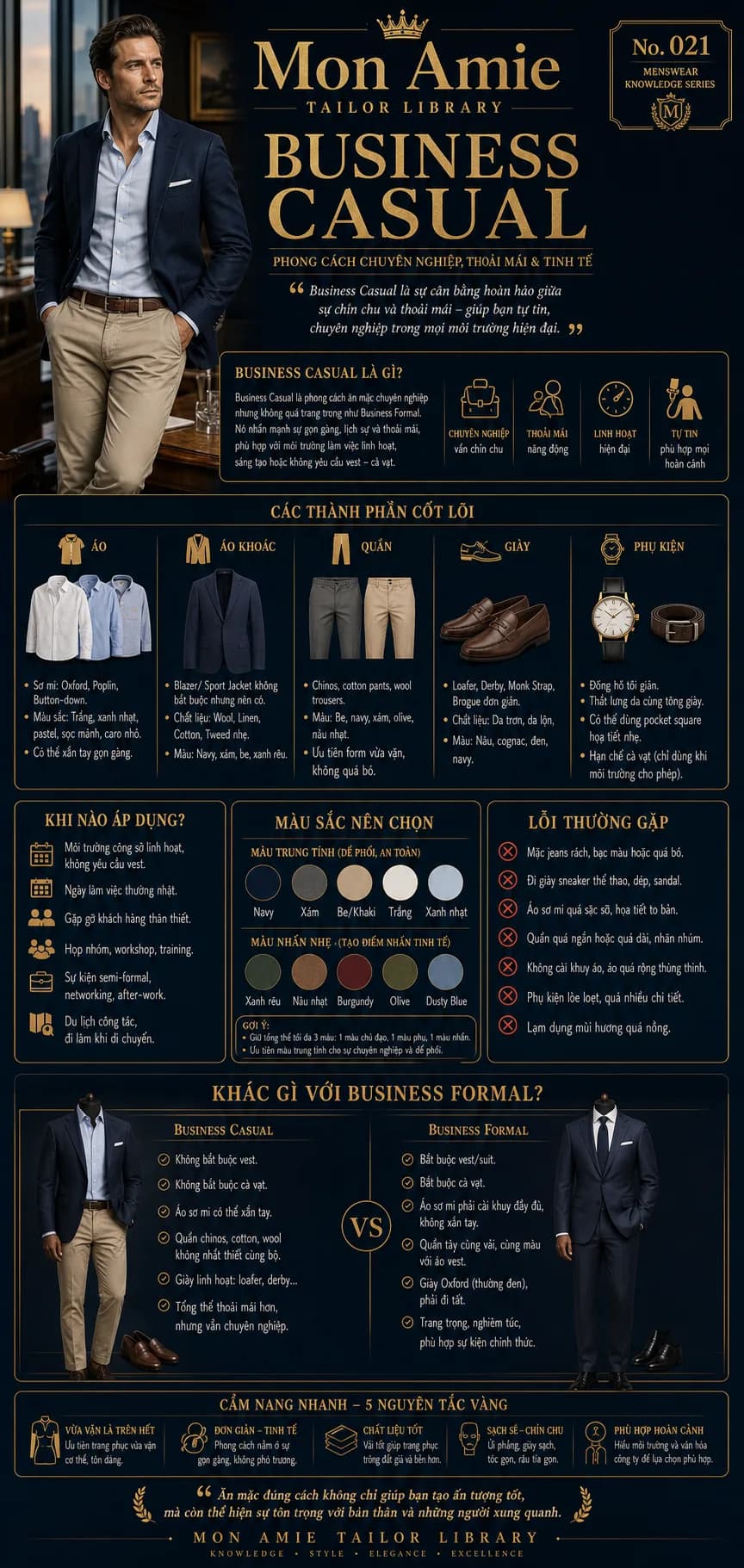
Start with the shirt: Oxford, poplin, button-down
The foundation of business casual is a proper shirt. Three dependable choices:
- Oxford shirt: substantial cloth with a lightly textured surface, relaxed in character yet entirely correct.
- Poplin shirt: smooth and crisp, a touch more formal — ideal for days with client meetings.
- Button-down: the collar is fastened with buttons, holding its shape neatly even without a tie.
For colour, favour white, pale blue, soft pastels, fine stripes or small checks. The difference from business formal is that you may roll your sleeves while working — provided the folds are neat rather than careless.
The odd blazer and chinos: the alternative to a matching suit
In a business casual environment a jacket is not compulsory, but it is very much worth having. A blazer or sport jacket — in wool, linen, cotton or a light tweed, in navy, grey, beige or forest green — immediately elevates the whole outfit without the rigidity of a full suit.
Below, chinos, cotton trousers or wool trousers are the standard choice. A few principles Mon Amie always shares with clients:
- Trousers are best in beige, navy, grey, olive or light brown — easy partners for most jackets.
- Favour a well-judged fit: never too tight, never too short or too long.
- Jacket and trousers need not match in cloth or set — this is precisely the spirit of business casual, in contrast to the matching suit of business formal.
Shoes and accessories: say less, say it well
Shoes are where most men lose ground. For business casual you have four safe choices: loafers, derbies, monk straps and simple brogues — in smooth leather or suede, in brown, cognac, black or navy. Athletic sneakers, slides and sandals all fall outside this dress code.
As for accessories, the more restrained the better:
- A watch with a modest case and understated design.
- A leather belt matched in tone to your shoes — a small rule that shows real attention.
- A pocket square with a light pattern if you want a point of interest.
- Ties are best used sparingly, only where the office culture calls for one.
The colour formula: one dominant, one secondary, one accent
The surest approach to business casual is to keep the whole outfit to three colours at most: one dominant, one secondary and one accent. The neutral family — navy, grey, beige and khaki, white, pale blue — is the safe backbone: easy to combine and reliably professional. Once you are confident, you can introduce gentle accents such as forest green, light brown, burgundy, olive or dusty blue for quiet interest without display.
The mistakes that turn business casual into merely casual
The line between relaxed and slapdash is very thin. The common errors to avoid:
- Wearing distressed, faded or overly tight jeans.
- Athletic sneakers, slides or sandals.
- Shirts that are too loud or heavily patterned.
- Trousers that are too short, too long or badly creased.
- Leaving buttons undone, or wearing pieces that are far too large.
- Flashy accessories, or too many of them.
- Overpowering fragrance.
What these mistakes share is that they break the word "business" in business casual: dress may be comfortable, but it must still be considered, clean and respectful of the people you meet.
A word from Mon Amie's artisans
From years of tailoring for business leaders, Mon Amie finds that a navy blazer made to your own measurements is the single best investment in a business casual wardrobe: it works with beige chinos by day, grey wool trousers by evening, and cotton trousers when travelling. When ordering, ask for a naturally close shoulder and a length that just covers the seat — two details that decide whether an odd jacket looks made for you or borrowed. Light wool or a linen blend suits the climate of Ho Chi Minh City far better than heavy tweed.
Business casual is not difficult — each piece simply needs to be chosen well and fitted to your own body. If you would like to build a business casual wardrobe starting with a made-to-measure blazer and trousers, we invite you to book an appointment with Mon Amie at one of our five showrooms in Ho Chi Minh City, or read about the tailoring process first.