
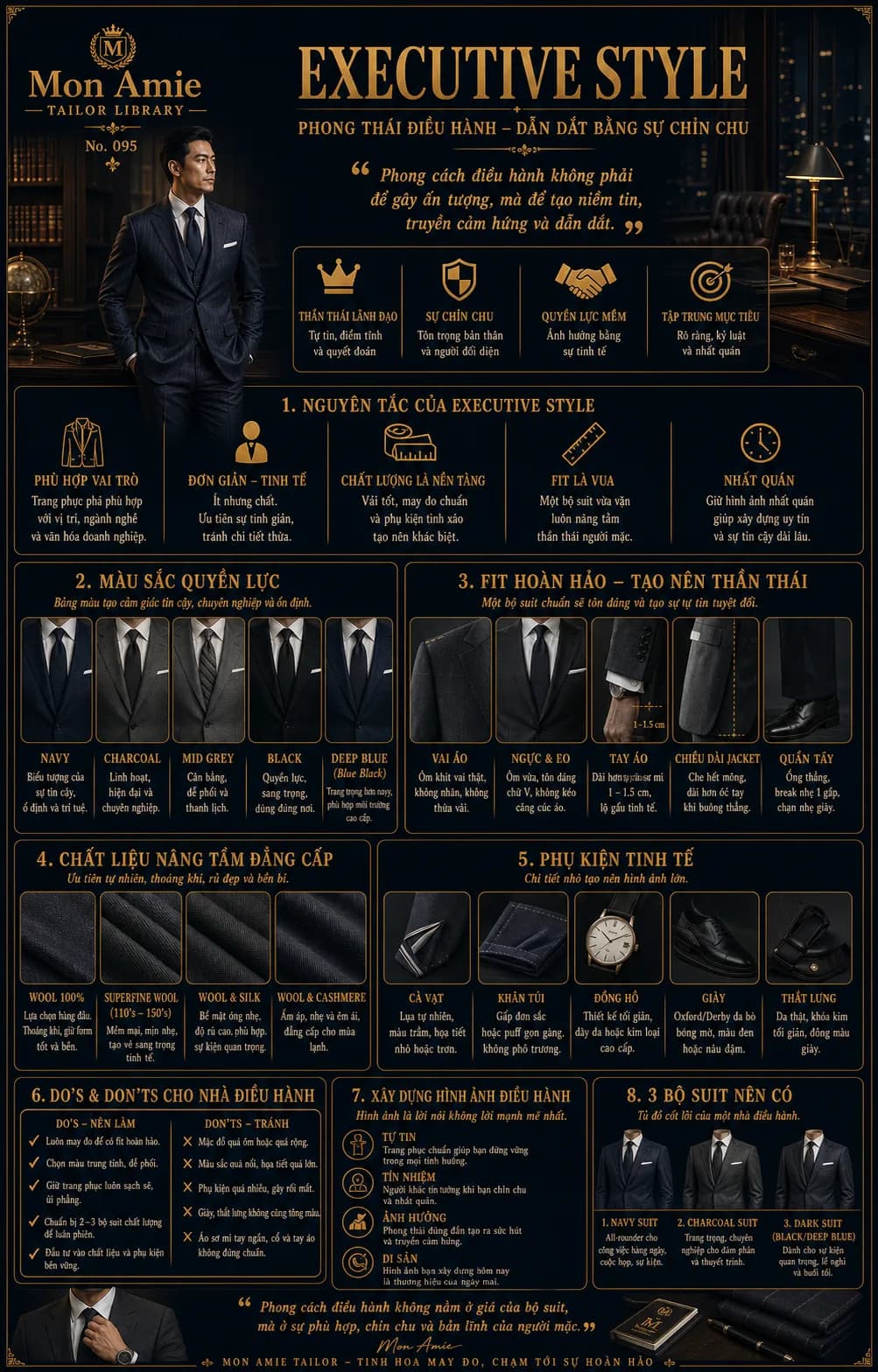
Executive style is the way a leader dresses: not to impress through display, but to build trust, inspire and lead. For Mon Amie, executive style rests on four pillars: leadership presence — confident, composed, decisive; polish — respect for yourself and for those you meet; soft power — influence through refinement; and focus — clarity, discipline, consistency. This article helps you build that image methodically, from colour and silhouette to accessories.
Five principles of executive style
Before cloth or cut, executive style needs a set of principles as its foundation:
- Suited to the role: dress must match your position, your industry and your company culture. A bank CEO and a technology founder wear different uniforms of authority.
- Simple and refined: less, but better. Favour restraint and avoid every superfluous detail.
- Quality as the foundation: good cloth, proper tailoring and fine accessories create the real difference — something others sense without being able to name it.
- Fit is king: a well-fitting suit lifts a man's presence more than any label can.
- Consistency: a steady image over time builds credibility and lasting trust.
The palette of authority
Colour in executive style must convey trust, professionalism and stability. Five foundation colours to know:
- Navy: the emblem of trust, stability and intelligence — the safest colour in any business setting.
- Charcoal: versatile, modern and professional, particularly suited to negotiation and presentation.
- Mid grey: balanced, easy to combine and elegant for everyday work.
- Black: powerful and luxurious, but best kept to its proper place — formal occasions, ceremonies and evenings.
- Deep blue: more formal than navy, and very much at home in senior executive environments.
What the whole palette shares is neutrality and depth — a steady ground so that your face, your words and your bearing become the focus.
Perfect fit: where presence is made
A properly cut suit flatters the figure and creates genuine confidence. Five points to check at a fitting:
- Shoulders: sitting cleanly on the natural shoulder, with no rippling or excess cloth — the hardest area to correct, so it must be right from the outset.
- Chest and waist: a close but comfortable fit that traces a V-shape, with no pulling when the jacket is buttoned.
- Sleeves: ending 1 to 1.5 cm short of the shirt cuff, revealing a refined sliver of linen.
- Jacket length: covering the seat, finishing just below the thumb knuckle when the arms hang naturally.
- Trousers: a straight line with a single soft break, just touching the shoe.
Cloth that raises the standard
Favour natural fibres: breathable, beautifully draping and durable over time.
- 100 percent wool: the first choice — breathable, shape-retaining and hard-wearing.
- Superfine wool (Super 110s to 150s): soft and finely finished, with quiet luxury; the higher the number, the finer the yarn.
- Wool and silk blends: a gentle sheen and generous drape, suited to important occasions.
- Wool and cashmere blends: warm, light and soft — a fine choice for cold seasons or trips to temperate climates.
Refined accessories: small details, large impression
- Tie: natural silk, in a deep tone, with a small pattern or none at all.
- Pocket square: a plain fold or a neat puff, never showy.
- Watch: minimal in design, on quality leather or metal.
- Shoes: oxfords or derbies in calf leather with a soft polish, in black or dark brown.
- Belt: genuine leather with a plain buckle, matched to the shoes.
Do's and don'ts for executives
Do: always have your suits made to measure for a perfect fit; choose neutral, versatile colours; keep garments clean and well pressed; keep two or three quality suits in rotation; invest in durable cloth and accessories.
Avoid: garments that are too tight or too loose; colours that are too loud and patterns that are too large; a clutter of accessories; shoes and belt out of tone; short-sleeved shirts, or collars and cuffs that sit incorrectly beneath the jacket.
As for the core wardrobe, the three suits an executive should own are: a navy suit — the all-rounder for daily work, meetings and events; a charcoal suit — formal and professional for negotiation and presentation; and a dark suit in black or deep blue — for important occasions, ceremonies and evenings.
A word from Mon Amie's artisans
After many years of tailoring for men in executive roles, Mon Amie finds that a leader's image is built on consistency rather than on one very expensive garment. Begin with a well-fitted navy suit, wear it often enough to understand your own body, and only then expand into charcoal and a dark suit. At a fitting, check the shoulders first — get the shoulder right and everything else can be corrected. And remember: the fewer the accessories, the finer they must be.
Executive style does not rest on the price of a suit but on its suitability, its polish and the character of the man wearing it — the image you build today is your brand tomorrow. If you would like to build an executive wardrobe properly, we invite you to book an appointment at one of Mon Amie's five showrooms in Ho Chi Minh City, or to read the tailoring process to see how we create a suit that fits your role.