
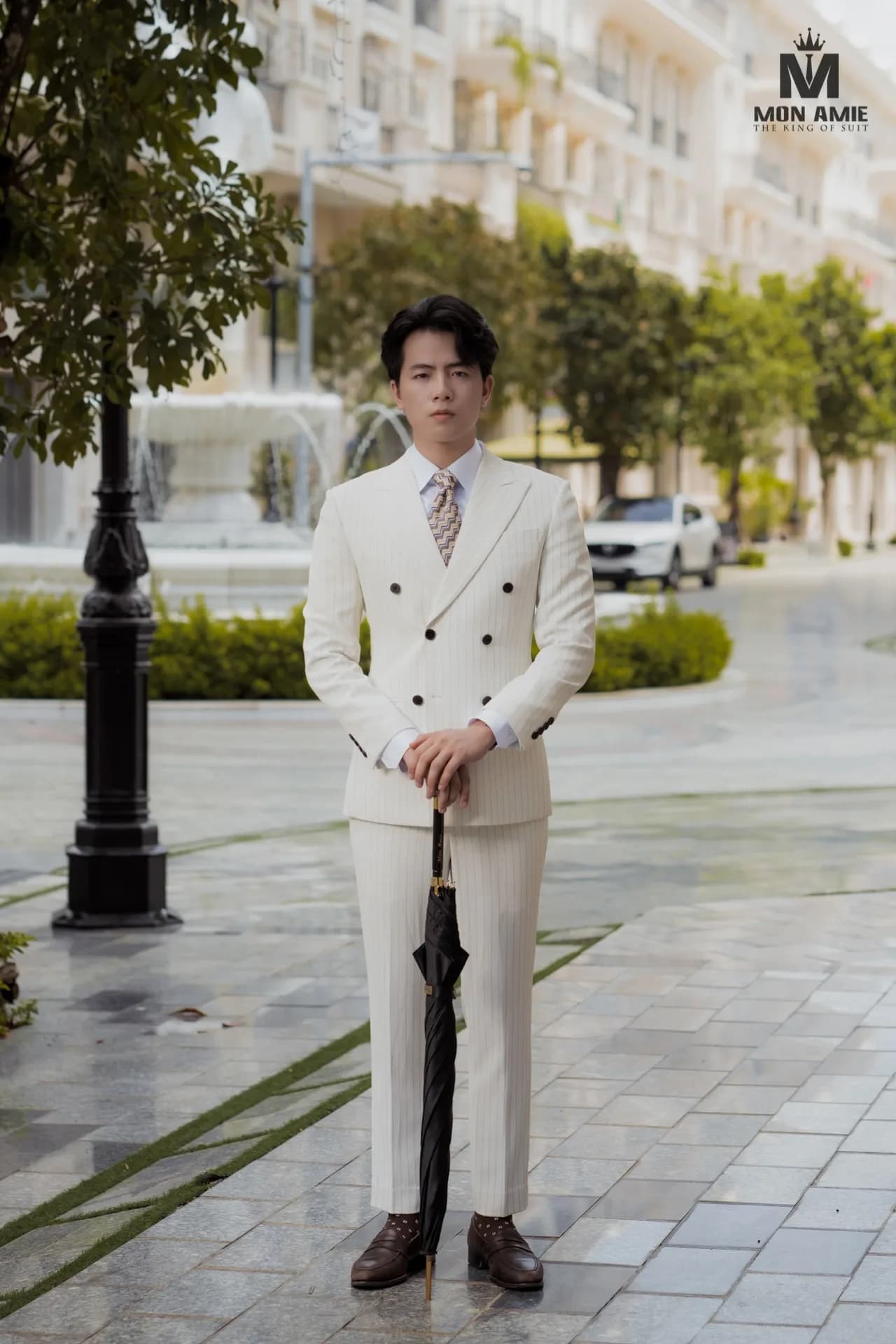
Someone asks this at the showroom every week: “I love the double-breasted jackets in those overseas grooms’ wedding photos, but I’m afraid I’ll look old in one, or that I’ll button it badly and end up looking messy.” The worry is fair, and it has an answer. A 6-button groom suit is a jacket that asks for a few right decisions from the moment you are measured: the right fit for your build, the right number of buttons, the right cloth. Get those right and it is one of the few suits that gives wedding photos real depth.
Quick answer
A 6-button double-breasted groom suit suits a balanced or slightly slim build best, at an evening wedding or in a formal setting. Choose peak lapels and a light, fine wool for Saigon’s climate, fasten the waist button when standing and undo everything when seated. Shorter or heavier-set grooms should consider a 4-button style.
How a 6-button double-breasted jacket differs from a single-breasted one
A regular suit jacket (single-breasted) has one row of buttons down the body, and its two front edges simply meet. A double-breasted jacket is different: one flap overlaps the other, with two parallel rows of buttons, so the chest is closed and thicker.
The 6-button version sits in three pairs. The top pair is mostly decorative, the middle pair is the one that actually fastens, at waist level, and the bottom pair sits lower and is usually left alone. Inside the flap there is also a hidden button that stops the jacket from sagging to one side. Tailors shorthand this style as “6x2”: six buttons, two to fasten. You can read more about where this style comes from in What Is a Double-Breasted Jacket.
Three things make a double-breasted jacket a good fit for a wedding day:
- A long closing line, which makes the torso look straight and lean from top to bottom.
- Shoulders and chest are given extra “structure” by the two overlapping layers of cloth, so you look more imposing without heavy shoulder padding.
- Two rows of buttons set a rhythm across the chest, so close-up photos still have detail to look at.
Which body types suit a 6-button groom suit
This is the part clients skip most often, because the sample photos usually show a man as tall as 1.85 m in a jacket that really fits. The table below is the master tailor’s made-to-measure experience, for you to check yourself against.
| Build | 6-button style | 4-button style | Master tailor’s note |
|---|---|---|---|
| Tall, slim | Very suitable | Suitable | Two layers of cloth at the chest give the upper body more fullness |
| Balanced, broad shoulders | Very suitable | Suitable | Keep the overlap moderate so the shoulders don’t look “blocky” |
| Short, short torso | Suitable if cut clean | Better | Choose a jacket just long enough to cover the seat, and high-rise trousers to lengthen the legs |
| Belly | Consider | Better | Needs ease at the waist, but the shoulders must stay truly close-fitting |
| Heavier-set, thick chest | Consider carefully | Better | Two layers of cloth at the chest can make the upper body look bigger |
A general rule: a double-breasted jacket forgives a small belly, but it does not forgive an over-wide shoulder. The shoulder cannot be altered much, so choose by the shoulder first and let the tailor adjust the rest.
6 buttons or 4 buttons: how to choose
The two styles differ most in the length of the closing line and in how open the lapels are.
- 6 buttons: a long closing line and a closed chest, looking more formal and classic. Suits evening weddings, hotels and upscale restaurants.
- 4 buttons: a shorter closing line with more lapel on show, so it feels airier and more modern. Suits shorter grooms, and daytime or outdoor weddings.
If you can’t decide, try both. In front of the mirror, a minute is enough for your eye to tell which style “sits” better on your frame.
Buttoning correctly: standing, sitting and for photos
A double-breasted jacket buttoned wrongly shows straight away, so a few moves are worth learning:
- Fasten the hidden inner button first, then the waist button in the middle row. The top pair stays undone.
- Fasten it when standing. A double-breasted jacket left open while you stand lets the flaps hang unevenly, which looks very messy in photos.
- Undo everything when seated. If you leave it fastened, the jacket pulls tight at the waist and creases in diagonal folds around the button.
- Fasten it again when you stand up. This should become a reflex throughout the reception.
- Before the photo, give the hem a light tug downward at the front so the flap lies flat and the lapels don’t roll.
If an X-shaped crease appears around the button when it is fastened, the jacket is tight at the waist. That is the moment to ask your tailor to let it out, rather than holding your breath through the photo session.
Pairing peak lapels, bow ties and accessories for wedding photos
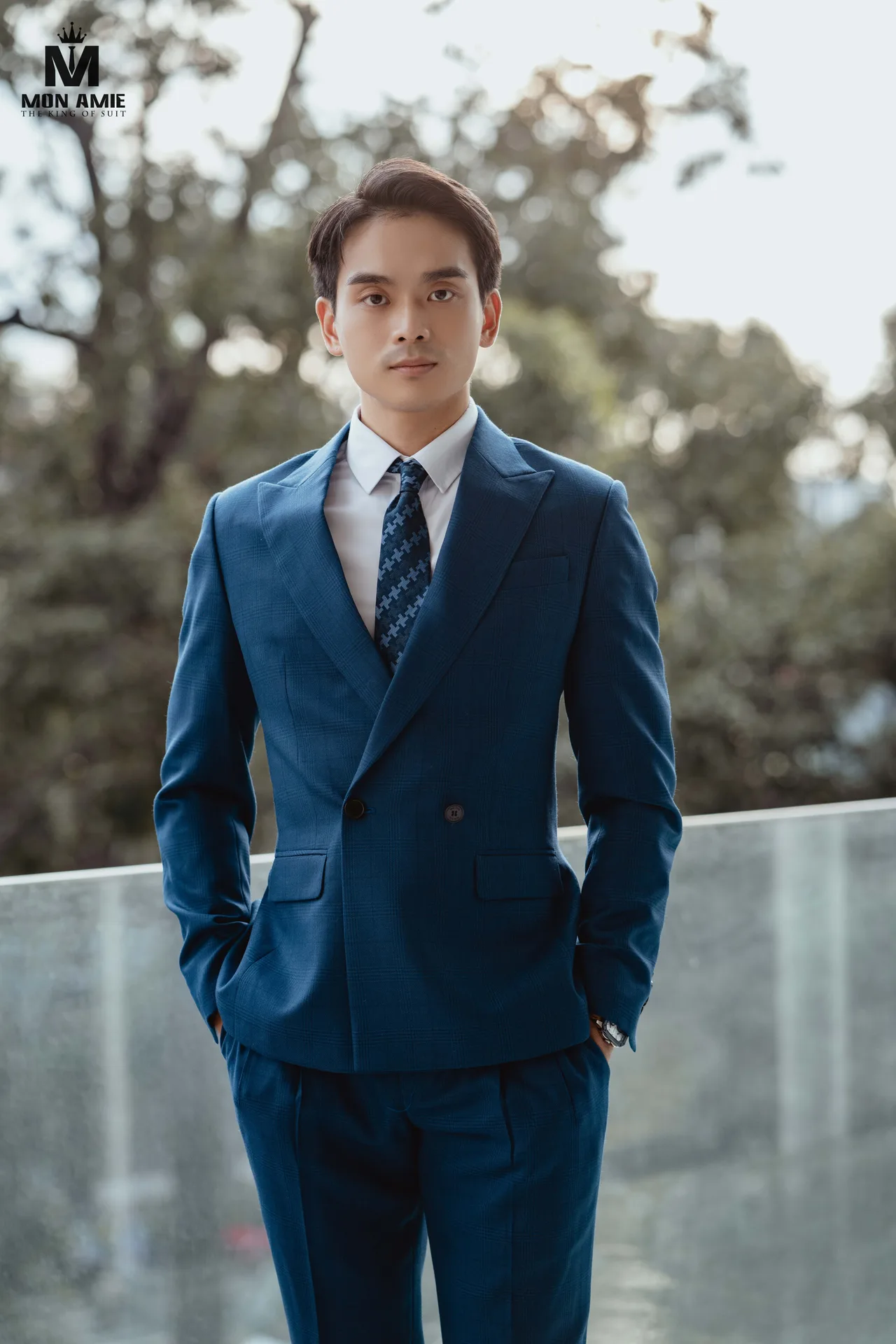
Almost every good double-breasted jacket goes with a peak lapel, the part of the lapel that points up and out toward the shoulder. It draws the eye upward and makes the shoulder frame cleaner. If you want to coordinate everything from lapel to accessories, Mon Amie’s Groom Styling service advises according to your wedding concept and venue.
A few tried-and-tested formulas:
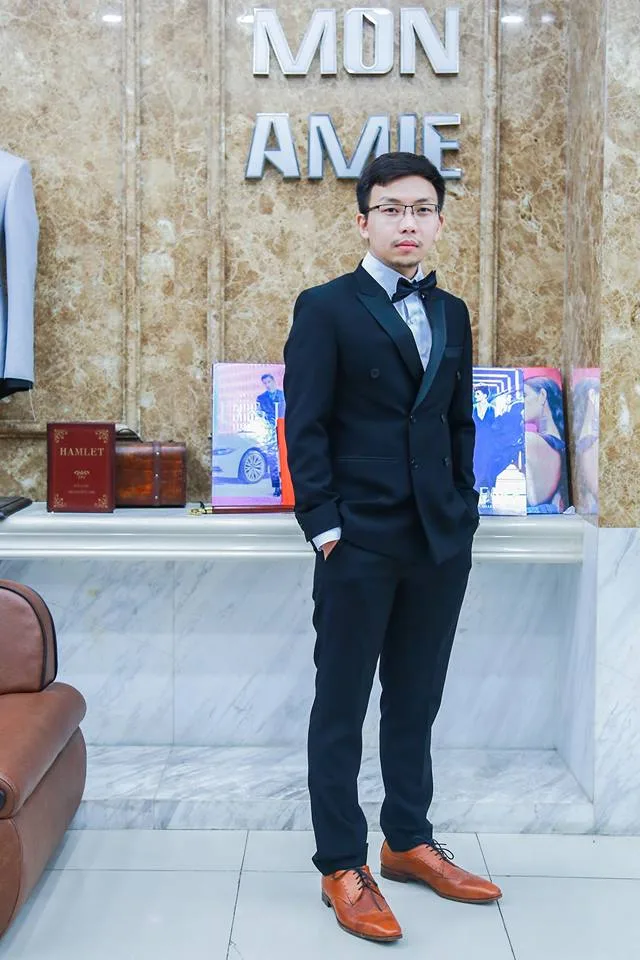
- Black double-breasted tuxedo: satin lapels, black bow tie, pleated shirt. The most formal, and suited to an evening reception.
- Light-coloured double-breasted suit (cream white, beige, light grey): tie or bow tie in the same tone, pocket square folded flat.
- Navy or charcoal double-breasted suit: add one small accent, such as a burgundy pocket square or a boutonniere.
Because the chest of the jacket already has plenty of detail, fold the pocket square flat rather than into an elaborate puff. Straight-leg trousers, with a high rise reaching about the navel, and a hem that just rests on the top of the shoe. Polished black leather shoes are the safe choice for a tuxedo, while a light suit can take deep brown shoes.
Choosing fabric: two layers at the chest and Saigon heat
A double-breasted jacket has an extra layer of cloth at the chest, so it is warmer than a regular jacket. At midday in the city sun, that is real. So:
- Choose a light, open-weave wool, and avoid thick cloth on the assumption that “thick means luxurious”.
- Ask for a half lining so the jacket releases heat better.
- Choose cloth with the natural elasticity of wool, because a double-breasted jacket is flexed a lot around the buttons.
Mon Amie makes the full jacket and trousers to measure in three lines: Essential (VND 4.8 – 10 million), Signature (VND 10 – 20 million) and Heritage (over VND 20 million). You can choose the cloth and look at samples in the fabric library before deciding.
Common mistakes when choosing a double-breasted jacket
- Choosing by photos of tall, slim models and forgetting your own build. A beautiful photo doesn’t mean the jacket will look beautiful on you.
- An overlap that is too narrow, so the two flaps gape when you move and the jacket looks tight.
- Choosing cloth that is too thick to “hold the shape”. A master tailor wants the shape to stand thanks to the internal construction, not thanks to heavy cloth.
- Forgetting to try sitting down, raising your arms and hugging the bride. A wedding suit has to live through a long day, not just one photograph.
- Buttoning it wrongly. Fastening the bottom-row buttons, or all the buttons, makes the jacket lose its shape.
Frequently asked questions
Is there any difference between a “6 nút” and a “6 cúc” groom suit?
No. “Nút” and “cúc” are simply two Vietnamese words for the same thing, a button: “cúc” is the usual word in the South, while “nút” is more common elsewhere. What matters is how many buttons are actually fastened: on a 6-button double-breasted jacket you normally fasten just one button in the middle row, besides the hidden inner button.
Is a 4-button or a 6-button groom suit better looking?
There is no general answer. The 6-button style is more formal and classic, suited to evening weddings and taller builds. The 4-button style is airier, more modern and easier to wear on shorter or heavier-set builds. Try both in front of the mirror and choose whichever makes your shoulders and waist look more harmonious.
Is a double-breasted groom suit suitable for a daytime wedding?
Yes, if you choose a light colour such as cream white, beige or light grey, in a light, fine wool. For a sunny outdoor wedding, favour a half-lined jacket and the 4-button style for better airflow.
How does a double-breasted tuxedo differ from an ordinary double-breasted suit?
A double-breasted tuxedo uses satin lapels and satin-covered or black buttons, is usually made in black or deep navy cloth, and is worn with a bow tie. An ordinary double-breasted suit has lapels in the same cloth as the body, with a tie or bow tie as you please. You can read more in Double-Breasted Tuxedo.
A final word
A double-breasted jacket is not for the man who wants everything easy, but it repays handsomely the man who is willing to be measured carefully. If you are still torn between 6 buttons and 4, book a measuring appointment at one of Mon Amie’s 5 showrooms, try on a baste fitting and let the stylist adjust it right on your body.