
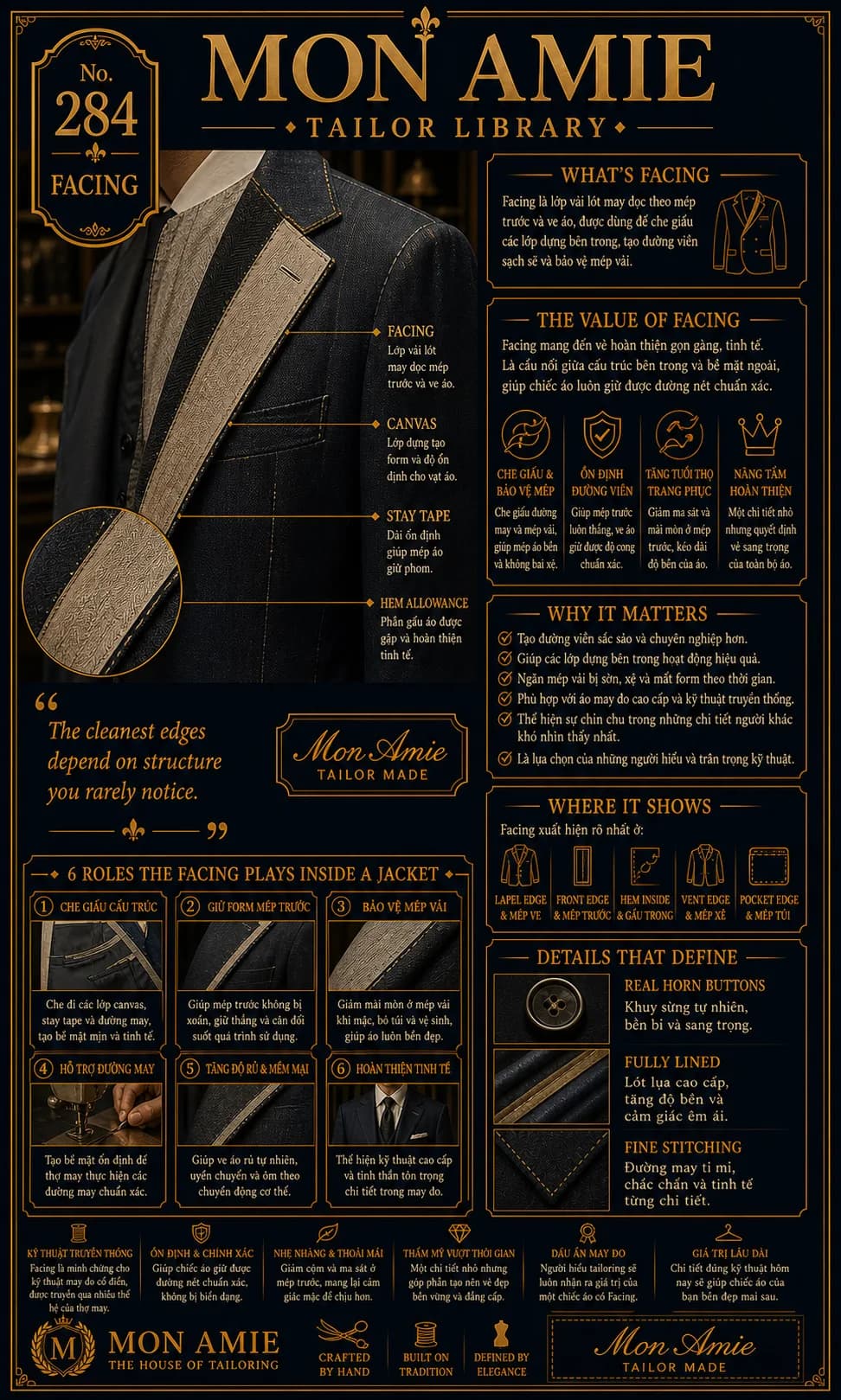
Facing is the panel of cloth sewn along the front edge and lapel of a suit jacket. It conceals the internal structural layers, creates a clean border and protects the raw edges of the fabric. It is a detail almost no one across the table will ever see, and yet it determines how crisp the most visible lines of the jacket look — because the neatest edges always rest on structure you rarely notice.
What facing is and where it sits on the jacket
Turn back the front of a jacket and you will find a strip of cloth, cut from the same material as the body, running from the lapel all the way down the front edge. That is the facing. It is the final link in the front structure of the jacket, working alongside several other layers:
- Canvas: the interlining that gives the front its shape and stability.
- Stay tape: the narrow tape that keeps the edge in shape and stops it from stretching.
- Hem allowance: the folded, carefully finished bottom edge.
- Facing: the outermost layer on the inside, closing the whole system with one clean border.
On a tuxedo, the facing steps out into full view: the satin or grosgrain lapels of formal wear are simply facing put on display.
Why facing matters in tailoring
Facing gives a jacket its neat, refined finish. It is the bridge between internal structure and outer surface, and it keeps the jacket's lines precise. Four benefits stand out:
- Concealing and protecting the edges: it hides seams and raw edges, keeping the border durable and free of sagging.
- Stabilising the border: it keeps the front edge straight and the lapel curve true.
- Extending the life of the garment: it reduces friction and wear along the front edge.
- Elevating the finish: a small detail that decides the refinement of the whole jacket.
Six roles facing plays inside a jacket
Look closer and this modest layer carries as many as six responsibilities:
- Hiding the structure: it covers the canvas, stay tape and seams, leaving a smooth, refined surface.
- Holding the front edge: it prevents curling and keeps the front straight and balanced through years of wear.
- Protecting the cloth: it reduces abrasion from wearing, pocketing and cleaning.
- Supporting the stitching: it gives the tailor a stable surface on which to work precise seams.
- Improving drape and softness: it lets the lapel roll naturally and follow the movement of the body.
- Delivering a refined finish: it reflects advanced technique and genuine respect for detail.
Where facing is most visible
Facing appears along the lapel edge, the front edge of the body, the inside of the hem, the rear vent edge and the pocket edges. Wherever an edge must endure daily folding, rubbing and contact, facing belongs there. That is why it suits high-end made-to-measure work and traditional technique — anyone who understands tailoring will recognise the value of well-executed facing, even though it is the detail others are least likely to see.
The finishing details that go with it
A jacket with carefully made facing usually comes with other refined details: natural horn buttons, durable and handsome; fine silk lining that adds both strength and comfort; and meticulous, secure stitching throughout. Facing is proof of classical tailoring technique passed down through generations of tailors — the detail done correctly today is exactly what keeps your jacket beautiful years from now.
A word from Mon Amie's artisans
At Mon Amie we like to say that facing is the back of the medal: clients rarely look at it, but one glance tells a tailor which workshop takes its craft seriously. Facing must be cut on the correct grain, basted smoothly to the canvas and given a touch of ease at the lapel edge so the roll stays soft rather than strained. Doing that hidden work properly is how we keep faith with every jacket that carries the Mon Amie name.
If you would like to see the inside of a properly made bespoke jacket for yourself, we invite you to book an appointment at one of Mon Amie's five showrooms in Ho Chi Minh City (Nguyen Trai, Ho Van Hue, 3/2 Street, Caravelle Hotel District 1, Nguyen Thi Thap) or call 0888.111.118. You may also wish to read about the tailoring process — from the first measuring session to alteration guarantees and lifetime record of your measurements.