
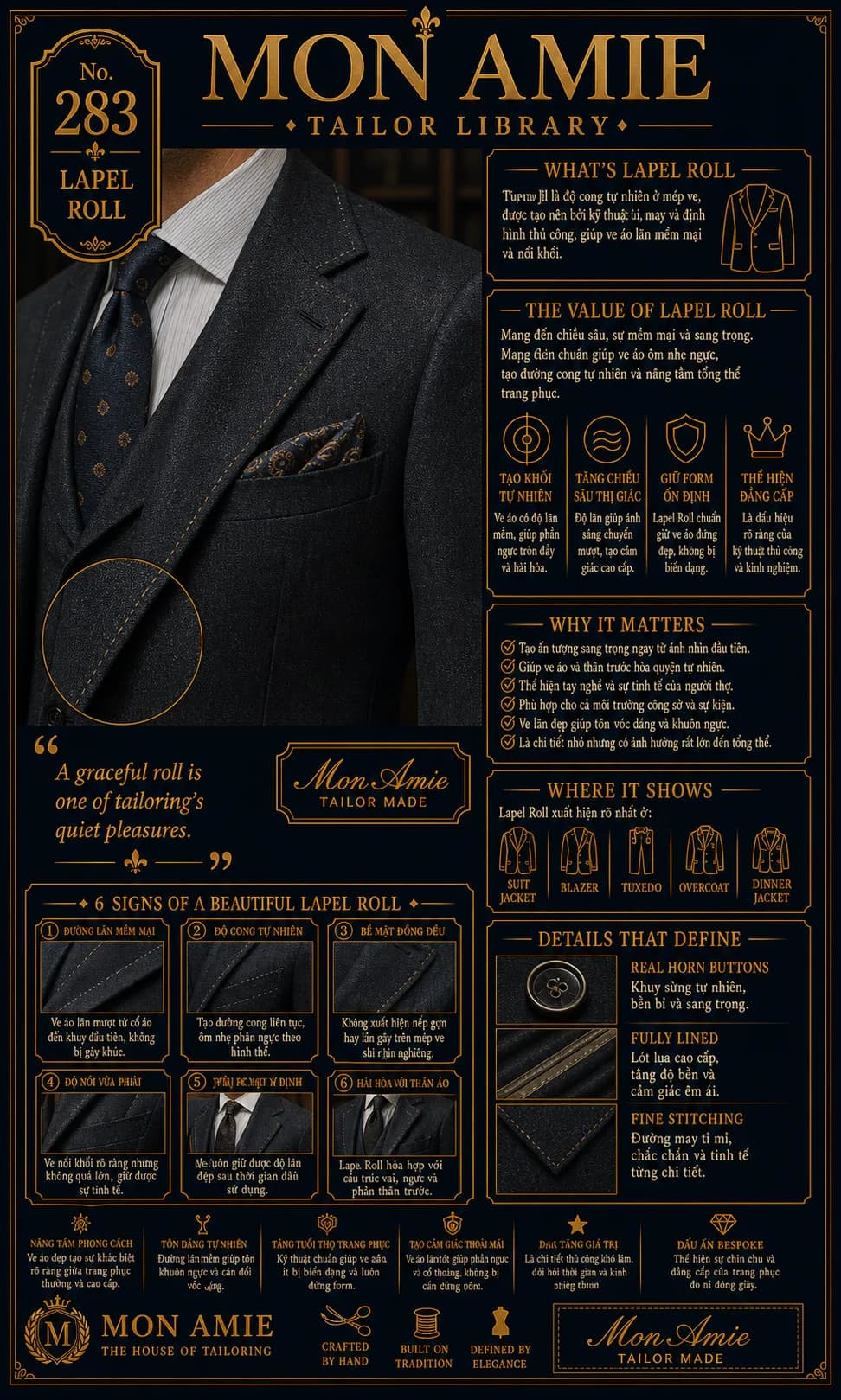
Lapel roll is the natural curve along the edge of the lapel, created by hand pad stitching, sewing and hand shaping, so that the lapel rolls softly and gains dimension instead of being pressed flat into a crease. It is one of the subtlest signs distinguishing a fine bespoke jacket from a factory-made one — as the trade says, a graceful roll is one of tailoring's quiet pleasures.
What lapel roll is and how it is made
On a factory jacket, the lapel is usually pressed into a hard, sharp fold, leaving it lying flat against the chest. On a bespoke jacket, the tailor uses pad stitching — thousands of small hand stitches attaching the outer cloth to the inner canvas, worked while the lapel is held in a curve — to teach the lapel a curve it will remember permanently. Combined with hand shaping under the iron, the lapel then rolls in one continuous curve from the collar down to the fastening button, resting lightly over the chest and following the body.
The value of lapel roll to the whole suit
Lapel roll brings depth, softness and elegance to the forepart. A correct roll lets the lapel rest gently on the chest, creates a natural curve and lifts the whole garment. In particular:
- Natural dimension: the lapel rolls softly, so the chest looks round and harmonious.
- Greater visual depth: the roll lets light move smoothly across the cloth, giving a luxurious impression.
- Stable shape: a correct lapel roll keeps the lapel standing well and undistorted over time.
- A mark of quality: it is a clear sign of handwork and of the tailor's experience.
Six signs of a beautiful lapel roll
When you pick up a jacket, you can judge the quality of its lapel roll on six points:
- A soft roll: the lapel rolls smoothly from collar to first button, with no break in the line.
- A natural curve: it forms a continuous curve, resting lightly over the chest along the body.
- An even surface: no ripples or hard creases appear along the lapel edge when viewed from the side.
- Measured relief: the lapel reads dimensional but never exaggerated, keeping its refinement.
- Lasting stability: the lapel keeps its handsome roll after long use.
- Harmony with the body: the roll agrees with the construction of the shoulder, chest and forepart.
Where lapel roll shows most clearly
The lapel roll is most present on suit jackets, blazers, tuxedos, overcoats and dinner jackets. On a one-button jacket, or a "3-roll-2" (three buttons with the lapel rolling past the top one), the roll is very nearly the entire character of the forepart. In the office and at events, the lapel is the first area the person opposite you looks at — so a fine roll makes an elegant impression at first glance, flattering both the figure and the chest.
The details that accompany a well-made lapel
A jacket with a beautiful lapel roll is almost always matched by consistent finishing: durable, handsome natural horn buttons; a fine silk lining for strength and a pleasant feel; and meticulous, secure sewing in every detail. A workshop willing to hand-stitch thousands of stitches into a lapel is rarely careless elsewhere. It is also why lapel roll extends a garment's life — the lapel resists hard creasing and keeps its shape year after year.
A word from Mon Amie's artisans
At Mon Amie, pad stitching the lapel is a stage we never hand over to a machine: each stitch is placed while the lapel is held in its curve, so that curve becomes the canvas's memory. Our artisans also adjust the break point of the lapel — the gorge and button stance — to each client's height and chest, because the same roll placed wrongly can make a man look visibly shorter. A small detail, but the one in which we take the most professional pride.
If you would like to feel for yourself the roll of a hand-padded lapel, we invite you to book an appointment at one of Mon Amie's five showrooms in Ho Chi Minh City, or call 0888.111.118. You may also read about our bespoke service, with cloths from Kevinlli to Canonico, Holland & Sherry, Dormeuil and Scabal — including alteration warranty and your measurements kept for life.