
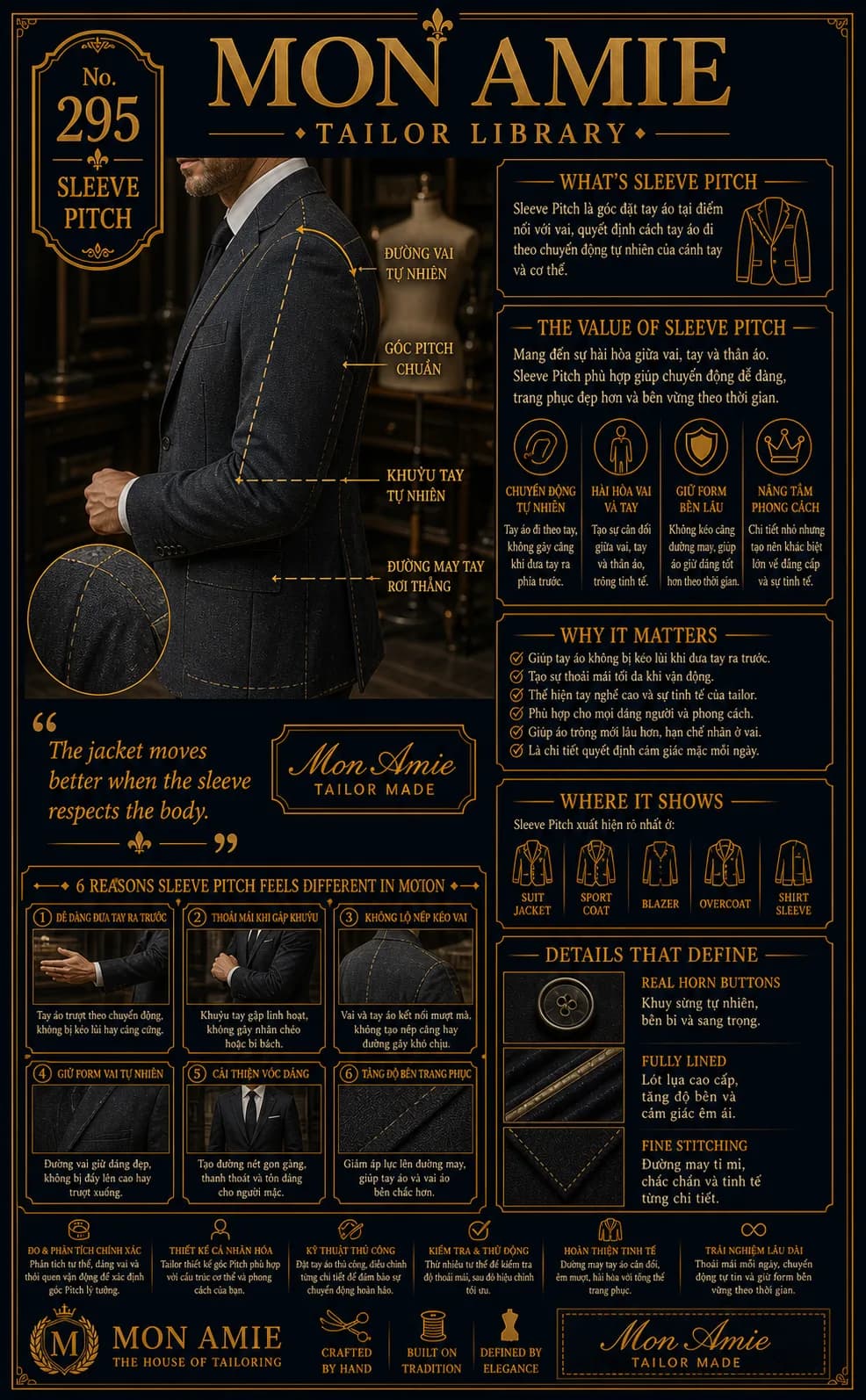
Sleeve pitch is the angle at which the sleeve is set into the shoulder — the detail that decides how the sleeve follows the natural movement of your arm and body. A jacket can be correct in every measurement, yet if the pitch is wrong you will feel it resisting you each time you reach forward. Mon Amie would like to explain why this overlooked detail is one of the clearest measures of a tailor's skill.
What sleeve pitch is and where it sits on the jacket
Looking at a jacket on a mannequin, few people notice that the sleeve is not set vertically into the body. The tailor must rotate it to a particular angle — the pitch — so the sleeve hangs along the natural line of the arm, which always curves slightly forward when relaxed at the side.
On a well-made jacket you will see the following:
- A natural shoulder line, pulled neither forward nor back.
- Correct pitch: the sleeve follows the true bend of the elbow.
- A natural elbow, with the sleeve tracking the slight forward curve of the arm.
- Sleeve seams falling straight, without twisting or diagonal creasing.
If the pitch is out by even a few degrees, diagonal wrinkles appear running down from the shoulder — a sign anyone in the trade recognises at a glance.
What correct sleeve pitch gives the jacket and the wearer
Correct pitch brings harmony between shoulder, sleeve and body. When the angle is right, movement becomes effortless, the garment looks better and lasts longer. In practice, a well-judged pitch delivers four things:
- Natural movement: the sleeve travels with the arm, with no strain when you reach forward.
- Harmony of shoulder and sleeve: a balanced relationship between shoulder, sleeve and body that reads as far more refined.
- Lasting shape: no strain on the seams, so the jacket holds its form over time.
- Elevated style: a small detail that makes a considerable difference in polish and refinement.
Why sleeve pitch matters so much
There are six reasons a jacket with correct pitch feels entirely different in motion:
- Easy forward reach: the sleeve glides with the movement rather than pulling back or binding.
- Comfort at the elbow: the elbow bends freely, without diagonal creasing or restriction.
- No shoulder drag: shoulder and sleeve join smoothly, with no tension lines or awkward breaks.
- A natural shoulder line: the shoulder holds its shape, neither riding up nor slipping down.
- A better figure: cleaner, longer lines that flatter the wearer.
- Greater durability: less stress on the seams, so sleeve and shoulder stay sound.
Correct pitch also keeps the sleeve from dragging back when you extend your arm, gives maximum comfort in movement, reflects the tailor's skill and judgement, suits every build, and keeps the jacket looking newer by limiting creasing at the shoulder — and above all, it shapes how the suit feels to wear every day.
Where sleeve pitch shows most clearly
You can observe pitch on nearly any garment with a set-in sleeve: suit jackets, sport coats, blazers, overcoats and even shirt sleeves. The more structured the garment — a suit or an overcoat — the more obvious a wrong pitch becomes, because the canvas and shoulder padding will not let the cloth settle on its own the way a soft garment does. That is why, on the same man, a bespoke jacket with correct pitch looks far more alive than a ready-made jacket of the same size.
Pitch is also closely tied to habit: a man who drives often, types at a desk or holds a microphone on stage carries his arms differently, and a capable tailor sets the angle to those habits rather than to a fixed formula.
How Mon Amie handles sleeve pitch
At Mon Amie, sleeve pitch is addressed through a deliberate sequence of steps:
- Precise measurement and analysis: we study your posture, shoulder shape and habits of movement to find the ideal angle.
- Personalised design: the pitch is set to your body structure and personal style.
- Handwork: the sleeve is set by hand, adjusted detail by detail for perfect movement.
- Fittings in motion: several positions are tested for comfort, then refined until optimal.
- Refined finishing: a balanced, smooth sleeve head in harmony with the whole garment.
- A lasting experience: daily comfort, confident movement and a jacket that holds its shape.
Alongside this come the details that define quality: natural horn buttons, durable and handsome; fine silk lining for longevity and a smooth feel; and meticulous, sound stitching throughout.
A word from Mon Amie's artisans
Mon Amie's tailors have a saying they are fond of: a jacket moves beautifully when the sleeve respects the body. Pitch cannot be taken with a tape measure alone — it requires watching how you stand, walk and reach in real life. That is why, at every fitting at Mon Amie, we ask you to move properly rather than simply stand still before the mirror.
If your current jacket creases diagonally at the upper arm or drags back when you reach forward, the problem may well be sleeve pitch rather than measurement. We invite you to book an appointment with Mon Amie at one of our five showrooms in Ho Chi Minh City (hotline 0888.111.118) for a study of your arm posture, and to explore the tailoring process in full — where every sleeve angle is built for you alone.