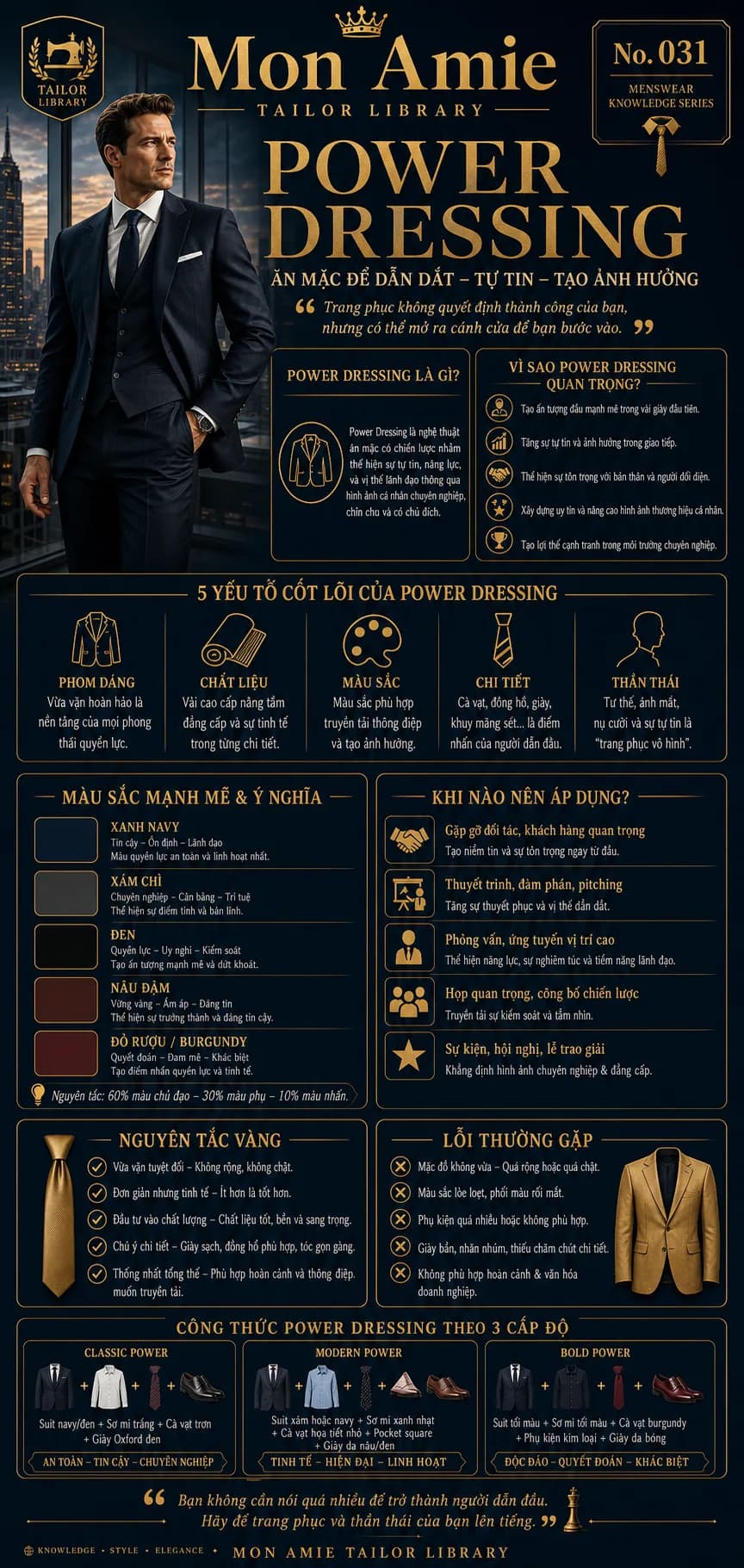
Power dressing is the art of dressing strategically to convey confidence, competence and leadership through a professional, deliberate personal image. Clothing does not decide your success, but it can open the door you walk through. In this article, Mon Amie takes you through the foundations of power dressing — from colour and silhouette to outfit formulas for every level of occasion.
Why power dressing matters for those who lead
In business, first impressions form within seconds — before you have said a word. A well-considered outfit delivers far more than good looks:
- It creates a strong first impression in the opening seconds of any encounter.
- It raises your confidence and your influence in conversation.
- It signals respect, both for yourself and for the person across the table.
- It builds credibility and strengthens your personal brand.
- It gives you a competitive edge in professional settings.
Put simply, power dressing is not dressing to show off. It is dressing to communicate a message: I am serious, I am capable, and I have this situation in hand.
The five pillars of power dressing
An image of authority rests on five pillars. Remove any one of them and the whole thing wavers:
- Silhouette: impeccable fit is the foundation of every commanding presence. An expensive suit that hangs loose will always lose to a carefully tailored one that fits.
- Fabric: fine cloth elevates the whole and shows in every detail. The surface, the drape and the way the cloth catches light all speak on your behalf.
- Colour: the right colour carries your message and shapes how you are received — every shade has its own language.
- Details: tie, watch, shoes, cufflinks. These are the marks of a leader. Small they may be, but a discerning eye always notices.
- Bearing: posture, gaze, smile and self-assurance are the invisible garment — the thing that brings a suit to life.
The language of colour in an authoritative wardrobe
Every colour sends a different signal. Reading that language well lets you dress according to the purpose of each meeting:
- Navy: trust, stability, leadership — the safest and most versatile colour of authority, suited to almost any occasion.
- Charcoal grey: professional, balanced, intelligent — a mark of composure and quiet strength.
- Black: authority, gravitas, control — decisive and striking, ideal for formal events.
- Deep brown: grounded, warm, dependable — a sign of maturity.
- Burgundy: assured, passionate, distinctive — an elegant accent of authority, usually best on a tie or accessory.
Keep the classic ratio in mind: 60 per cent dominant colour, 30 per cent secondary, 10 per cent accent. That proportion gives depth without visual noise.
When to apply power dressing
You do not need to dress at full strength every day, but there are moments when your clothes work on your behalf:
- Meeting key partners and clients: it establishes trust and respect from the outset.
- Presentations, negotiations and pitches: it lends persuasive force and the standing to lead.
- Interviews and senior appointments: it demonstrates capability, seriousness and leadership potential.
- Important meetings and strategy announcements: it conveys control and vision.
- Events, conferences and award ceremonies: it affirms a professional, elevated image.
Golden rules and mistakes to avoid
Five golden rules of power dressing:
- Fit above all — never loose, never tight.
- Simple yet refined — less is more.
- Invest in quality — good cloth wears well and looks the part.
- Mind the details — clean shoes, a fitting watch, tidy hair.
- Keep it coherent — dress to suit the occasion and the message you intend to send.
The common failings work the other way: garments that do not fit, whether too loose or too tight; garish colours and cluttered combinations; too many accessories or the wrong ones; scuffed shoes and creased, neglected clothing; and outfits out of step with the occasion or the company culture.
Three levels of power dressing
Depending on your character and the setting, you can choose one of three formulas:
- Classic Power — safe, trustworthy, professional: navy or black suit, white shirt, plain tie, black Oxfords. This never goes wrong at a formal engagement.
- Modern Power — refined, contemporary, adaptable: grey or navy suit, pale blue shirt, small-patterned tie, pocket square, brown or black leather shoes.
- Bold Power — distinctive, decisive, individual: dark suit, dark shirt, burgundy tie, metal accessories, polished leather shoes. For those who want to leave their own mark.
A word from Mon Amie's artisans
After years of tailoring for business leaders, Mon Amie has found that authority comes not from a logo or a price tag, but from how the shoulder and chest of the jacket sit — the first place another person's eye lands. Begin with one well-cut navy suit made to your measure, then expand into charcoal and the bolder, darker tones. Every Mon Amie suit comes with your measurements kept on file for life and an alteration guarantee after delivery, so your image stays true over the years.
Power dressing is not about display. It is about letting your clothes and your bearing speak for you: you need not say much to be the one who leads. If you would like to build a wardrobe with genuine authority, book an appointment with Mon Amie at one of our five Ho Chi Minh City showrooms, or read about the tailoring process to see how we build a suit that fits you exactly.