
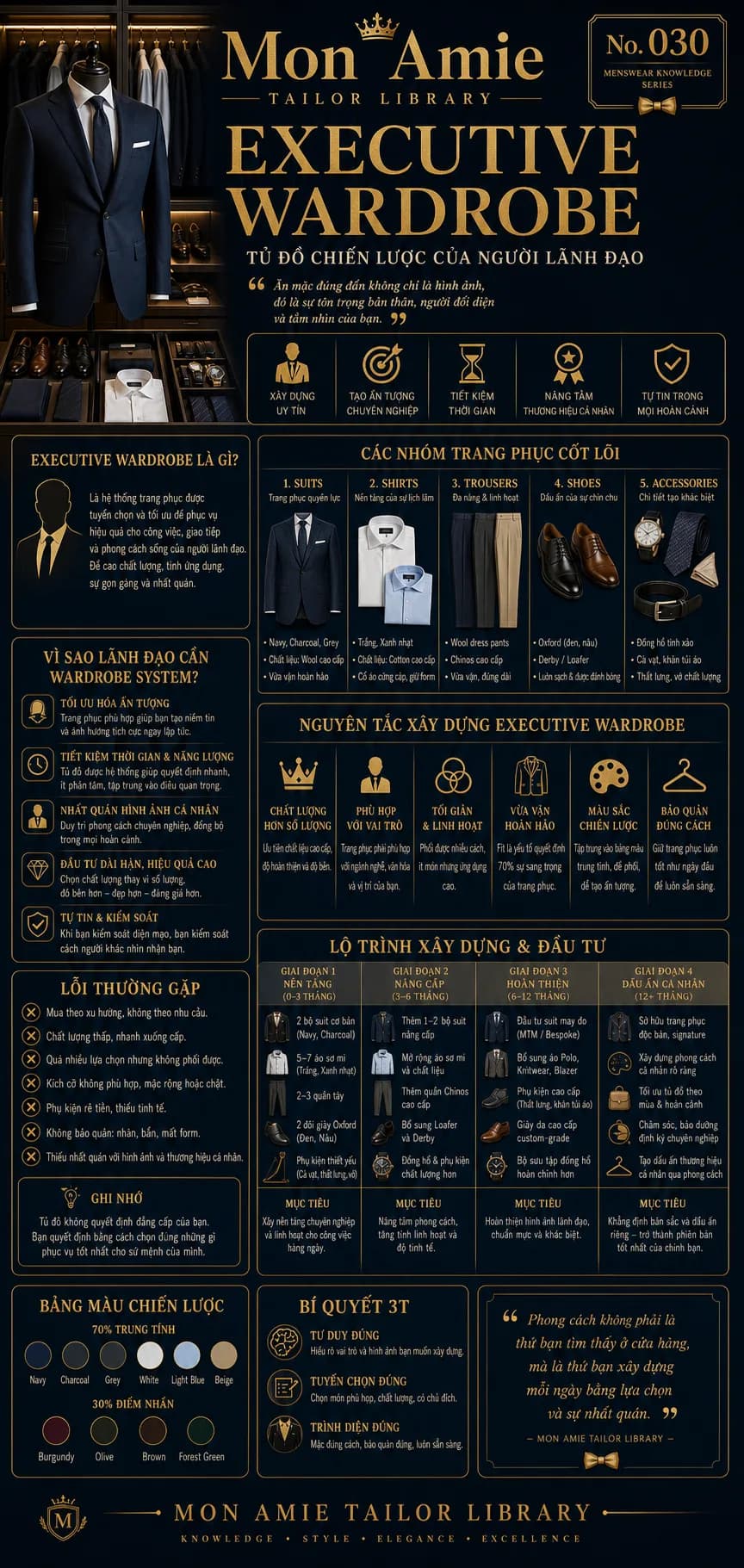
An Executive Wardrobe is a curated, optimised system of clothing built to serve a leader's work, communication and way of living. Unlike an ordinary closet accumulated on impulse, a strategic wardrobe values quality, usefulness, order and consistency. Dressing well is not only a matter of image; it is respect for yourself, for the person across from you, and for your own vision.
Why a leader needs a wardrobe system
A properly built wardrobe system delivers five practical benefits:
- A stronger first impression. The right clothing builds trust and positive influence from the first meeting — particularly valuable in negotiation and senior-level communication.
- Time and energy saved. A systematised wardrobe lets you decide quickly each morning, with less distraction, keeping your focus for more important decisions.
- A consistent personal image. A professional, coherent style maintained in every setting — from the boardroom to the event.
- A long-term, efficient investment. Quality over quantity: fewer pieces, but finer, more durable and more valuable over time.
- Confidence and control. When you control how you appear, you also control how others perceive you.
The five core garment groups
A proper Executive Wardrobe turns on five groups, each with its own role:
- Suits — the garments of authority. Favour navy, charcoal and grey; fine wool cloth; and above all, a perfect fit.
- Shirts — the foundation of elegance. White and pale blue, in fine cotton, with a collar that holds its shape well.
- Trousers — versatile and adaptable. Wool dress trousers and good chinos, in precise length and cut.
- Shoes — the mark of a considered man. Black or brown Oxfords, Derbies or loafers; always clean and polished. Discerning people look at the shoes before the suit.
- Accessories — the details that distinguish. A refined watch, ties, pocket squares, a good belt and wallet.
Six principles for building an Executive Wardrobe
- Quality over quantity: favour fine cloth, good finishing and durability.
- Suited to your role: clothing must match your industry, your company's culture and your position.
- Pared back and adaptable: choose pieces that combine with one another in many ways — fewer items, greater use.
- A perfect fit: fit accounts for some 70% of how refined a garment looks, mattering more than label or price.
- Strategic colour: concentrate on a neutral, easily combined palette for a steady impression. A useful formula: 70% neutrals (navy, charcoal, grey, white, pale blue, beige) and 30% accent colours (burgundy, olive, brown, forest green).
- Proper care: keep garments as good as the day they arrived, so they are always ready.
A four-stage roadmap for building and investing
A leader's wardrobe need not be completed in a single round of shopping. You can follow a roadmap:
- Stage 1 — Foundation (0–3 months): two basic suits (navy, charcoal), five to seven white and pale blue shirts, two or three pairs of dress trousers, two pairs of Oxfords in black and brown, together with essential accessories such as ties and a belt. The aim: a professional, adaptable base for daily work.
- Stage 2 — Upgrade (3–6 months): one or two finer suits, a broader range of shirts in colour and cloth, chinos, loafers and Derbies, a quality watch and accessories. The aim: to raise the level of your style, with more versatility and refinement.
- Stage 3 — Completion (6–12 months): invest in tailored suits (made-to-measure or bespoke), add polos, knitwear, a blazer, fine accessories and custom-grade leather shoes; begin a watch collection. The aim: a complete leadership image, correct and distinctive.
- Stage 4 — Personal signature (from 12 months onward): acquire one-of-a-kind, signature pieces; establish a clear personal style; optimise the wardrobe by season; and maintain everything through regular professional care. The aim: to affirm your own identity — to become the best version of yourself.
Common mistakes to avoid
- Buying by trend rather than by real need.
- Choosing low quality, so garments deteriorate quickly.
- Too many options that do not combine with one another.
- The wrong size — too loose or too tight both ruin the line.
- Cheap accessories, lacking refinement.
- Poor care: creased, soiled, out of shape.
- Inconsistency with your image and personal brand.
The whole of it fits into three ideas: think correctly — understand the role and the image you want to build; choose correctly — select pieces that are fitting, of quality and deliberately acquired; and present correctly — wear them well, care for them well, always ready.
A word from Mon Amie's artisans
Across many years of tailoring for business leaders, Mon Amie has found the most common error to be buying a great deal without a system — a full closet and yet "nothing to wear" every morning. Our advice: begin with two foundation suits in navy and charcoal, cut to fit absolutely, then expand gradually along the roadmap. Your measurements are kept by Mon Amie for life, so every later addition to the wardrobe is as swift and precise as the first.
Your wardrobe does not determine your standing — you determine it, by choosing exactly what best serves your purpose. If you would like to begin building your own Executive Wardrobe, book an appointment with Mon Amie at one of our five showrooms in Ho Chi Minh City, or read about the tailoring process — full made-to-measure suits from VND 4.8 million (the Kevinlli line) through to the Canonico, Holland & Sherry, Dormeuil and Scabal collections. Hotline 0888.111.118.