
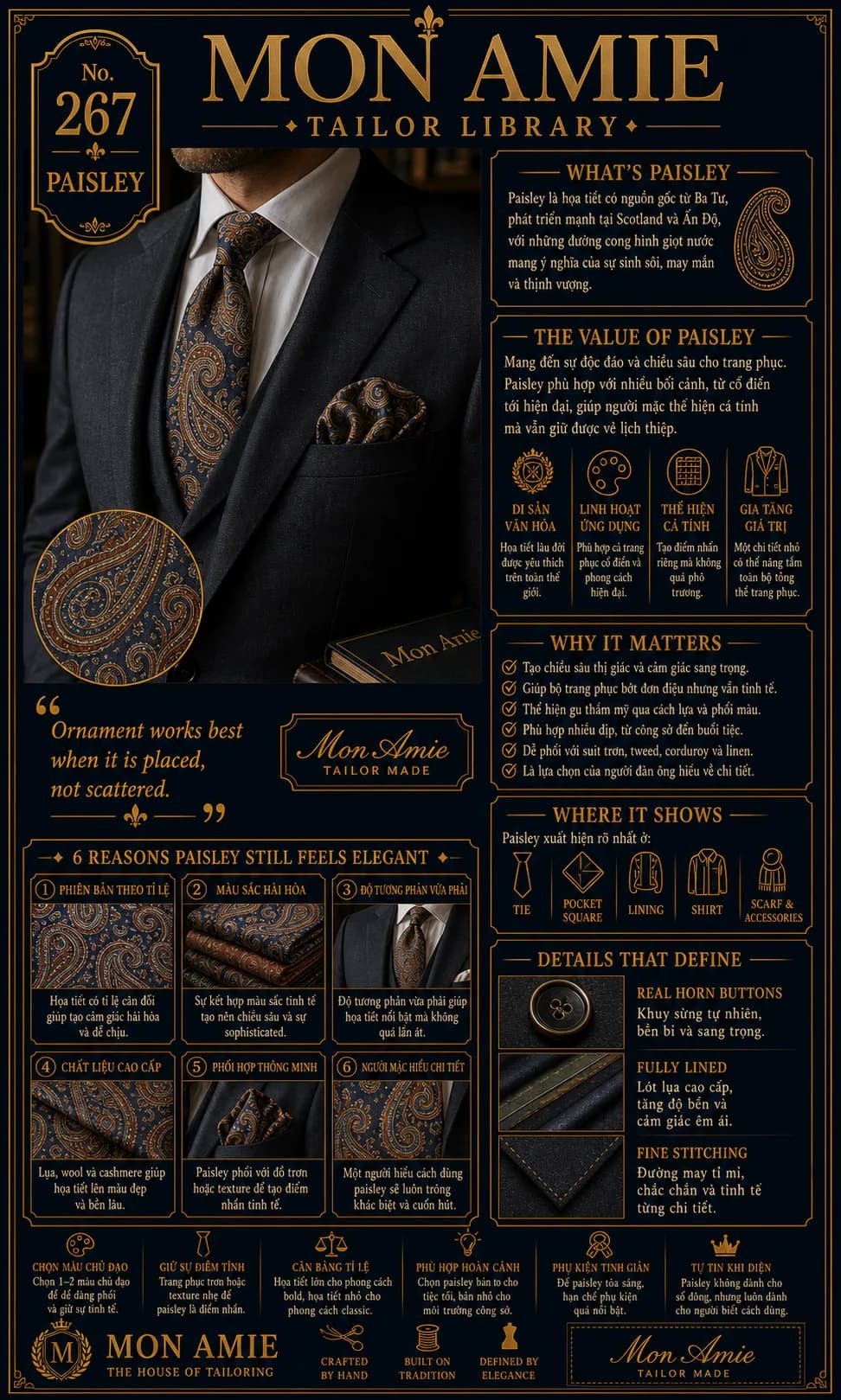
What is paisley? It is a motif of Persian origin, later flourishing in Scotland and India, built from curved teardrop shapes that carry meanings of growth, good fortune and prosperity. In menswear, paisley is the most classical of ornaments still fully alive — provided it is used in the right place and the right measure.
What paisley is, and the journey of a heritage motif
The curved teardrop — known as boteh or buta — appeared on Persian textiles many centuries ago, travelling along trade routes to India and then to Europe. The Scottish town of Paisley wove shawls carrying the motif in such quantity that the town's name became the international name of the pattern. Today paisley is an ancient motif loved the world over — a genuine piece of cultural heritage in textiles.
Its value lies in the distinction and depth it brings to an outfit. Paisley suits many settings, from the classical to the modern, and lets you express character while remaining entirely courteous:
- Cultural heritage — an ancient motif cherished across the world.
- Versatile in use — at home in classic dress and modern style alike.
- Expressive of character — a personal accent that never overstates itself.
- Added value — one small detail can lift an entire outfit.
Six reasons paisley remains elegant
- A considered scale — a well-proportioned motif feels harmonious and easy on the eye.
- Harmonious colour — a refined combination of tones creates depth and sophistication.
- Measured contrast — enough for the motif to read, never enough to dominate.
- Fine materials — silk, wool and cashmere carry the colours beautifully and hold them for years.
- Intelligent pairing — paisley set against solids or texture gives a refined accent.
- A wearer who understands detail — the man who knows how to use paisley always looks distinctive and compelling.
In short: paisley creates visual depth and a sense of luxury, relieves the monotony of an outfit while remaining refined, and expresses taste through the choice and combination of colour. It suits many occasions, from the office to a party, and pairs readily with plain suits, tweed, corduroy and linen — the choice of a man who understands detail.
Where paisley appears
- Ties — the classic position; a silk paisley tie against a plain suit is the perfect introduction.
- Pocket squares — a small accent that says a great deal about the wearer's taste.
- Jacket linings — the most discreet way to enjoy paisley: composed outside, in full bloom when the jacket opens.
- Shirts — for the confident wearer, usually in the evening.
- Scarves and accessories — soft, classical and well suited to cooler weather.
Using paisley in the right measure
Ornament is at its best when placed deliberately, not scattered everywhere. A few principles Mon Amie usually advises:
- Choose a lead colour: take one or two dominant tones to keep pairing simple and the effect refined.
- Stay composed: keep the rest of the outfit solid or lightly textured so paisley is the only accent.
- Balance the scale: a large motif for a bold look, a small one for a classic one.
- Match the occasion: larger paisley for the evening, smaller for the office.
- Keep accessories restrained: let paisley shine by avoiding other attention-seeking pieces.
- Wear it with confidence: paisley is not for everyone, but it is always for the man who knows how to use it.
Against a properly tailored suit — natural horn buttons, fine silk lining, meticulous stitching — a carefully chosen paisley detail carries its full weight.
A word from Mon Amie's artisans
At Mon Amie, paisley often serves as a suit's signature: a silk tie, a pocket square, or a lining chosen personally during a bespoke commission. Our experience is to let paisley appear at one point only — if the tie is paisley, the pocket square should be plain, or the reverse. That restraint is precisely what makes the wearer look refined rather than fussy.
If you would like to choose a paisley detail to suit your own suit, or to commission a personal paisley lining for a jacket about to be made, we would be glad to welcome you to one of Mon Amie's five showrooms in Ho Chi Minh City (Nguyen Trai, Ho Van Hue, 3/2 Street, Caravelle Hotel District 1, Nguyen Thi Thap), or you may call 0888.111.118. You are welcome to book an appointment and to learn more about our bespoke service — where every last detail is yours to decide.