
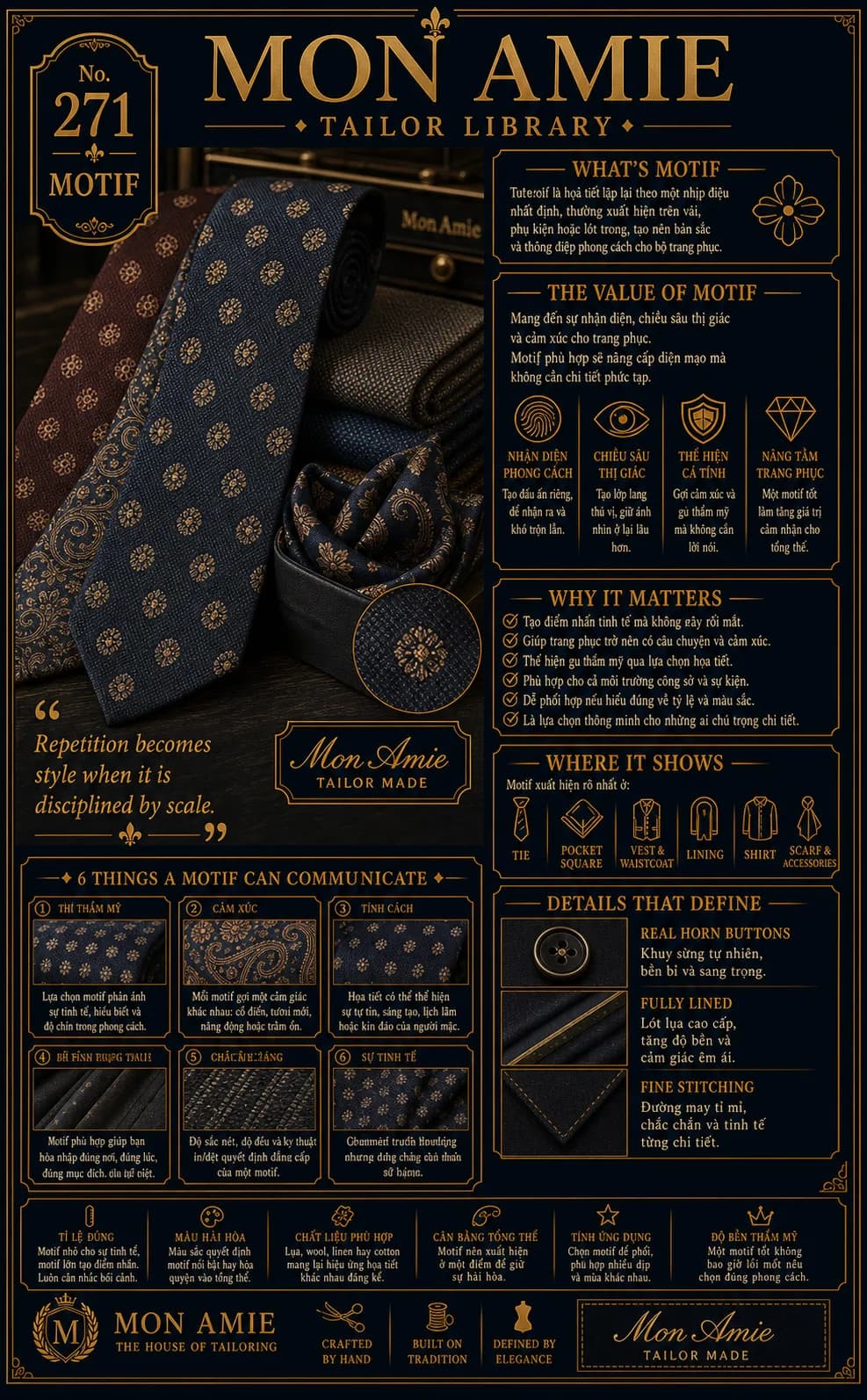
A motif is a pattern repeated in a set rhythm, usually found on cloth, accessories or linings, giving a garment its identity and its message. For a man who wears a suit, a motif is a way of speaking about taste without saying a word. Mon Amie invites you to explore this quiet visual language.
What a motif is, and why it matters
A dot, a stylised flower, a paisley curve — repeated with discipline in spacing and scale, they become a motif. Repetition is what separates a motif from a random print: an even rhythm creates a sense of order, while scale decides whether the pattern reads as elegant or loud. As those in the trade say, repetition only becomes style once discipline of scale is imposed on it.
The value of a motif rests on four points:
- Style identity: it creates a mark of your own, recognisable and hard to confuse.
- Visual depth: it adds interesting layers that hold the eye a moment longer.
- Personal expression: it suggests feeling and taste without words.
- Elevated impression: a good motif raises the perceived value of the whole.
Six things a motif can communicate
- Taste — the motif you choose reflects refinement, knowledge and maturity of style.
- Feeling — each motif evokes something different: classic, fresh, energetic or composed. Paisley suggests nostalgia; a small dot suggests cheerful precision.
- Character — pattern can convey confidence, creativity, elegance or reserve.
- Context — the right motif helps you belong in the right place, at the right moment, for the right purpose.
- Technical class — definition, evenness and the printing or weaving method decide a motif's standing; a woven jacquard motif always outranks a blurred print.
- Refinement — a good motif draws attention without showing off, and that line is the mark of a man who knows how to dress.
Where motifs appear most
In a man's wardrobe, motifs rarely live on the suit itself; they live in the accents:
- Ties: the most common place; foulard, dot and paisley are the three classics.
- Pocket squares: the easiest accent to play with and to change.
- Waistcoats: a patterned waistcoat under a plain suit creates engaging layers.
- Linings: a motif in the lining is a secret revealed only when you unbutton — a hallmark of tailoring.
- Shirts: small, densely spaced patterns for a discreet effect.
- Scarves and accessories: scarves, socks, braces — where you may be bolder.
Rules for using motifs that never date
Experience in the Mon Amie workshop distils into six principles:
- Right scale: small motifs for refinement, larger ones for statement; always weigh the setting.
- Harmonious colour: colour decides whether a motif stands out or blends into the whole.
- Suitable cloth: silk, wool, linen and cotton give notably different effects — the same dot on lustrous silk and on matte wool tells two different stories.
- Overall balance: let a motif appear at one point to keep harmony; two or three competing patterned areas create clutter.
- Practicality: choose motifs that combine easily and suit many occasions and seasons.
- Lasting appeal: a good motif never dates, provided the style is chosen well.
On a tailored garment the motif is supported by the finishing: natural horn buttons, durable and handsome; a fine silk lining, comfortable against the arm; and meticulous stitching, secure in every detail.
A word from Mon Amie's artisans
A tailor reads a motif the way a musician reads rhythm: what matters is not which note, but whether the repetition is disciplined. When advising, Mon Amie's artisans usually begin with the plain suit you already own, then choose a single point — tie, pocket square or lining — to carry the motif, so the whole tells a story while remaining composed. That is how a refined man leaves his mark without raising his voice.
You are welcome at any of Mon Amie's five showrooms in Ho Chi Minh City, or call 0888.111.118, and we will choose the motif that suits your style. You may book an appointment beforehand and read more about our bespoke service — where even the lining inside your jacket is personalised to your wishes.