
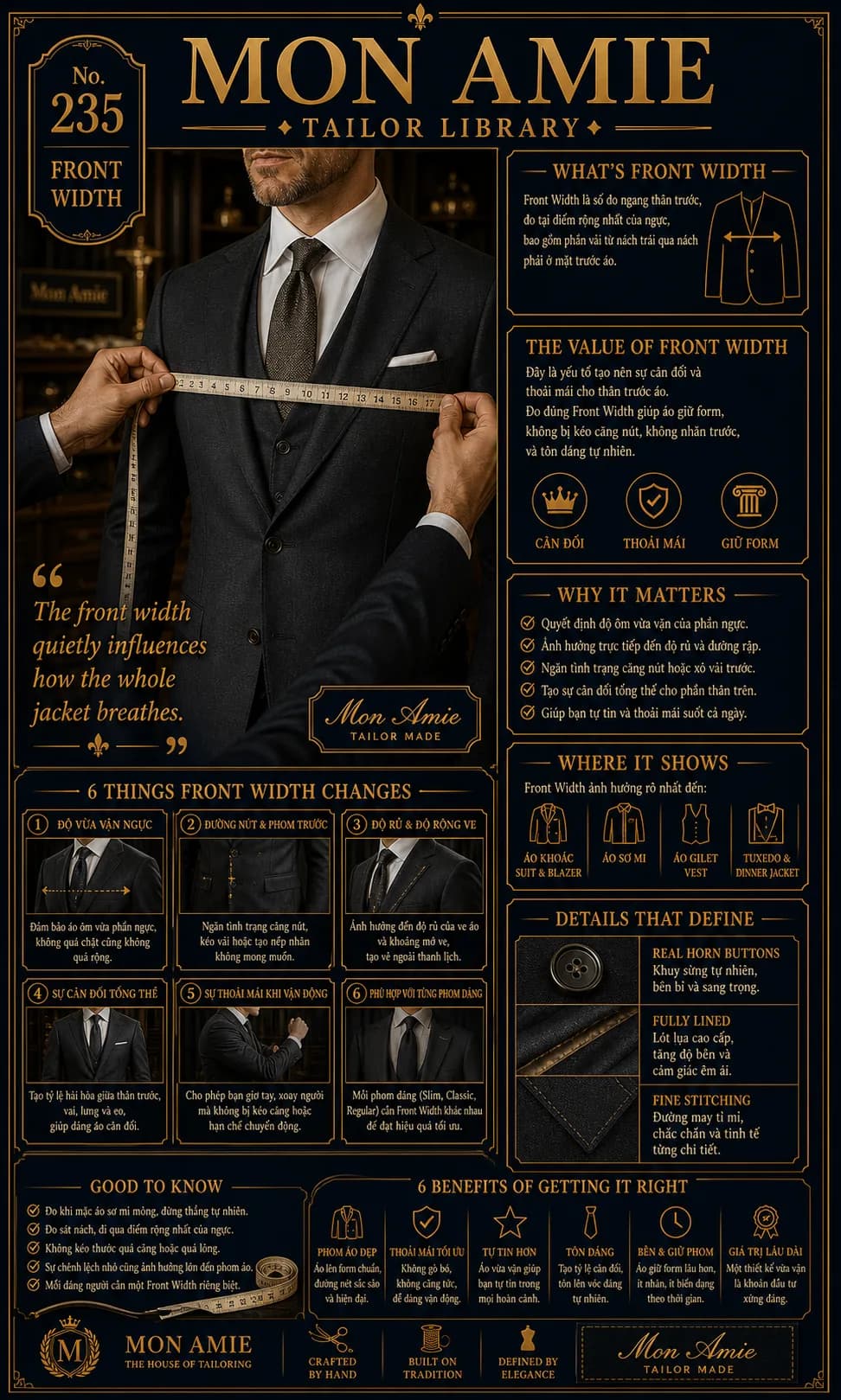
Front width is the across-front measurement of a suit jacket, taken at the fullest part of the chest, from the left armhole to the right armhole across the front of the body. It rarely appears on standard size charts, yet for an experienced tailor it decides directly whether a jacket can breathe — as the trade puts it, the width of the front quietly governs how the entire garment behaves.
What front width is, and where it is taken
Front width is measured straight across the chest at its fullest point, covering all the cloth from one armhole seam to the other on the front of the jacket. Unlike the chest measurement, which encircles the whole body, front width accounts only for the front — which is why it reflects so precisely how cloth is distributed between front and back.
A few things Mon Amie always mentions when taking it:
- Measure over a thin shirt, standing naturally, without pushing out the chest or tensing the shoulders.
- Keep the tape close to the armholes, crossing the fullest point of the chest.
- Do not draw the tape too tight or leave it too loose — a single centimetre changes the shape noticeably.
- Every build calls for its own front width; there is no universal figure.
Why front width matters so much
It is what gives the whole front of the jacket its balance and ease. With the front width correct, the jacket holds its shape, the button line does not strain, no horizontal creases appear across the chest, and the wearer's frame is flattered naturally. In practice, front width:
- Determines how closely the chest is fitted.
- Directly affects the drape and the pattern lines of the body.
- Prevents button strain and cloth distortion at the front — the most common fault in ready-to-wear.
- Creates overall balance through the upper body.
- Keeps you confident and comfortable through a long day, including hours seated in meetings.
In tailoring, when a fastened jacket pulls its fronts out of line, when the lapels spring away from the chest, or when X-shaped creases radiate from the button — the front width is almost certainly short.
Six things front width changes on a jacket
From experience in the workshop, front width governs six aspects of a suit:
- Chest fit: the jacket follows the chest closely without being tight or loose.
- Button line and front shape: no strain, no dragging cloth, no unwanted creases along the button stance.
- Drape and lapel width: it shapes how the lapels roll and how the V opens, giving the jacket its elegance.
- Overall balance: it sets a harmonious proportion between front, shoulder, back and waist.
- Ease in movement: you can raise an arm or turn your body without restriction or pull.
- Suitability to each cut: every cut — Slim, Classic, Regular — needs its own front width to work properly.
Where front width shows most clearly
The measurement matters most in four groups of garments: suit jackets and blazers, shirts, waistcoats for three-piece suits, and tuxedos and dinner jackets. With a tuxedo — worn on the most formal occasions of all — a mistaken front width is exposed instantly under event lighting, because the subtle sheen of the cloth reflects every crease. With a waistcoat, the front sits closer to the body than a jacket does, so the front width must be very nearly exact.
Six benefits of a correct front width
- A handsome silhouette: the jacket takes its intended shape, sharp and contemporary.
- Optimal comfort: nothing binds or strains, and you move easily.
- Greater confidence: a jacket that fits carries you through any situation.
- A flattering line: balanced proportions bring out your natural frame.
- Durability and shape retention: the jacket holds its form longer, creases less, distorts less.
- Lasting value: a garment that truly fits is an investment worth making.
A word from Mon Amie's artisans
At Mon Amie, front width is not merely a figure on a measurement sheet but the balance point between the front and the back of the pattern. Our artisans always read it against the across-back measurement and the client's posture — a gentleman who stoops slightly needs more room across the back, one who stands with an open chest needs more across the front. Every finished jacket is fitted and this very number re-adjusted before the horn buttons and final seams are set.
If your current suit strains at the button or creases across the chest, the front width may simply not be yours. We invite you to book an appointment at one of Mon Amie's five showrooms in Ho Chi Minh City, or call 0888.111.118 to be measured to the centimetre — your measurements are then kept for life for every future commission. You may also read about the tailoring process at Mon Amie to see how a jacket that truly fits comes into being.