
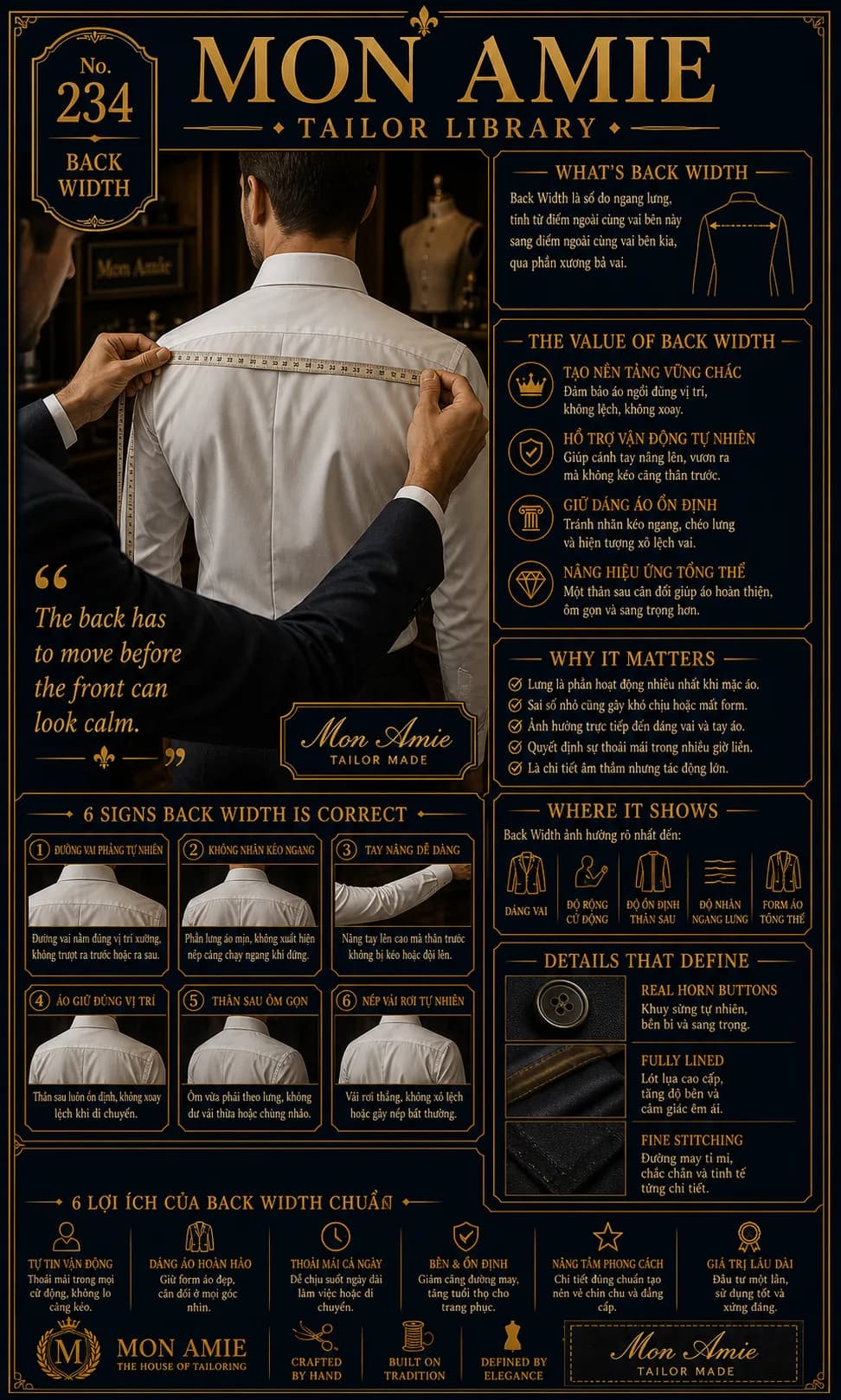
Back width is the across-back measurement, taken from the outermost point of one shoulder to the outermost point of the other, passing over the shoulder blades. Tailors have a saying: the back must be able to move before the front can look still. Back width is the key to that principle — it sits quietly behind you, yet it governs almost everything about how a jacket feels.
What back width is, and what it gives you
When you reach for something, hold a steering wheel or fold your arms at a meeting table, the back is the part of the jacket that stretches most. A correct back width delivers four things:
- A solid foundation: the jacket sits where it should, without shifting or twisting as you move.
- Natural freedom of movement: your arms lift and reach without dragging the front of the jacket.
- A stable silhouette: no horizontal or diagonal pull lines, no shoulders sliding out of place.
- A finer overall effect: a balanced back makes the whole jacket read as clean, close and refined.
Why the across-back measurement matters
- The back does the most work of any part of the jacket — every movement of arm and shoulder passes through it.
- Small errors are unforgiving: a centimetre too narrow and the cloth strains, a centimetre too wide and the back sags.
- It directly shapes the shoulder line and the sleeve — a beautiful shoulder begins with a correct back.
- It determines your comfort over long hours, from the morning meeting to the evening reception.
- It is a quiet detail with loud consequences: you never see your own back, but everyone else does.
Six signs the back width is right
- The shoulder line lies flat: it follows the bone, neither creeping forward nor slipping back.
- No horizontal pull: the back stays smooth, with no tight lines running across it when you stand.
- Arms lift easily: you can raise your arms without the front of the jacket riding up or pulling.
- The jacket stays put: the back remains stable and does not rotate as you move.
- A close, clean back: it follows your frame without excess cloth or slack.
- The cloth falls naturally: it hangs straight, with no distortion or odd breaks.
Where back width shows most clearly
- The shoulder line: the anchor point of the whole jacket — get it wrong and everything below follows suit.
- Range of movement: your reach and ease when raising an arm, driving, or carrying something.
- Stability of the back: the jacket does not travel around your body through the day.
- Creasing across the back: the most visible symptom of a mistaken across-back measurement.
- Overall shape: a balanced back is what allows the front to lie flat and the lapels to sit calmly.
Six benefits of a correct back width
- Confidence in motion: move freely, with no fear of pulling or straining.
- A faultless silhouette: the jacket holds its shape and balance from every angle.
- All-day comfort: easy to wear through long working days and long journeys.
- Durability: less strain on the seams, and a longer life for the garment.
- Elevated style: correct details are what make a look considered rather than accidental.
- Lasting value: invested once, worn well, and worth it.
A word from Mon Amie's artisans
At Mon Amie, the tailor takes the across-back measurement with you standing naturally, then asks you to fold your arms forward to check how the shoulder blades expand — because the back of a good suit must be built for a body in motion, not only for a body posing for a photograph. For gentlemen with particular postures, such as a slightly rounded back or uneven shoulders, the across-back is adjusted independently on each side of the pattern. Every measurement is kept for life, with an alteration guarantee so the jacket keeps pace with your frame.
We invite you to book an appointment at one of Mon Amie's five showrooms in Ho Chi Minh City (Nguyen Trai, Ho Van Hue, 3/2 Street, Caravelle Hotel District 1, Nguyen Thi Thap) or call 0888.111.118. You may also read about the tailoring process to understand why Mon Amie measures in such detail.