
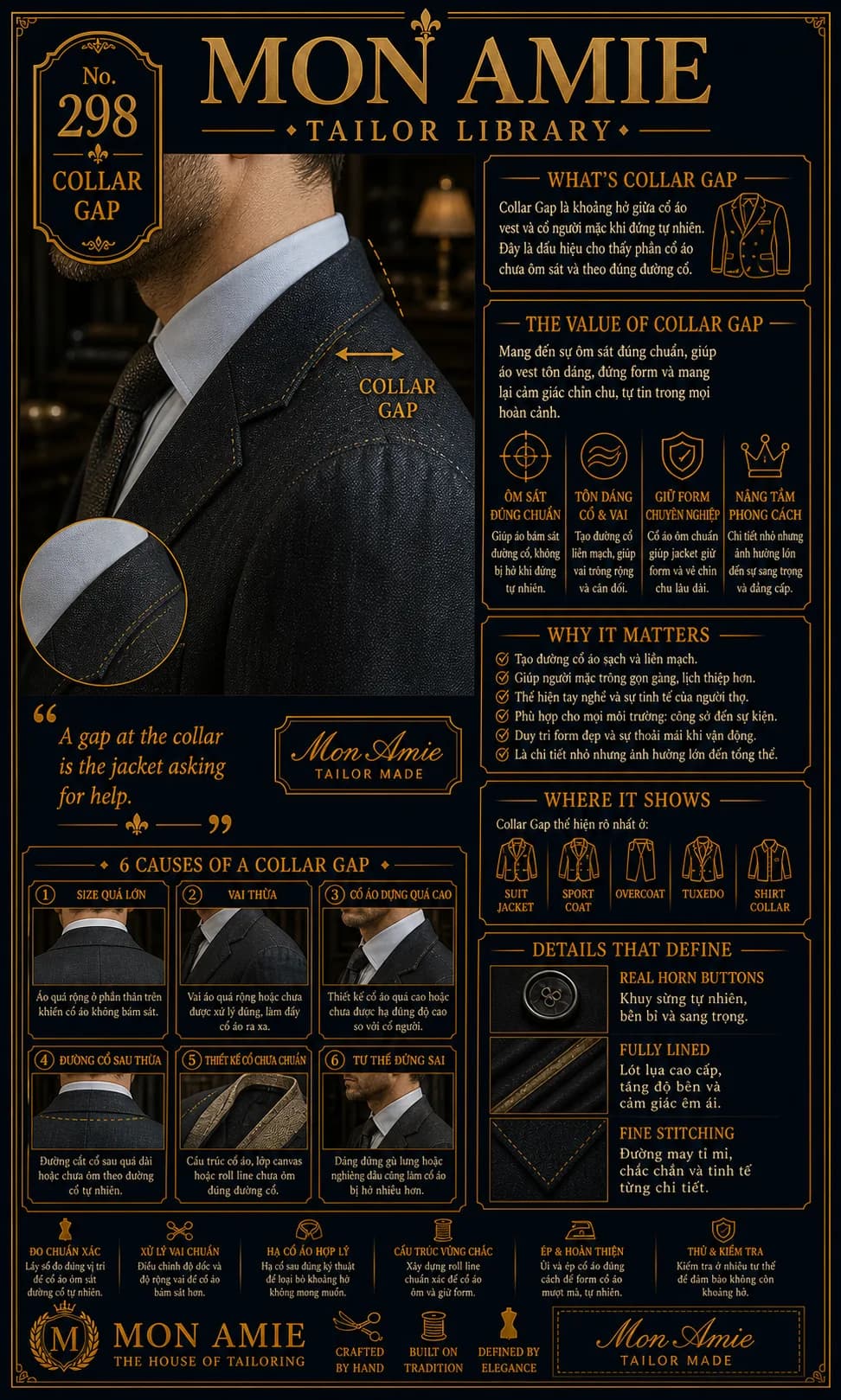
Collar gap is the space that opens between a jacket collar and the wearer's neck when he stands naturally — a sign that the collar is not hugging and not following the neck line. To anyone in the trade it is one of the most recognisable fit faults, and one of the hardest to correct on ready-to-wear. Mon Amie would like to examine why this gap appears, and how a tailoring house addresses it at the root.
What collar gap is and why it is so easy to spot
On a properly made jacket, the collar should rest lightly against the shirt collar all day, leaving about half a centimetre of shirt showing above it — continuously, from the nape round to both lapels. When a gap opens between jacket collar and shirt collar while the wearer is simply standing, that is collar gap.
It is worth noting that collar gap is not merely a cosmetic fault. It shows that the upper body of the jacket is out of balance — the cloth has been pushed out of position, and the neck is simply where the problem becomes visible.
What a properly hugging collar gives you
A collar that follows the neck line brings genuine closeness, allowing the jacket to flatter, to hold its shape, and to look considered and confident in any setting:
- Proper closeness: the collar sits against the neck without gapping when you stand naturally.
- A flattering neck and shoulder: a continuous neck line that makes the shoulders look broad and balanced.
- A professional shape: a well-seated collar keeps the jacket in form and looking sharp for years.
- Elevated style: a small detail with a large effect on elegance and refinement.
A correct collar also creates a clean, unbroken neck line, makes the wearer look neater and more courteous, reflects the tailor's skill, suits every setting from office to evening event, and keeps its shape even in movement.
Six causes of collar gap
- Oversized jacket: too much room through the upper body leaves the collar unable to sit close.
- Excess shoulder: shoulders too wide or poorly worked, pushing the collar away from the neck.
- A collar built too high: a collar designed too tall, or not lowered to suit the wearer's neck.
- Excess back neck: the back neckline cut too long, or not following the natural neck line.
- Faulty collar construction: collar structure, canvas or roll line not following the neck correctly.
- Posture: a stooped stance or a forward-tilted head will widen the gap further.
So the cause may lie in the jacket itself (the first four faults), in the construction, or in the wearer's own posture. A capable tailor must diagnose the source before correcting anything — mechanically pulling the collar down only hides the symptom, it does not cure the illness.
Where collar gap appears
The gap shows most plainly on suit jackets, sport coats, overcoats, tuxedos and even shirt collars. On a tuxedo the fault is especially damaging, since evening dress demands perfection at the collar and lapel — exactly where the eye settles. On an overcoat, a gapping collar also lets the wind in and defeats the garment's purpose.
How Mon Amie handles the collar
- Accurate measurement: measurements taken at the right points so the collar follows the natural neck line.
- Correct shoulder work: adjusting shoulder slope and width so the collar sits closer.
- Lowering the collar properly: dropping the back neck by correct technique to close the gap.
- Sound construction: building an accurate roll line so the collar hugs and holds.
- Pressing and finishing: pressing the collar correctly for a smooth, natural shape.
- Fitting and checking: verifying in several positions that no gap remains.
Alongside this come the details that define quality: natural horn buttons, durable and handsome; fine silk lining for longevity and a smooth feel; and meticulous, refined stitching in every detail.
A word from Mon Amie's artisans
There is a half-joking remark in the Mon Amie workshop that happens to be entirely true: a gap at the collar is a jacket calling for help. The collar is where shoulder, back and chest all meet, so we never correct it in isolation — the whole upper body must be rebalanced, sometimes starting from your shoulder slope. That is why fitting in several positions is always a required step.
If your jacket gaps at the collar whenever you stand naturally, do not give up on it yet — let an artisan look at it in person. We invite you to book an appointment with Mon Amie at one of our five showrooms in Ho Chi Minh City (hotline 0888.111.118) and to explore the tailoring process — where every jacket comes with an alteration guarantee and your measurements are kept for life.