
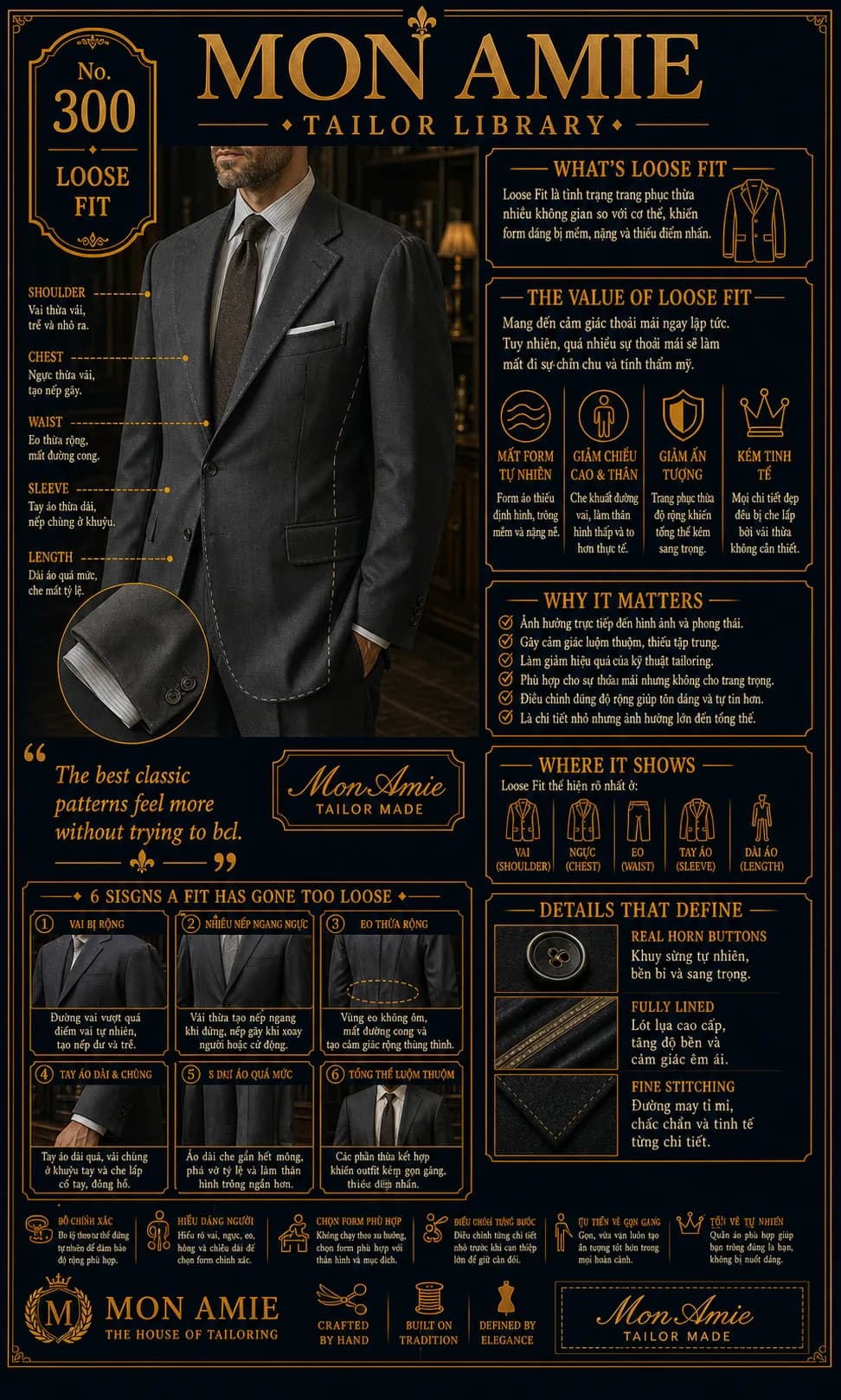
A loose fit is a garment carrying far more room than the body needs, leaving the silhouette soft, heavy and without definition. On a suit, that excess shows in five places: shoulders, chest, waist, sleeves and jacket length. In this article, Mon Amie helps you identify precisely when a suit has become too big — and why that works directly against the image you present.
What a loose fit is and where it shows on a suit
Unlike a deliberately relaxed cut, a loose fit is what happens when the surplus cloth goes beyond what movement requires. It appears most clearly at five points:
- Shoulder: excess cloth at the shoulder, drooping and extending past the natural shoulder point.
- Chest: surplus across the chest, breaking into creases when you stand or move.
- Waist: too much room at the waist, losing the gentle curve that gives the body of the jacket its shape.
- Sleeve: sleeves too long, with slack cloth pooling at the elbow.
- Length: an overlong jacket that hides the proportion between torso and legs.
If just two of these five zones run full, the suit as a whole begins to look untidy no matter how expensive the cloth.
Comfort has its price
It must be said: a loose fit feels comfortable straight away. Nothing binds, nothing catches. But too much comfort costs you polish and elegance in four specific ways:
- Lost natural shape: the jacket lacks structure and looks soft and heavy.
- Less height and presence: surplus cloth buries the shoulder line, making you look shorter and broader than you are.
- Weaker impression: excess width makes the whole outfit read as less refined.
- Less finesse: every fine detail — lapel, buttons, breast pocket — disappears under cloth that serves no purpose.
Put another way, an oversized suit does not "hide" flaws as many men assume; it exaggerates them and erases your advantages.
Six signs a suit has become too big
You can check for these six signs in front of a mirror:
- Wide shoulders: the shoulder line extends past your natural shoulder point, creating surplus and drooping.
- Creasing across the chest: excess cloth folds horizontally at rest and breaks when you turn or move.
- A slack waist: the waist no longer follows the body, losing its curve and looking shapeless.
- Long, slack sleeves: sleeves run too long, pool at the elbow and cover both shirt cuff and watch.
- An overlong jacket: the body of the jacket covers most of the seat, breaking proportion and shortening the leg.
- An untidy whole: the surplus adds up, leaving the outfit unkempt and without a focal point.
Why the width of your suit deserves attention
Fit speaks directly to your image and bearing. A loose-fitting suit reads as untidy and unfocused — a disadvantage in both the workplace and formal occasions. It also cancels out every piece of tailoring craft: shoulder balance, waist suppression and chest structure all become meaningless once surplus cloth swallows them. A loose fit may suit occasions where ease comes first, but not formal ones. Set the width correctly — enough to move, not enough to sag — and the suit flatters your figure and makes you carry yourself with more confidence. It is a small detail with a large effect on the whole.
How Mon Amie handles width in made-to-measure
In the workshop, Mon Amie's approach rests on six principles:
- Measure accurately: take the true measurements with the body standing naturally, so the allowance is right.
- Read the body: assess shoulders, chest, waist, hips and length clearly before choosing the cut.
- Choose the right cut: never chase trends; match the cut to the build and the purpose.
- Adjust in stages: refine the small details before making any major intervention, keeping the balance intact.
- Favour a trim line: trim, yet still easy to move in on any occasion.
- Respect the natural figure: clothes that suit you make you look like yourself, not like a man lost inside his jacket.
Every Mon Amie suit comes with natural horn buttons, fine silk lining and meticulous stitching — details that only pay off once the cut is trim enough for them to be seen.
A word from Mon Amie's artisans
The finest classic patterns only come alive when the cut is not straining under surplus cloth. Mon Amie's artisans often say that removing a centimetre in the right place is worth more than adding a decorative flourish. And because every client's measurements are kept for life, each new commission is another chance to bring the cut a little closer to the body.
If you suspect your current suit has grown too big, bring it to one of Mon Amie's five showrooms in Ho Chi Minh City (Nguyen Trai, Ho Van Hue, 3/2 Street, Caravelle Hotel District 1, Nguyen Thi Thap) or call 0888.111.118 — our alteration warranty will restore its proper line. You are welcome to book an appointment and read about the tailoring process at Mon Amie.