
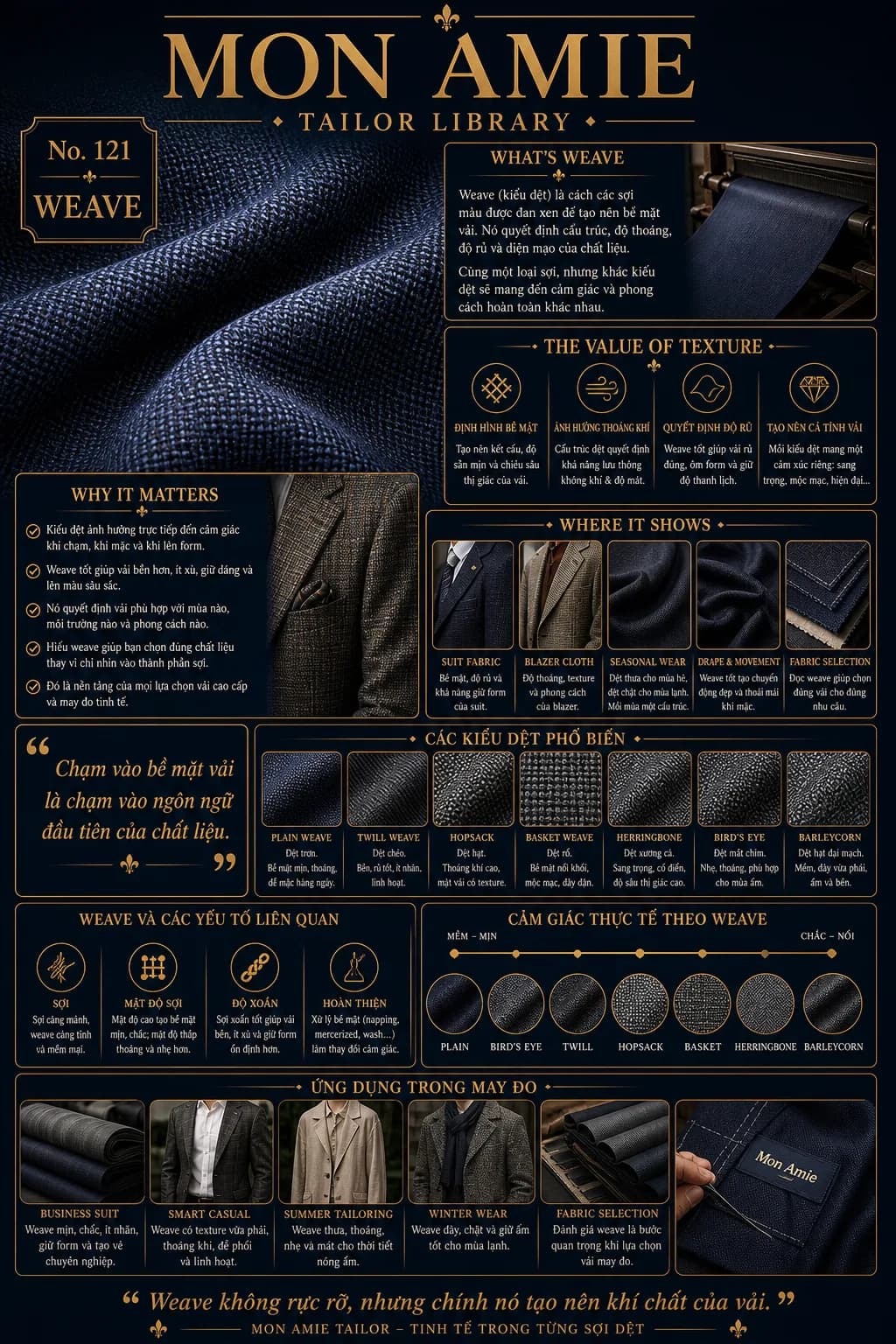
What is a weave? A weave is the way coloured yarns are interlaced to create the surface of a cloth — it determines structure, breathability, drape and overall appearance. The same fibre, woven differently, produces an entirely different feel and character; this is why people who truly know cloth look at the weave before they look at the fibre content.
Why weave matters when choosing cloth for made-to-measure
Many gentlemen ask only about wool percentage and Super number, when the weave is in fact the first thing they touch. Weave directly affects how a cloth feels in the hand, how it wears, and how it takes shape:
- A good weave makes cloth more durable, less prone to pilling, better at holding its shape and richer in colour.
- The weave decides which season, which setting and which style a cloth belongs to.
- Understanding weave lets you choose the right material rather than judging by fibre content alone.
- It is the foundation of every fine cloth selection and every refined piece of tailoring.
Put simply, touching the surface of a cloth is touching its first language.
The value of texture: four things a weave does
A weave performs four jobs at once within a single length of cloth:
- It shapes the surface: creating texture, smoothness or grain, and visual depth. A hopsack reads as distinctly grainy next to a smooth twill.
- It governs breathability: the structure decides airflow and coolness — open weaves for summer, tight weaves for winter warmth.
- It determines drape: a good weave lets cloth fall correctly, follow the body and stay elegant in motion.
- It gives the cloth character: every weave carries its own mood — refined, rustic or modern.
Where weave shows up in a suit
Weave is not an abstract idea; it is present in every tailoring decision. In suiting cloth, surface, drape and shape retention depend largely on the weave. In a blazer, breathability and texture define the style — blazers usually call for grainier, more textured weaves than business suiting. Seasonally, open weaves belong to summer and tight weaves to cold weather; each season has its own structure. And when you stand before a wall of cloth, reading the weave means reading how that cloth will move on you.
The common weaves in tailoring cloth
Seven weaves you will meet most often when choosing suiting:
- Plain weave: smooth surface, airy, easy to wear every day.
- Twill: durable, drapes well, resists creasing, versatile — the workhorse weave of business suiting.
- Hopsack: highly breathable, visibly textured, ideal for blazers.
- Basket weave: pronounced, rustic surface with substance.
- Herringbone: refined, classic, with considerable visual depth.
- Bird's eye: light and airy, well suited to warmer months.
- Barleycorn: soft, moderately substantial, warm and hard-wearing.
Ranked by how they actually feel, from soft and smooth to firm and pronounced: plain, bird's eye, twill, hopsack, basket, herringbone, barleycorn.
Weave and the factors around it
A weave never works alone; it resonates with three other qualities of the cloth:
- Yarn: the finer the yarn, the finer and softer the weave.
- Yarn density: high density gives a smooth, firm surface; lower density feels airier and lighter.
- Twist: well-twisted yarn makes cloth more durable, less prone to pilling and more stable in shape.
- Finishing: surface treatments such as napping, mercerising or washing change the final hand of the cloth.
Applying weave in tailoring
When advising on cloth, Mon Amie always begins with the purpose and only then chooses the weave. A business suit needs a smooth, firm, crease-resistant weave to hold its shape and read as professional — twill is the safe choice. Smart casual suits a moderately textured, breathable and easily combined weave such as hopsack. Summer tailoring calls for open, airy, light and cool weaves; winter wear asks for the opposite — dense, tight weaves that hold warmth. Assessing the weave is therefore an essential step in selecting cloth, from the Kevinlli range through to the Canonico, Holland & Sherry, Dormeuil and Scabal mills Mon Amie works with.
A word from Mon Amie's artisans
In this trade we often say the weave is never showy, yet it is precisely what gives a cloth its character. Two cloths of identical wool content can yield two utterly different suits in drape, breathability and presence, simply because they are woven differently. That is why, when a client visits our showroom, Mon Amie's artisans invite you to touch the cloth first and listen to what the surface says, before any talk of price or mill.
If you would like to feel the difference between twill, hopsack and herringbone for yourself, do visit one of Mon Amie's five showrooms in Ho Chi Minh City (Nguyen Trai, Ho Van Hue, 3/2 Street, Caravelle Hotel District 1, Nguyen Thi Thap) or call 0888.111.118. You are welcome to book an appointment for guidance on the right weave, and to review our pricing beforehand, with complete suits from VND 4.8 million.