
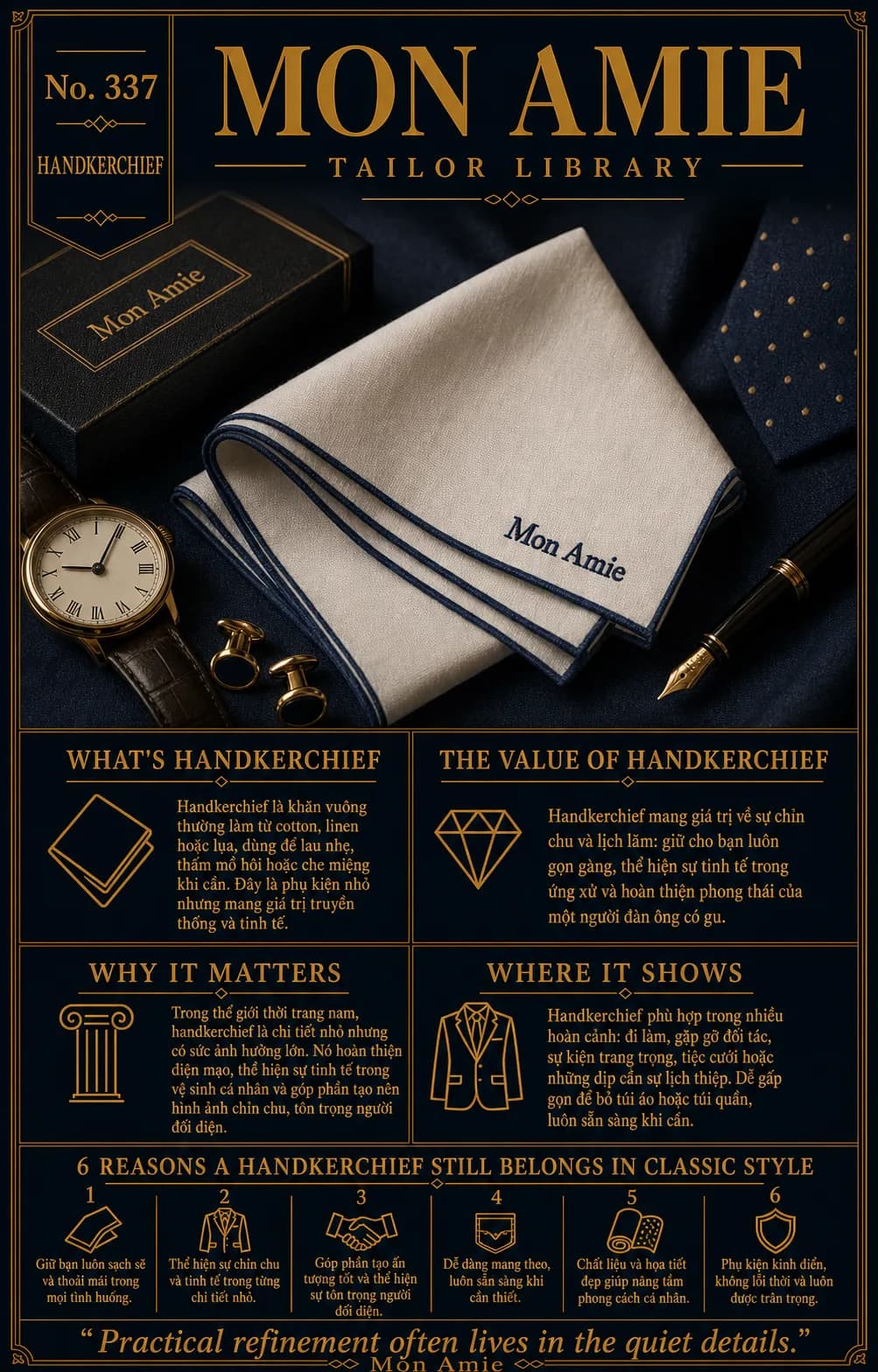
A handkerchief is a square of cloth, usually cotton, linen or silk, used to wipe, blot perspiration or cover the mouth when needed. It is a small accessory, yet one carrying centuries of tradition and refinement, bound up with the image of the classic gentleman. Mon Amie invites you to reconsider why the handkerchief still has its place in a modern man's wardrobe.
What a handkerchief is, and how it differs from a pocket square
Many men confuse the handkerchief with the pocket square. The two share a common origin, but their functions have long since parted:
- Handkerchief: a working cloth, kept in a trouser pocket or the inside jacket pocket, genuinely used — to wipe the hands, blot perspiration, cover a cough, or offer to someone who needs it
- Pocket square: a decorative cloth, folded and displayed in the jacket's breast pocket, essentially never used for wiping
The classic materials for a handkerchief are cotton and linen — absorbent and hard-wearing in the wash; silk is reserved for cloths of a more ceremonial nature. The common size is roughly 38–45 cm on each side, with a hand-rolled hem on the finest examples.
What a handkerchief means to a man with taste
A handkerchief carries value in polish and elegance: it keeps you neat, expresses refinement in the way you conduct yourself, and completes the bearing of a man with taste. Its value does not lie in being seen — most of the time it sits quietly in a pocket — but in readiness: when the moment comes, you have a clean cloth to hand instead of fumbling for a paper napkin.
Offering a handkerchief to someone across from you — at a wedding, a funeral, or a moment of emotion — is among the most classic gestures of gallantry, and no device can replace it.
Why this small detail still matters
In menswear, the handkerchief is a small detail with outsized influence. It completes the look, expresses refinement in personal grooming, and contributes to an image of polish and respect for the person before you. A man in a beautiful suit who wipes his brow with his sleeve loses every impression he has built; conversely, the neat gesture of drawing out a cloth to blot his forehead reinforces it. Style, in the end, is the sum of small details tended to consistently.
The situations a handkerchief serves
A handkerchief suits many settings: work, meetings with partners, formal events, weddings and any occasion calling for courtesy. It folds away neatly into a jacket or trouser pocket and is always ready. A few habits worth keeping:
- Prepare a clean, pressed handkerchief each day, just as you would a fresh shirt
- Carry two on important occasions: one to use, one to offer
- A white cotton cloth with a coloured border is the safe choice and works with anything
- Wash by hand or on a gentle cycle, avoiding heavily scented softener — a handkerchief should smell faint and clean
6 reasons the handkerchief still belongs to classic style
- It keeps you clean and comfortable in any situation.
- It expresses polish and refinement in the smallest details.
- It helps create a good impression and shows respect for others.
- It is easy to carry and always ready when needed.
- Fine materials and patterns lift your personal style.
- It is a classic accessory — never dated, and always appreciated.
A word from Mon Amie's artisans
At Mon Amie, we believe that practical refinement usually lives in quiet details — such as an inside jacket pocket cut to the right depth so a handkerchief sits flat rather than bulging. In made-to-measure work, the tailor accounts for what you carry every day so the suit keeps its clean line. That is the difference between a suit off the rack and one made for you alone.
If you would like a suit that is considered down to every pocket, you are welcome to book an appointment with Mon Amie at one of our five showrooms in Ho Chi Minh City, or to read about the tailoring process — hotline 0888.111.118.