
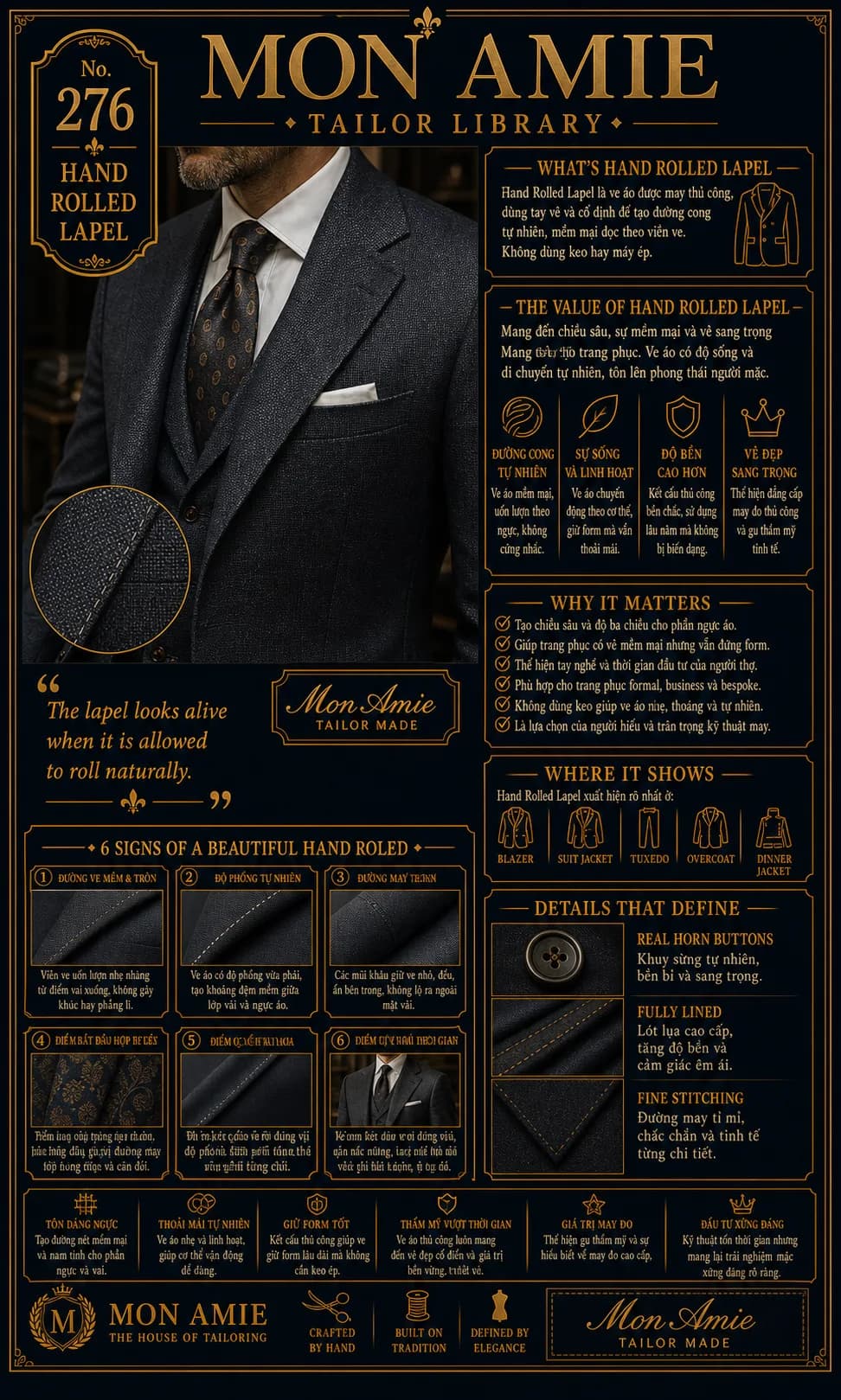
A hand rolled lapel is shaped entirely by hand: the tailor rolls and secures the cloth to create a natural, soft curve along the lapel edge, without any fusing or pressing machine. The result is a lapel with life in it, curving gently away from the chest instead of lying flat as though pressed into submission. Mon Amie invites you to discover why tailors regard this detail as a measure of skill.
What a hand rolled lapel is, and how it differs from a fused one
On a factory suit, the lapel is usually fused and pressed flat, creating a fold as sharp as a blade. With a hand rolled lapel, the tailor works hundreds of small stitches between the face cloth and the canvas beneath, curving the lapel over the hand as the stitching progresses. The lapel therefore does not fold, it rolls — the line moves softly from the collar down to the button, giving the chest a three-dimensional shape.
The value of the technique lies in the depth, the softness and the quiet luxury it gives a garment. The lapel has life in it and moves naturally with the wearer, adding to his bearing:
- A natural curve: a soft lapel that follows the chest instead of standing rigid.
- Life and flexibility: the lapel moves with the body, holding its form while staying comfortable.
- Greater durability: hand-made structure lasts for years without distortion — fusing can bubble and lift over time, hand stitching does not.
- Understated luxury: it speaks of hand tailoring and refined taste.
Why a hand rolled lapel matters
Those who know suits look at the lapel first, because that is where craftsmanship shows most plainly. A hand rolled lapel matters because:
- It gives depth and dimension to the chest of the jacket.
- It lets the garment look soft while still holding its shape.
- It reflects the tailor's skill and the hours invested.
- It suits formal, business and bespoke clothing alike.
- Without fusing, the lapel stays light, breathable and natural.
- It is the choice of those who understand and value tailoring.
Six signs of a well-rolled lapel
With the jacket in your hands, you can check six points. First, a soft, round line: the lapel edge curves gently from the shoulder down, neither broken nor flattened. Second, a natural fullness: the lapel has a measured swell, creating a soft cushion between cloth and chest. Third, refined stitching: the stitches holding the lapel are small, even and hidden inside, never showing on the face of the cloth.
Fourth, a sensible starting point: the roll begins exactly where it should, in harmony with the body of the jacket and balanced on both sides. Fifth, a well-judged break: the roll finishes precisely at the fastening button, creating an unbroken line from collar to waist. Sixth, beauty that lasts: the structure holds through years of wear and proper care.
Where you find the hand rolled lapel
The technique shows most clearly on garments that make a feature of the chest:
- Blazer — the standalone jacket for everyday wear.
- Suit jacket — the jacket of a business suit.
- Tuxedo — evening dress with silk lapels, where the roll is even easier to see.
- Overcoat — the long wool coat for cooler weather.
- Dinner jacket — formal evening wear.
A hand rolled lapel usually comes with details of matching quality: natural horn buttons, durable and refined; a fine silk lining that adds strength and comfort; and meticulous, solid stitching throughout.
A word from Mon Amie's artisans
Mon Amie's tailors have a favourite line: a lapel only becomes beautiful when it is allowed to roll naturally. Rolling a lapel by hand takes far longer than fusing it, but in return the jacket flatters the chest, moves freely, holds its form without adhesive and keeps its value over the years. It is an investment that rewards anyone who understands what technique is worth.
We invite you to visit one of Mon Amie's five showrooms in Ho Chi Minh City — Nguyen Trai, Ho Van Hue, 3/2 Street, Caravelle Hotel in District 1, and Nguyen Thi Thap — to feel the roll of a hand-worked lapel for yourself, or call our hotline 0888.111.118. You are welcome to book an appointment and read about the tailoring process at Mon Amie.