
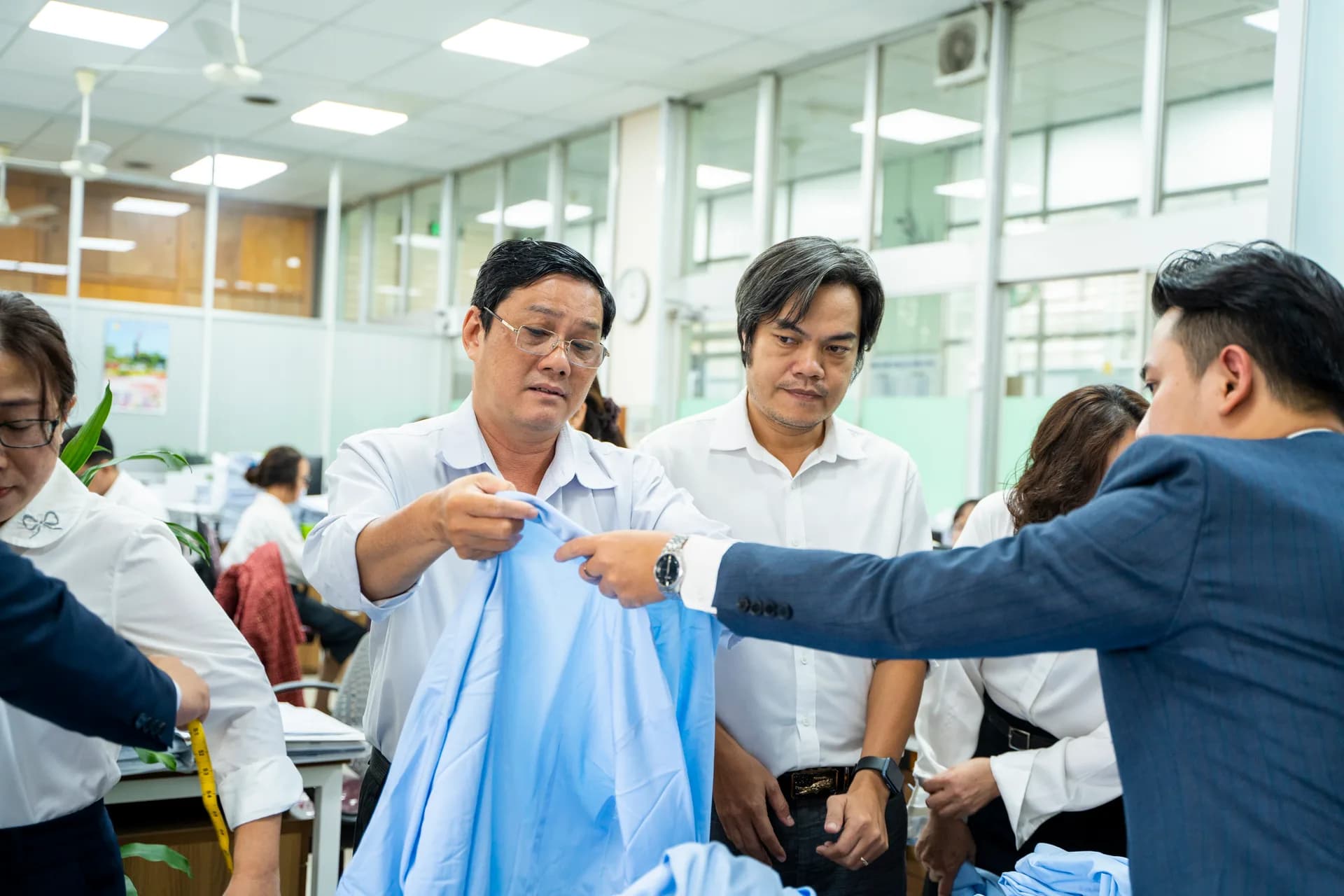
Ten to eight in the morning, the lift doors open onto the work floor: one person has shoulders sitting just right, another has sleeves swallowing half the hand, a third has a jacket front that flicks open every time it is buttoned. All three are wearing the "uniform", yet together they do not look like a team. Men's office uniform suits only become a uniform when they share colour, share cut, and each person fits his own build. Below are five styles commonly seen in offices, with concrete figures to check against when you approve the trial samples.
Quick answer
Men's office uniform suits should be in navy or charcoal and made to measure for each person. Five styles: a two-button navy suit for the office, a charcoal suit for sales, a three-piece suit with a waistcoat for managers, a slim-cut suit for the younger team, and a waistcoat with a shirt for hot days.
1. Two-button navy suit: the foundation for the whole office division
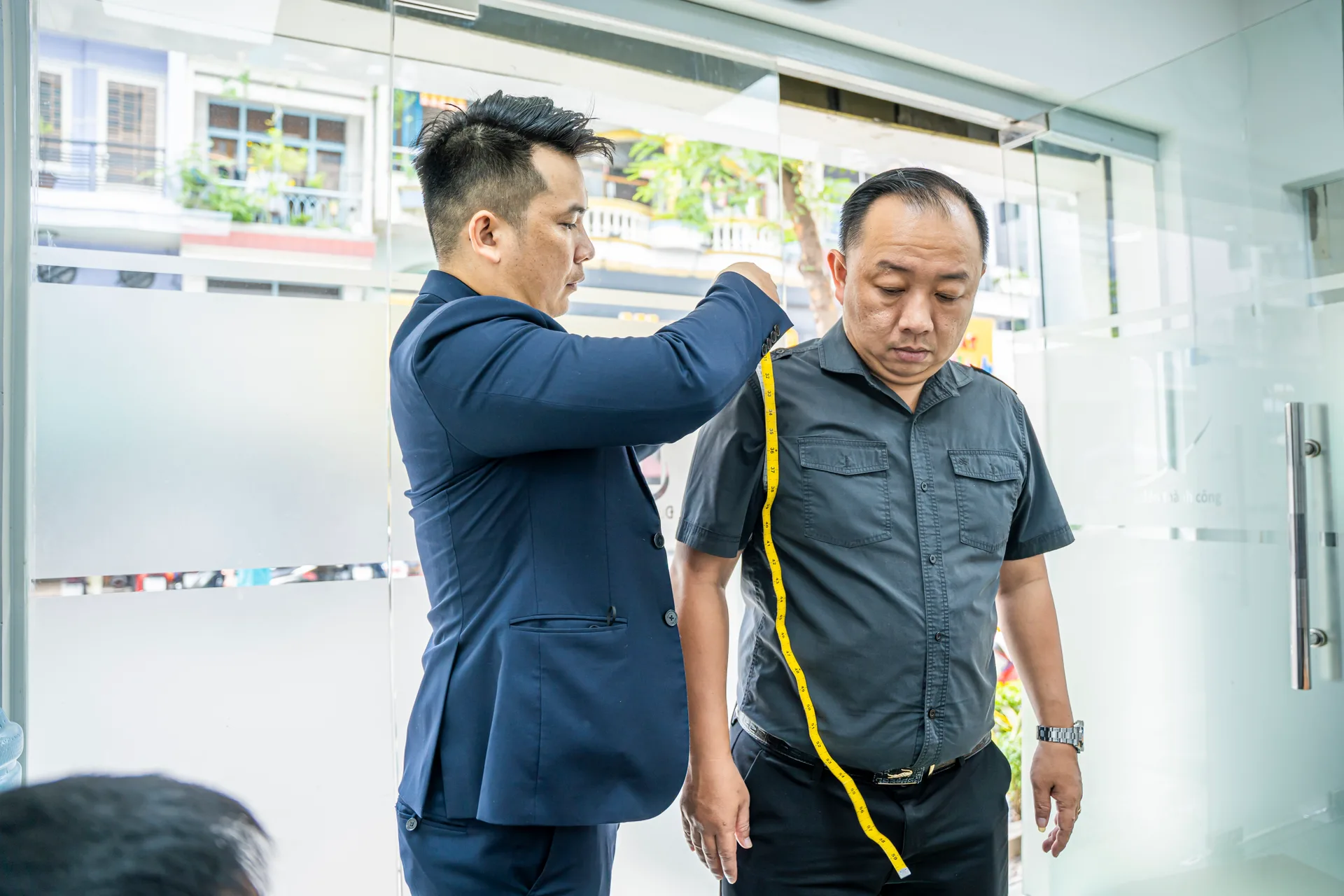
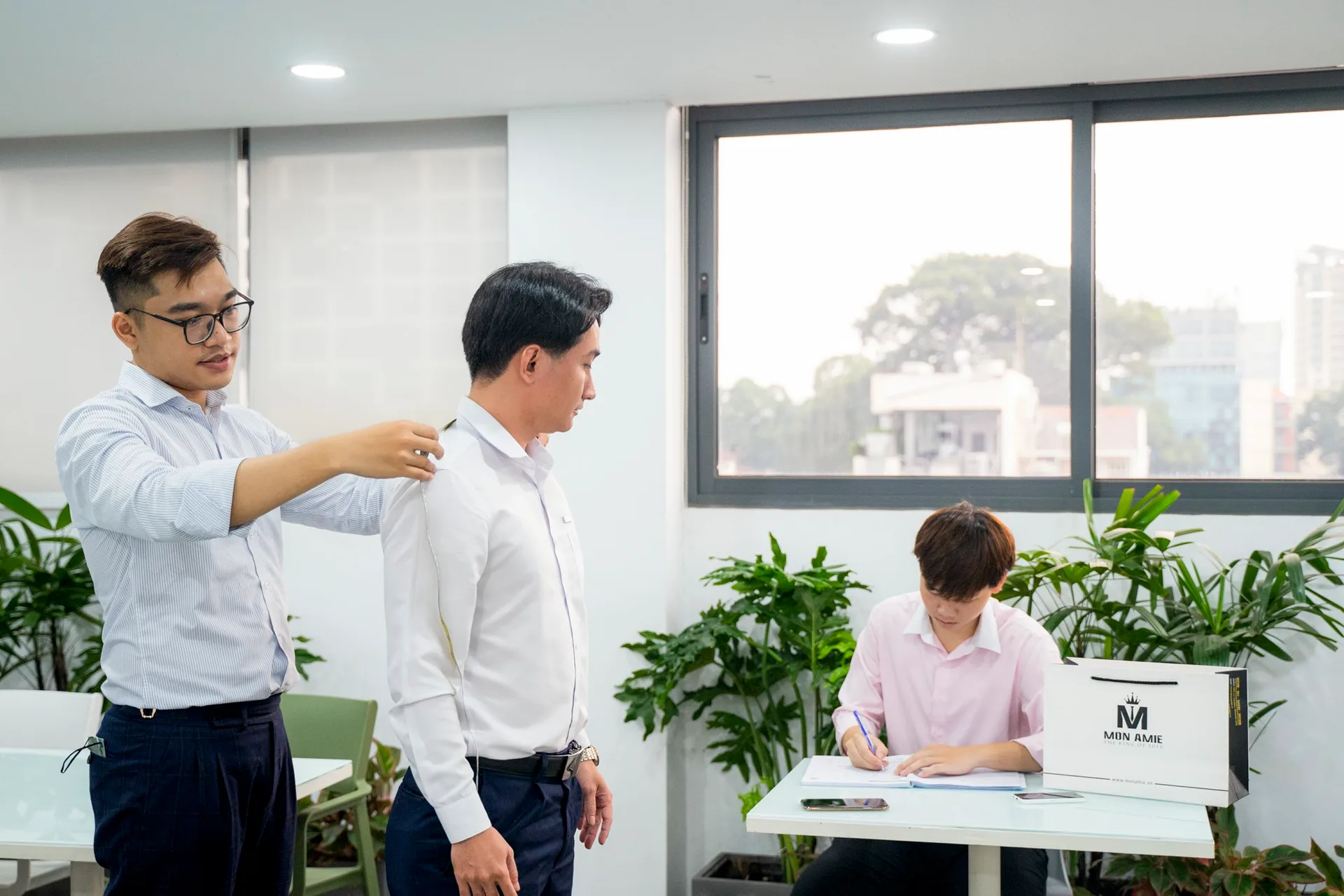
A single-breasted, two-button jacket with notch lapels (the familiar V-shaped lapel), in deep navy blue. This style rarely goes out of fashion and suits everyone from administrative staff to newly hired specialists. Three points to settle when measuring: the shoulder line must land exactly on the shoulder point, neither jutting out nor collapsing; the sleeve shows 1–1.5 cm of shirt cuff when the arm hangs; and the jacket length covers the seat fully, reaching about the knuckle of the thumb when the arm is relaxed. Choose a wool blend in a fine twill with a matte surface, because shiny cloth looks smart when first delivered but shows sitting creases very quickly. For a two-button jacket the rule is simple: fasten the top button, leave the bottom one undone. A common mistake is to approve samples from a photo of one 1.80 m model and apply them to the whole department; a sample that looks good on one person does not necessarily look good on ten. Mon Amie measures each person individually, with no standard sizing.
2. Charcoal twill suit: for sales teams who often meet clients
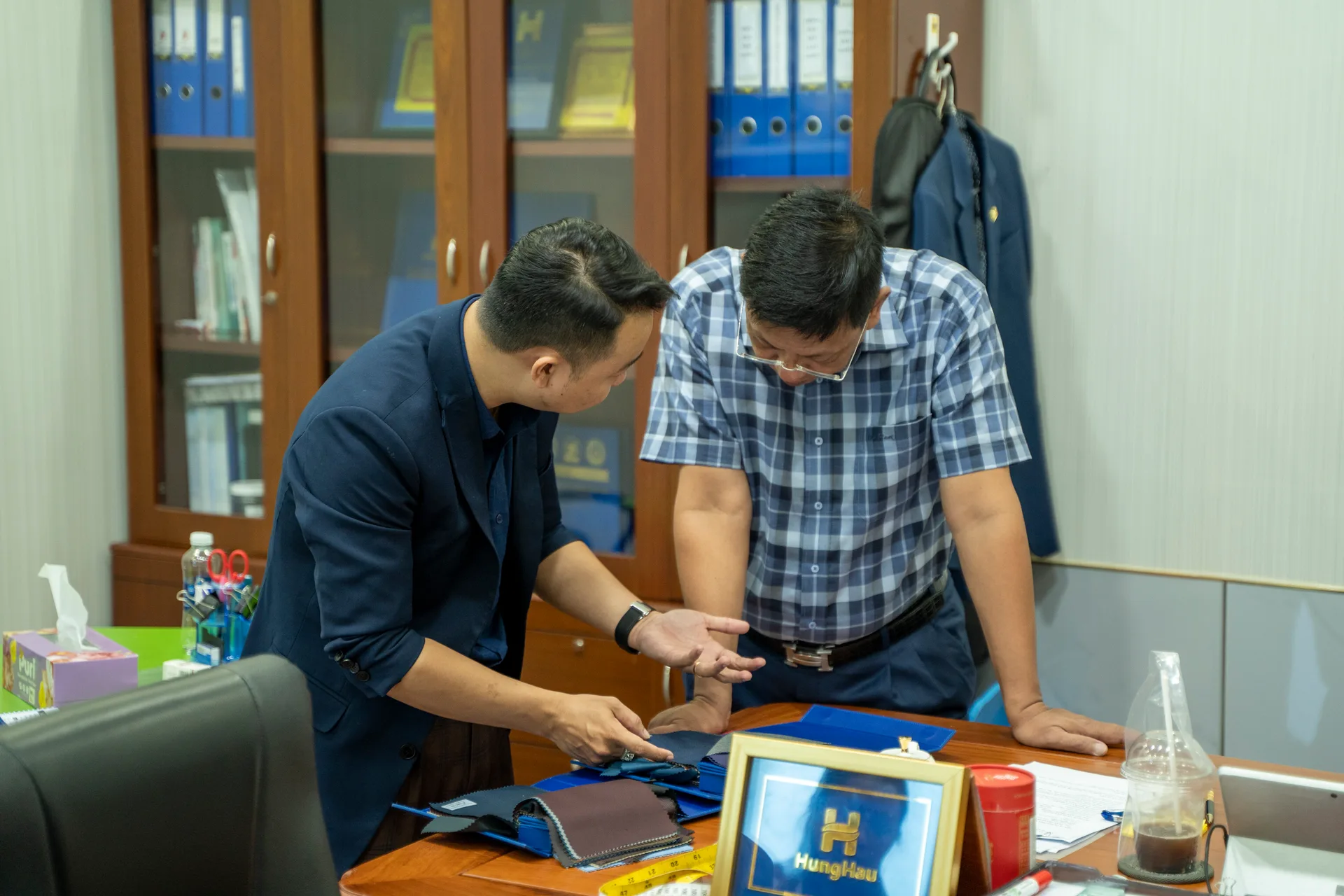
Charcoal is a neutral shade like navy, but it looks more serious and neater under office lighting. Sales teams ride in cars, sit in meetings and visit partners all in the same day, so prioritise a fine-yarn wool twill in 100s–120s for less creasing. In Mon Amie's fabric library, the Kevinlli line at the Essential tier has 40–70% wool and yarn counts from 100s to 140s. Pair with a white or pale blue shirt and a plain or fine-striped tie; avoid broad stripes and shiny cloth because they look busy in photographs. A note on inside pockets: people who work out in the field need pockets deep enough for a phone and a notebook, so say so at the fitting and the tailor can place the pockets so the chest of the jacket does not bulge.
3. Three-piece suit with a waistcoat: for department heads and managers
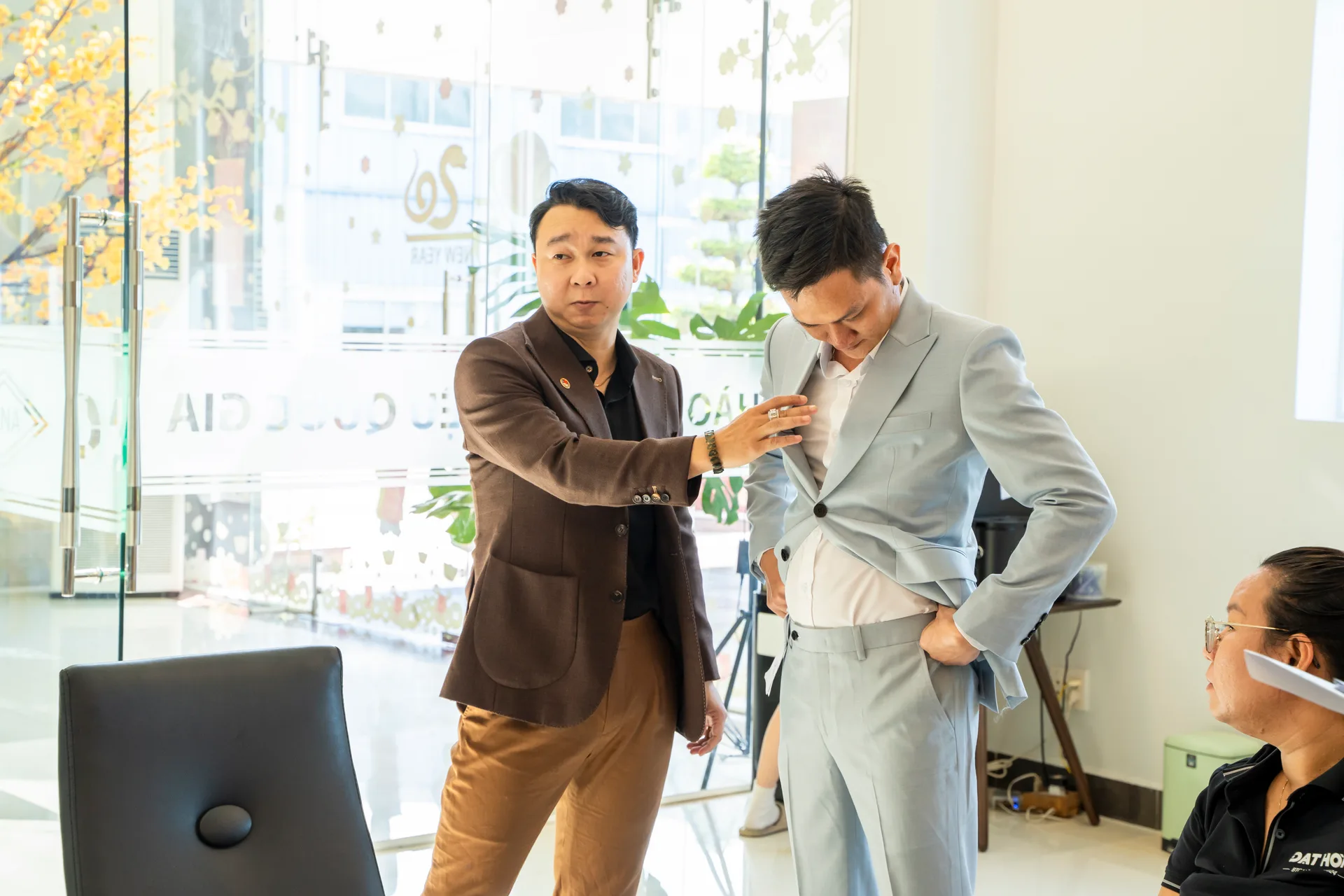
The waistcoat is the third layer, sitting between the shirt and the jacket. In the same cloth, a three-piece suit looks formal without any extra accessories, and when the meeting room is hot, taking off the jacket still leaves a tidy outfit. A few rules to keep: button the waistcoat except for the last button, make it long enough to cover the waistband so no shirt shows, and keep the tie tucked neatly inside. This style suits plain charcoal or navy with a tone-on-tone stripe, with all three pieces cut from the same bolt so the tone does not drift. Have the waistcoat measured once more seated, because cutting it slightly tight makes it bulge over the stomach at once. This style should be reserved for a few positions that need a visible tier in the organisation, not for the whole department: for most people, a two-piece suit is enough.
4. One-button slim-cut suit: for the younger team and creative divisions
One button, smaller notch lapels, trim shoulders, a close-fitting body, and tapered trousers that just touch the top of the shoe. This is a slim fit (a close, trim silhouette) suited to young staff in marketing, design and technology. Slim does not mean tight: raise your arm to shoulder height; if the collar is dragged off-centre or the body of the jacket wrinkles into diagonal lines, the armhole needs easing. A lighter navy or mid-grey suits this cut better than pure black. You can drop the tie and open one collar button, as long as the whole team follows the same convention. A common fault is to apply the same degree of closeness to every body; fuller builds need a few extra centimetres in the chest and waist, otherwise a trim cut turns into a strained one.
5. Waistcoat with a shirt: a lighter outfit for hot days and field work
Not every day calls for a full jacket. A waistcoat in the same cloth as the suit, worn over a shirt, lets technical, logistics or on-site teams stay coordinated with the office without overheating. The shirt is the part most often overlooked: choose the same tone of white or pale blue, the same collar style, in a closely woven cotton thick enough not to show a T-shirt beneath, with the collar rising about 1–1.5 cm above the neckline of the waistcoat when fully buttoned. A classic collar (a moderate two-point spread collar) suits many face shapes and is therefore a safe choice for the whole team. Large quantities of shirts can be produced in batches through maydongphuc.vn, while waistcoats and suit jackets are still measured individually.
Quick summary table
| Style | Suited to | Key points |
|---|---|---|
| 1. Two-button navy suit | Office and administrative staff | 1–1.5 cm of shirt cuff showing; jacket covers the seat |
| 2. Charcoal twill suit | Sales, frequent client meetings | Wool 100s–120s; inside pockets deep enough |
| 3. Three-piece suit with waistcoat | Department heads, managers | Leave the last waistcoat button open; waistcoat covers the waistband |
| 4. One-button slim-cut suit | Younger team, creative divisions | Raise the arm to check the armhole; do not apply one closeness to all |
| 5. Waistcoat with shirt | Technical, logistics, field staff | Same shirt tone, same collar style |
Tips from Mon Amie's master tailors
- Measure when the person is wearing a shirt and the shoes they normally wear to work. Measurements taken in casual clothes often differ from those taken when properly dressed, especially in trouser length and waist.
- Order an extra pair of trousers for each suit. Trousers bear the sitting and the friction of the chair and wear out before the jacket; a spare pair makes the suit last longer.
- Settle the accompanying conventions at the same time: black or brown shoes, a belt in the same tone as the shoes, dark socks. A fine suit with white socks costs the whole team points.
- When trying on, sit down, reach up for documents and bend to pick up a dropped item. A jacket that fits standing does not necessarily fit at work.
- Keep each person's measurement sheet. New staff or supplementary batches will match the earlier suits without starting the fitting from scratch.
Frequently asked questions
What does a men's office uniform include?
A standard set has a suit jacket (or waistcoat), trousers, a shirt and a tie depending on company policy; plus a belt and dress shoes in the same tone. The policy should specify the colour, shirt collar style and accessories for each group; see the article on a framework for company uniform policy.
Do men's and women's office uniforms need to be the same colour?
They should share a palette so the whole team looks cohesive, but the cut should be separate: men's with squared shoulders and a straight body; women's shaped at the waist and hip to the figure. The women's styles are covered separately in Top 5 Women's Office Uniform Suits.
What colour and fabric should men's office uniform shirts be?
White and pale blue are the two safe colours, with the same collar style for the whole group. Choose tightly woven cotton or an easy-iron cotton blend, thick enough not to show the undergarments beneath. A shirt worn under a suit should be fitted to the body, avoiding a loose cut that wrinkles the body of the jacket.
Can a small group of a few people have uniform suits made?
Yes. A small team is still measured individually just like a large group; you can read the article on making uniform suits in small quantities to see how to divide groups and choose fabric.
A men's office uniform suit does not need to be elaborate; it needs the right cut, the right cloth and consistency from one person to the next. If you are considering one department or the whole company, book a site survey or message Zalo 0888.111.118 so a stylist can review your needs, propose options by scale and invite you to view the made-to-measure price list as a reference point.